Closing a corrective action is not the same as proving it worked.
Why ISO 9001 asks you to review corrective action effectiveness, how to set criteria before closure, and why a 90-day check catches recurrence.
The principle
Verification asks whether the action was done. Effectiveness asks whether the problem stayed gone.
Many CAPA processes end at the moment the last task is complete. The action is verified, the record closes, and everyone moves on. The question the standard actually cares about, whether the problem came back, is never asked.
This is not a small gap. An organisation that never reviews effectiveness has no way of knowing whether its corrective actions work. It may be repeating the same ineffective fixes for years, closing records on time while the underlying problems persist, and only discovering it when a customer or an auditor points out the pattern.
01 · Start with context
Two different checks, often confused.
ISO 9001 clause 10.2.1 asks you to review the effectiveness of any corrective action taken. That is distinct from verifying implementation.
- Verification of implementation: the new check was added to the work instruction, operators were briefed, the fixture was modified.
- Review of effectiveness: over a meaningful period afterwards, the nonconformity did not recur.
An action can be implemented perfectly and still be ineffective, usually because the root cause was misidentified.
Consider a supplier delivering parts outside specification. The corrective action requires the supplier to send a certificate of conformity with every delivery, and the first three deliveries arrive with certificates. Implementation is verified. Effectiveness is a different question: did the out-of-specification parts stop? If the certificates are issued without the supplier actually changing its process, the problem continues, now with paperwork attached.
02 · Set the criteria early
Decide what success looks like before you close.
Effectiveness is hard to judge after the fact if nobody agreed what it would mean. The criteria belong on the CAPA when the action is planned.
- No repeat of the same nonconformity across the next three production lots.
- Zero related customer complaints within a defined period.
- An inspection pass rate above an agreed threshold for a quarter.
Measurable criteria turn the effectiveness review from an opinion into a check.
Choosing good criteria
Good criteria are specific to the problem and observable in normal operations. They should not require a special study to evaluate. Where possible, use data the organisation already collects, such as inspection results, complaint logs or process KPIs. If a nonconformity is rare by nature, such as an annual calibration failure, the criteria may need to rely on related indicators, such as audit results for the calibration process, rather than waiting a year for recurrence.
03 · Choose the interval
Why ninety days is a sensible default.
The review needs enough time for the problem to have had a chance to recur. Too soon, and the result proves nothing. Too late, and nobody remembers the context.
For most process-related nonconformities, a review around ninety days after closure balances the two. Low-frequency problems, such as an annual calibration failure, may justify a longer interval. Whatever the period, it should be scheduled automatically, not left to memory.
High-volume processes may produce enough data sooner. A production line making thousands of units a week can show within weeks whether a defect has stopped. The interval should match how often the problem would reasonably be expected to show up if the fix had not worked.
04 · Review honestly
Not effective is a valid result.
The value of an effectiveness review comes from being willing to record a negative outcome. A result of "not effective" or "partially effective" is information, not failure.
- Compare actual results against the criteria set at planning.
- Record the outcome: effective, partially effective or not effective.
- When it is not effective, reopen the analysis and challenge the root cause.
- Link any new action to the original record so the history stays intact.
Organisations that never record an ineffective action are usually not looking closely enough.
Who should review
The reviewer should be independent of the action owner and close enough to the process to judge the evidence. In many organisations this is a quality engineer or the process owner. For significant nonconformities, a second review by someone senior provides additional assurance and signals that effectiveness matters.
05 · Learn across the system
Effectiveness data is management information.
Over time, effectiveness results show which kinds of problems your organisation fixes well and which keep returning. That is valuable input for management review under clause 9.3, which asks about the effectiveness of actions taken to address risks and nonconformities.
Trends worth watching include the share of actions rated effective, recurring causes, and the average time from detection to verified effectiveness.
Common pitfalls
- Effectiveness checks that never happen: reviews planned but not scheduled, so they are forgotten once the record closes.
- Effective by default: reviews that always conclude "effective" because nobody looked at data.
- Losing the history: a recurrence raised as a new, unrelated nonconformity, so the pattern is invisible.
- Criteria set after the fact: success defined once the results are known, which proves nothing.
06 · Certora nonconformity & CAPA
Effectiveness reviewed after closure, on schedule.
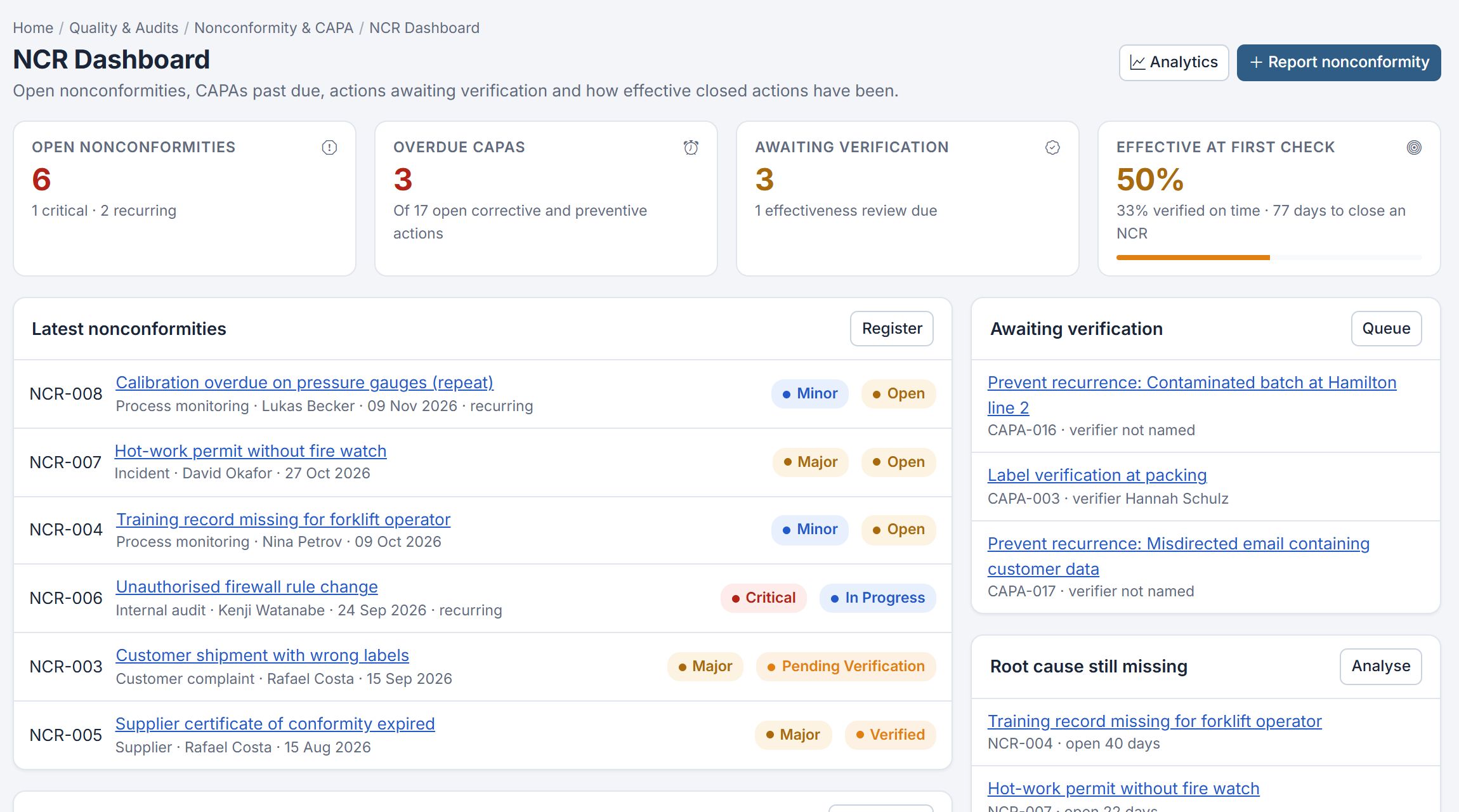
Certora runs corrective and preventive actions task by task, verifies them independently, and schedules an effectiveness review 90 days after closure. Each review records whether the action was effective, partially effective or not effective, and the effectiveness review and analytics screen shows the results across your CAPAs.
Because every action stays linked to its nonconformity, root cause and source, an ineffective result leads straight back to the analysis that needs revisiting, and the history of each problem stays in one place.
See how actions are planned in CAPA software and root cause analysis, or read how effectiveness feeds management review inputs.