Corrective action fails when the root cause is a guess.
How CAPA software supports ISO 9001 clause 10.2 with containment, 5 Whys and fishbone root cause analysis, and actions that remove the cause.
The principle
A corrective action that does not address the root cause is just a correction with more paperwork.
Every quality team knows the pattern. A nonconformity is raised, someone fixes the immediate problem, an action is logged as "retrain operator", and six months later the same issue appears again. The record was closed, but the cause was never found.
Corrective and preventive action, usually shortened to CAPA, is where a quality system proves whether it learns. Auditors know this, which is why they so often pick an old nonconformity and follow it through: what was found, what was done, and whether it happened again. A CAPA process that closes records quickly but leaves causes in place will show up in that trail.
01 · Start with context
What ISO 9001 clause 10.2 asks for.
Clause 10.2 sets out a clear sequence when a nonconformity occurs, including one arising from a complaint.
- React to it: take action to control and correct it, and deal with the consequences.
- Evaluate the need for action to eliminate the cause, by reviewing the nonconformity, determining its causes, and checking whether similar nonconformities exist or could occur.
- Implement any action needed.
- Review the effectiveness of any corrective action taken.
- Update risks and opportunities and make changes to the system if necessary.
The organisation must keep documented information on the nature of the nonconformity, the actions taken and the results. The standard is less interested in the speed of closure than in whether the cause was removed. That is where root cause analysis earns its place.
02 · Contain first
Correction and containment come before analysis.
Before anyone asks why, the immediate risk has to be controlled. Containment protects customers and operations while the investigation runs.
- Quarantine suspect product or stop the affected process.
- Check whether the same problem exists in other batches, sites or lines.
- Record what was contained, by whom and when.
Containment is not the corrective action. It buys the time needed to find the real cause.
Correction, containment and corrective action
These three terms are often used interchangeably, but they mean different things. A correction fixes the specific instance, such as reworking a faulty part. Containment stops the problem spreading, such as holding the rest of the batch. A corrective action removes the cause so the problem does not recur. A CAPA record that contains only a correction has not met clause 10.2.
03 · Find the cause
Use structured methods, not opinion.
Two methods cover most quality problems.
5 Whys follows one chain of cause and effect by asking why the problem happened, then why that happened, until the answer is something the organisation controls. It works well for single, linear failures.
Fishbone (Ishikawa) analysis groups possible causes into categories such as method, machine, material, manpower, measurement and environment. It suits problems with several contributing factors.
The test of a good root cause is simple: if you removed it, would the problem stop? "Human error" rarely passes that test. A missing check, an unclear instruction or a tool that allows the mistake usually does.
A worked example
Two torque wrenches were used past their calibration due date. Why? Operators did not know they were overdue. Why? Calibration dates were only visible in a spreadsheet in the quality office. Why? The shift-start checklist predated the calibration tagging scheme and never included a check. The root cause is a missing control at the point of use, not a careless operator, and the corrective action follows naturally: add a calibration check to the shift-start checklist and make status visible on the equipment.
04 · Plan the action
Corrective and preventive actions, task by task.
Once the cause is understood, the action plan should remove it, and where the same weakness exists elsewhere, prevent it there too.
- Define each task with an owner and a due date.
- Link the action to the nonconformity, the root cause and any related audit finding or risk.
- Track task completion, not just the overall action status.
- Collect evidence that each task was done.
Breaking actions into tasks makes delays visible early instead of at the due date.
Scale the response to the problem. A minor, isolated nonconformity may need a single task. A major one, or one that affects several sites, may need a plan with many tasks across departments. Severity ratings help teams agree how much rigour each case deserves, and where a full root cause analysis is justified.
05 · Verify independently
The person who did the work should not close it.
Verification confirms the planned actions were implemented as described. It works best when someone other than the action owner checks the evidence, such as a quality engineer or the process owner.
Independent verification protects against the most common weakness in CAPA systems: actions marked complete because the deadline arrived, not because the work was finished.
Common pitfalls
- Retraining as the default action: training rarely fixes a cause unless the cause really was a lack of knowledge. Look for the control that would have caught the error.
- Closing on the due date: actions closed to meet a target, with evidence still pending.
- No link to the source: CAPAs that cannot be traced back to the audit finding, complaint or incident that triggered them.
- Too many open actions: a backlog so large that nothing gets proper attention. Prioritise by severity and risk.
06 · Certora nonconformity & CAPA
From containment to verified closure.
Certora Nonconformity & CAPA records nonconformities from any source, including audits, inspections, complaints and incidents, with containment captured on the record. Root cause analysis supports both 5 Whys and fishbone categories, and corrective and preventive actions run task by task with owners, due dates and lateness.
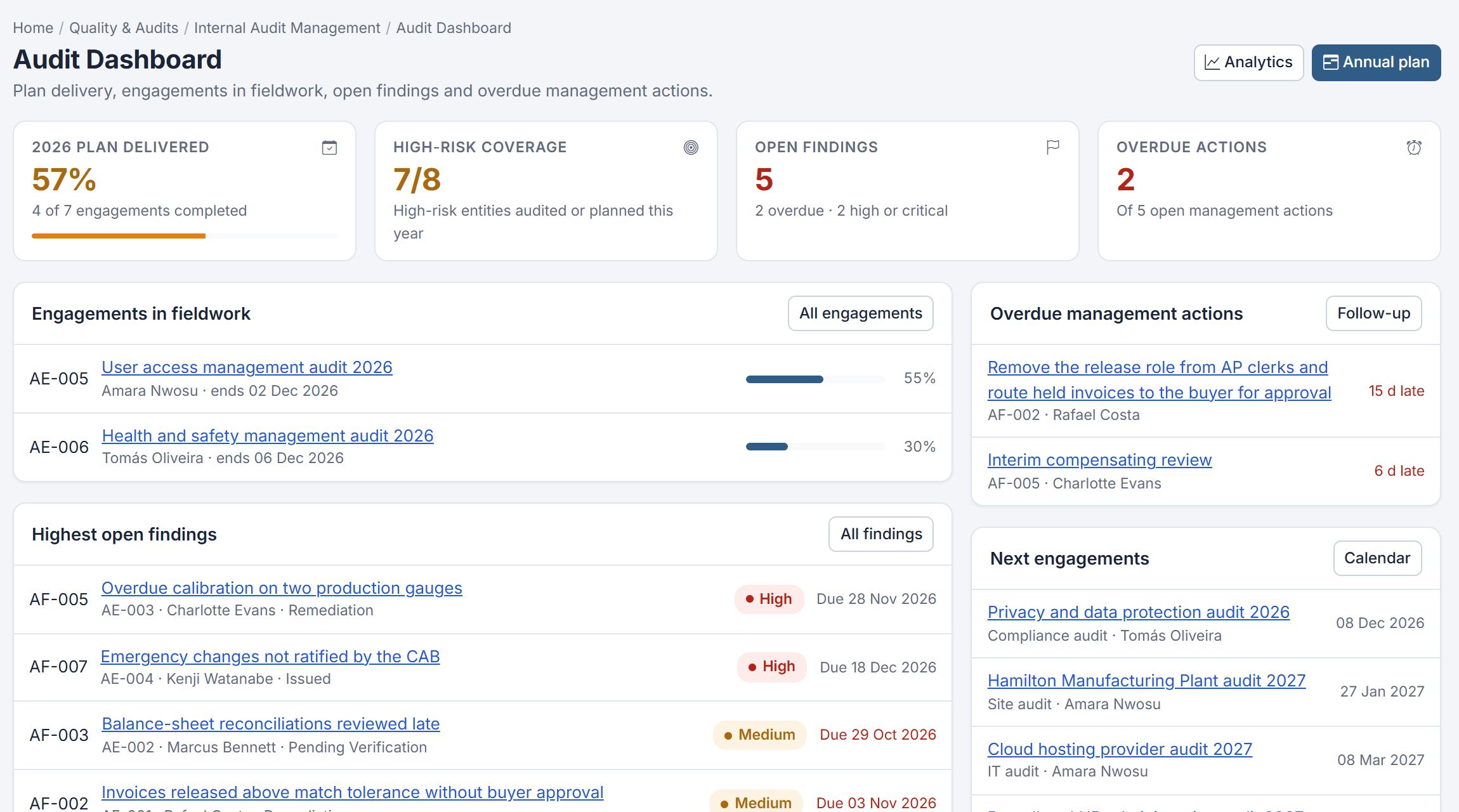
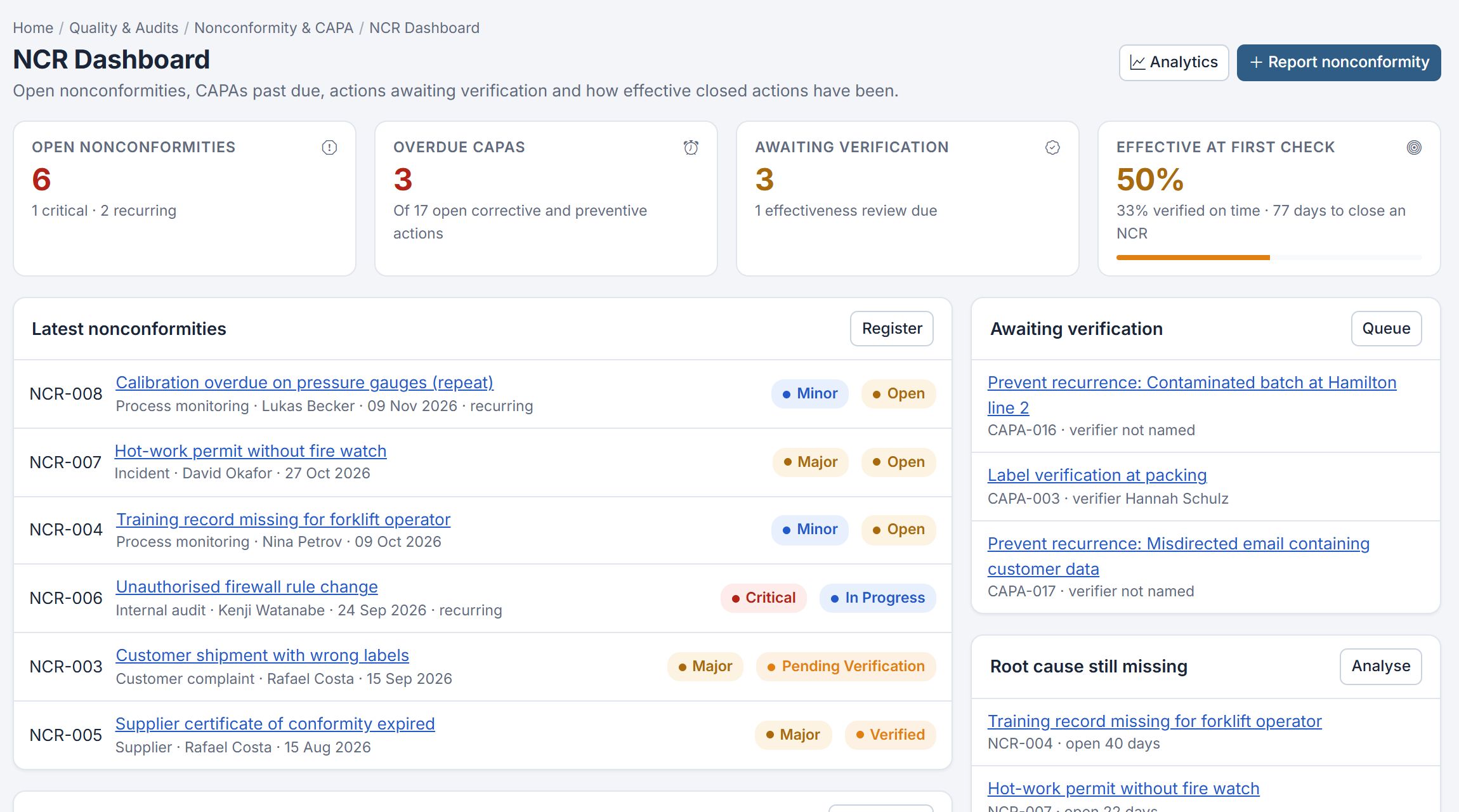
Actions are verified independently before closure, and every CAPA stays linked to its nonconformity, audit finding and risk. The NCR dashboard shows open nonconformities and overdue actions, so backlogs are visible before they grow.
Read the companion article on verifying corrective action effectiveness for what happens after closure, or the Nonconformity & CAPA user guide for the full workflow.