Preparing for an ISO certification audit, stage by stage.
What happens in stage 1 and stage 2 of an ISO certification audit under ISO/IEC 17021-1, what auditors look for, and how to prepare your evidence.
The principle
Certification audits reward a system that is lived every day, not one that is assembled the week before.
For many organisations, the first certification audit feels like an exam. In practice, it is closer to a structured conversation: the certification body wants to see that your management system exists, works and is maintained. Preparation is about making that evidence easy to find.
The organisations that find certification straightforward are rarely the ones with the most documentation. They are the ones where the system is genuinely in use, records are created as part of normal work, and people can explain how their job connects to it. Preparation then becomes a matter of organisation, not invention.
01 · Start with context
How certification audits are structured.
Accredited certification bodies follow ISO/IEC 17021-1, which defines how management system audits are run. Initial certification is normally a two-stage audit.
- Stage 1 reviews your documented system, scope, readiness and planning, often partly off-site. It confirms whether you are ready for stage 2.
- Stage 2 evaluates implementation and effectiveness on site: interviews, observation and records across the processes in scope.
After certification, surveillance audits follow at least once a year, and the certificate is renewed through a recertification audit within the three-year cycle.
Choosing a certification body
Choose an accredited certification body, accredited by a recognised accreditation body for the standard and your industry sector. Accreditation means the body itself is assessed against ISO/IEC 17021-1, which is what gives the certificate its credibility with customers. It is reasonable to ask about auditor experience in your sector and how the body handles combined audits if you certify to more than one standard.
02 · Get the basics right
What stage 1 typically checks.
Stage 1 focuses on whether the foundations are in place.
- A defined scope, with any exclusions justified.
- The policy, objectives and the documented information the standard requires.
- Evidence that internal audits have been carried out.
- A completed management review.
- An understanding of applicable legal and customer requirements.
Gaps found at stage 1 are expected and useful. They give you time to close them before stage 2.
A common question is how long the system must run before certification. There is no fixed rule, but auditors need to see evidence of operation: typically at least one full cycle of internal audits covering the scope, and at least one management review, with records of the processes running for a reasonable period, often three months or more.
03 · Show it working
What stage 2 looks for.
Stage 2 is about implementation. Auditors sample processes and follow trails: from a customer order to delivery, from a nonconformity to its corrective action, from a risk to its controls.
The strongest evidence is ordinary. Records created as part of normal work, current documents in use, and people who can explain how their work connects to the system.
Preparing people, not scripting them
People will be interviewed. They do not need to recite the quality policy word for word, but they should be able to explain what it means for their work, where to find the procedures they use, and what to do when something goes wrong. Short briefings before the audit help people feel confident. Scripted answers usually do the opposite, because auditors can tell when someone is reciting rather than explaining.
04 · Organise the evidence
Make every request answerable in minutes.
Audit days are short, and time spent searching for records is time not spent demonstrating the system. Preparation should focus on retrieval.
- Group evidence by clause and by process.
- Prepare an audit plan with interviewees and their availability.
- Agree who will guide the auditor and who will retrieve records.
- Keep a log of evidence requests and what was provided.
A shared, access-controlled evidence area avoids emailing files back and forth during the audit.
Logging requests has a second benefit. After the audit, the log shows which records were hard to find, which is useful input for improving the system before the first surveillance visit.
05 · Respond to findings
Nonconformities need root cause, not just correction.
Certification bodies classify findings, typically as major or minor nonconformities and opportunities for improvement. Major nonconformities usually must be resolved before a certificate is issued.
Responses should follow the same discipline as internal corrective action: correction, root cause, corrective action and evidence, submitted within the deadline the certification body sets.
Common pitfalls
- Building the system for the audit: documents written in the final month, with no records showing they were used.
- Missing management review: a review held too late, or without top management, which stage 1 will catch.
- Incomplete internal audits: an audit programme that does not cover the whole scope before stage 2.
- Superficial responses: findings answered with a correction and no root cause, which certification bodies routinely reject.
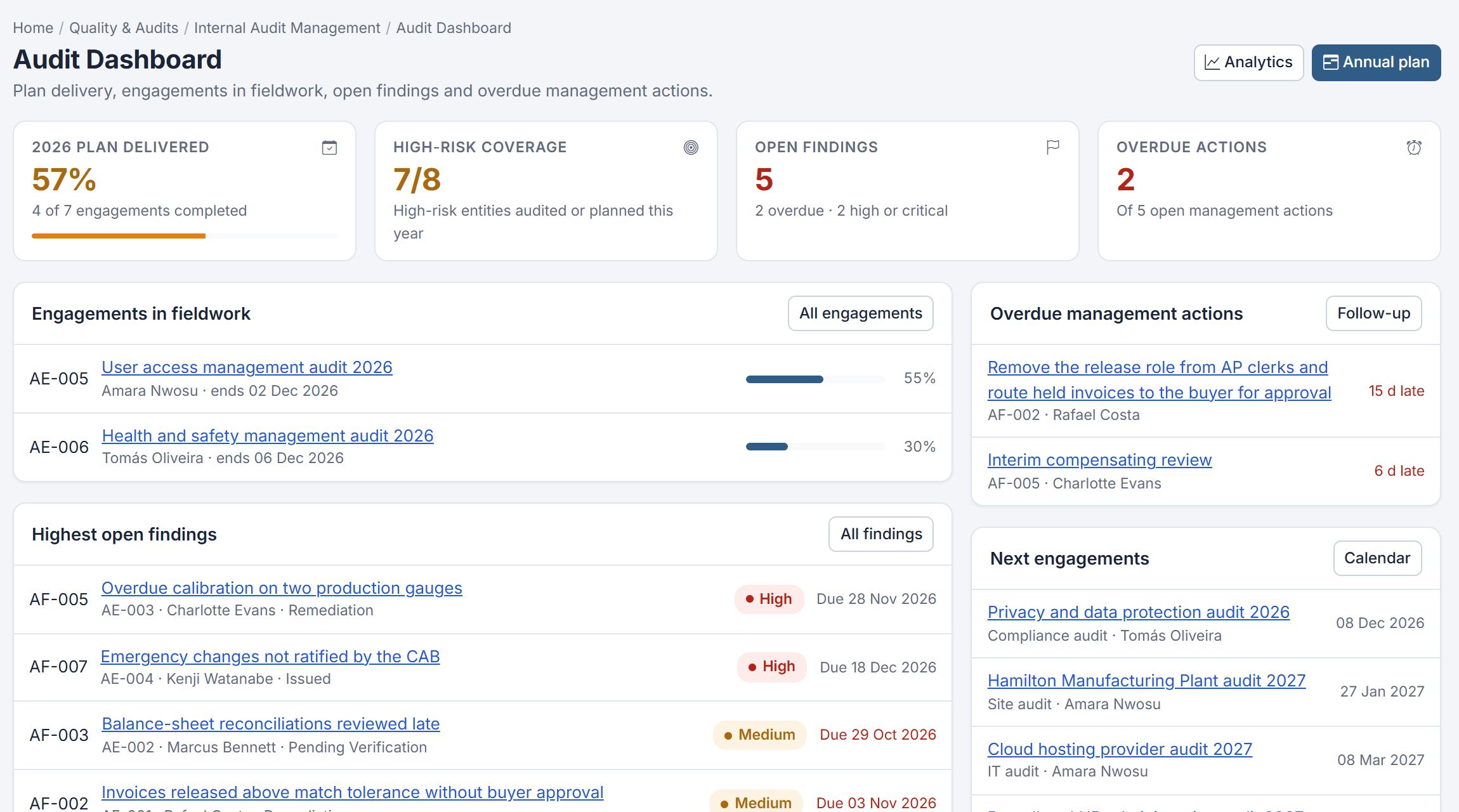
06 · Certora external audit
Certification audits planned, evidenced and tracked.
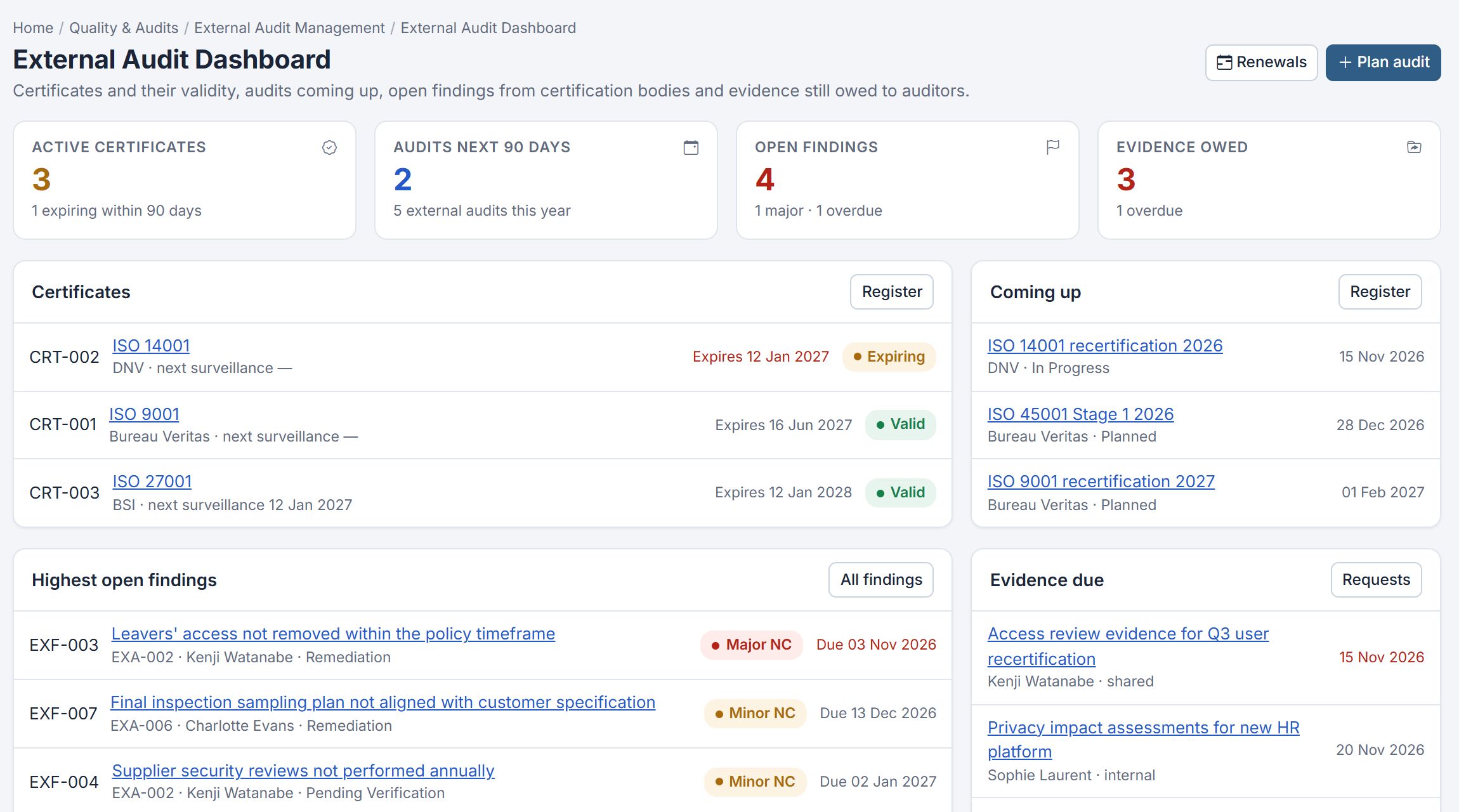
Certora External Audit Management plans certification, surveillance and recertification audits in a certification register. Evidence is shared with auditors through a restricted portal and tracked as evidence requests, so every request has an owner and a status.
External audit findings are answered with root cause and corrective action, and certificates are tracked with their renewal dates. Because internal audits, management review and corrective actions run in the same system, the evidence auditors ask for at stage 1 and stage 2 is already connected.
Read keeping certificates valid between audits for what happens after certification.