A management review agenda should be built from data, not slides.
The inputs ISO 9001 clause 9.3.2 requires for management review, and how to build the agenda from live data on audits, actions, objectives and risks.
The principle
When every input is pulled from live records, the meeting can spend its time deciding instead of reporting.
Management review is the one meeting the standard requires top management to attend. Too often it becomes a long slide presentation assembled from spreadsheets the week before, with little time left for the decisions the review exists to make.
The preparation burden is usually the root of the problem. When each input has to be gathered by hand from a different team and a different system, the review becomes an annual reporting exercise. When the inputs already exist in connected records, preparation shrinks to hours and the meeting can focus on what the numbers mean.
01 · Start with context
Why management review matters.
ISO 9001 clause 9.3 requires top management to review the quality management system at planned intervals, to ensure its continuing suitability, adequacy, effectiveness and alignment with the strategic direction of the organisation. ISO 14001, ISO 45001 and ISO/IEC 27001 contain equivalent requirements.
Auditors treat management review as evidence of leadership involvement under clause 5.1. A thin agenda, missing inputs or a review held without top management is a common finding, and one that certification bodies look for as early as stage 1.
Suitable, adequate, effective, aligned
These four words are worth separating. Suitable asks whether the system fits the organisation’s purpose. Adequate asks whether it is sufficient. Effective asks whether it achieves its intended results. Aligned asks whether it supports the strategic direction. A review that only looks at effectiveness, through KPIs, misses the other three questions.
02 · Cover every required input
Clause 9.3.2 is specific.
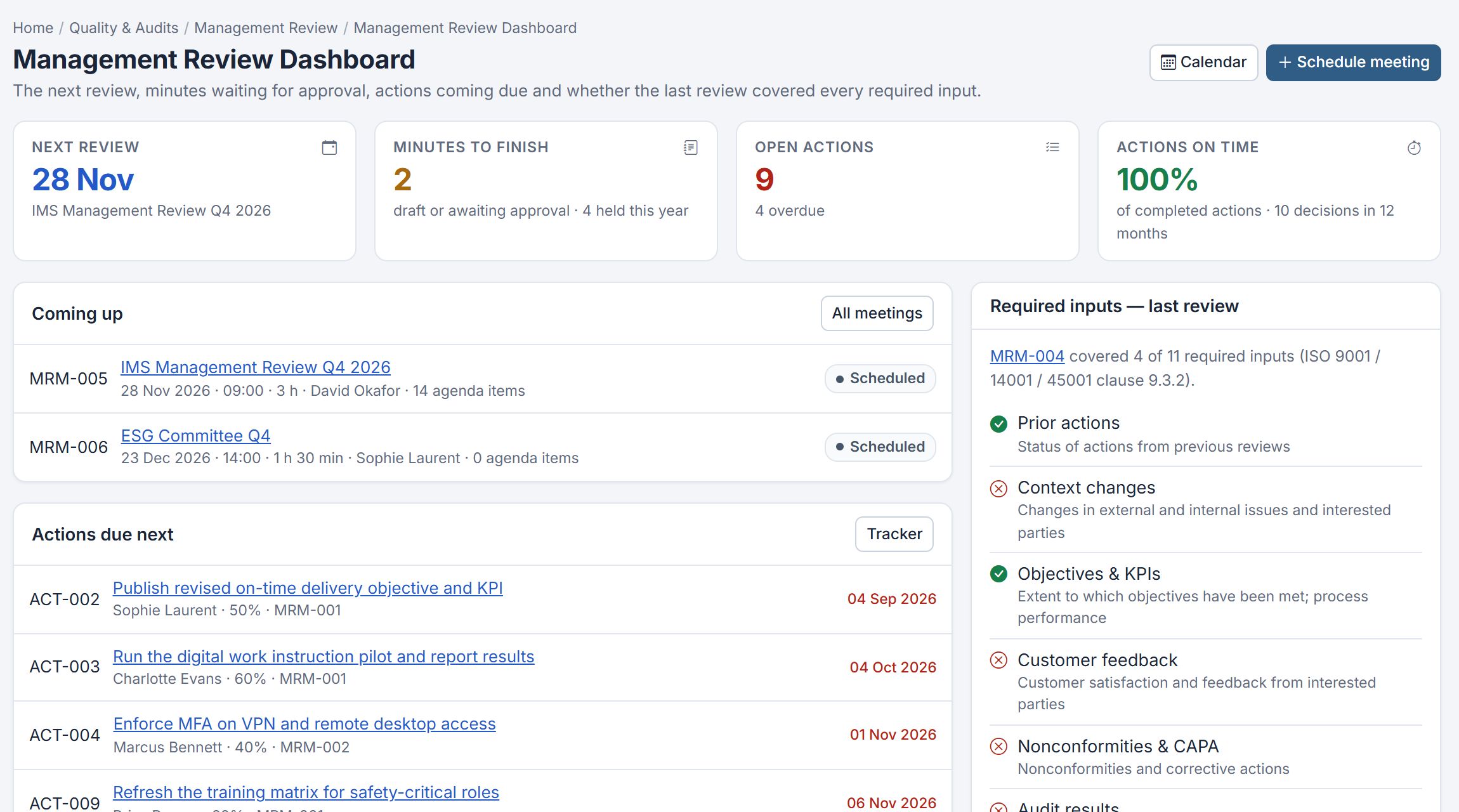
The standard lists what management review must consider. Summarised, the inputs are:
- The status of actions from previous management reviews.
- Changes in external and internal issues relevant to the system.
- Performance and effectiveness information, including customer satisfaction and feedback from interested parties, the extent to which quality objectives are met, process performance and conformity of products and services, nonconformities and corrective actions, monitoring and measurement results, audit results, and the performance of external providers.
- The adequacy of resources.
- The effectiveness of actions taken to address risks and opportunities.
- Opportunities for improvement.
A standing agenda built around these headings makes it hard to miss one.
Organisations certified to several standards can hold a single integrated review, as long as the inputs specific to each standard are covered, such as environmental performance and compliance obligations for ISO 14001, or consultation and participation of workers for ISO 45001.
03 · Use live data
Each input already exists somewhere.
Every input on that list is produced by another process: audit results from the audit programme, nonconformities from the CAPA process, objectives from KPI tracking, supplier performance from purchasing. The work of preparing a review is mostly collecting it.
When those processes run in connected systems, the agenda can be assembled from current records rather than retyped. That removes transcription errors and lets the meeting start from the same numbers everyone else sees.
Presenting data that supports decisions
Raw data is rarely helpful in a leadership meeting. Each input works best as a short summary: the current position, the trend, and what the presenter thinks it means. "Supplier on-time delivery has fallen from 94% to 87% over two quarters, driven by two suppliers" invites a decision. A page of supplier scores does not.
04 · Prepare the meeting
Attendance, timing and pre-reading.
- Schedule reviews at planned intervals, typically at least once a year and more often in larger organisations.
- Confirm attendance of top management and the process owners presenting inputs.
- Circulate the agenda and the data in advance so the meeting is for discussion.
- Record attendance, apologies and notes against each agenda item.
A review that happens late, or without top management, undermines the evidence it is meant to provide.
Many organisations find that one large annual review is less effective than shorter, more frequent reviews, for example quarterly, with the full set of inputs covered over the year. The standard allows this, provided every required input is considered at planned intervals.
05 · Focus on decisions
The inputs exist to inform outputs.
Data that is simply presented and noted adds little. Each agenda item should end with a conclusion: is performance acceptable, is action needed, are resources sufficient? Those conclusions become the outputs covered in the companion article on decisions, actions and minutes.
Common pitfalls
- Missing inputs: supplier performance or risk effectiveness quietly left off the agenda.
- Delegated attendance: top management sending deputies, so the review cannot show leadership involvement.
- Presentation overload: so much time spent presenting that no decisions are made.
- Stale data: figures gathered weeks before the meeting and already out of date.
06 · Certora management review
An agenda built from every required input.
Certora Management Review schedules reviews and builds the agenda from every required input, pulling live data from across Certora: audits, nonconformities and CAPA, KPIs and objectives, risks, suppliers and customer feedback. The meeting is run with attendance and notes recorded against each item.
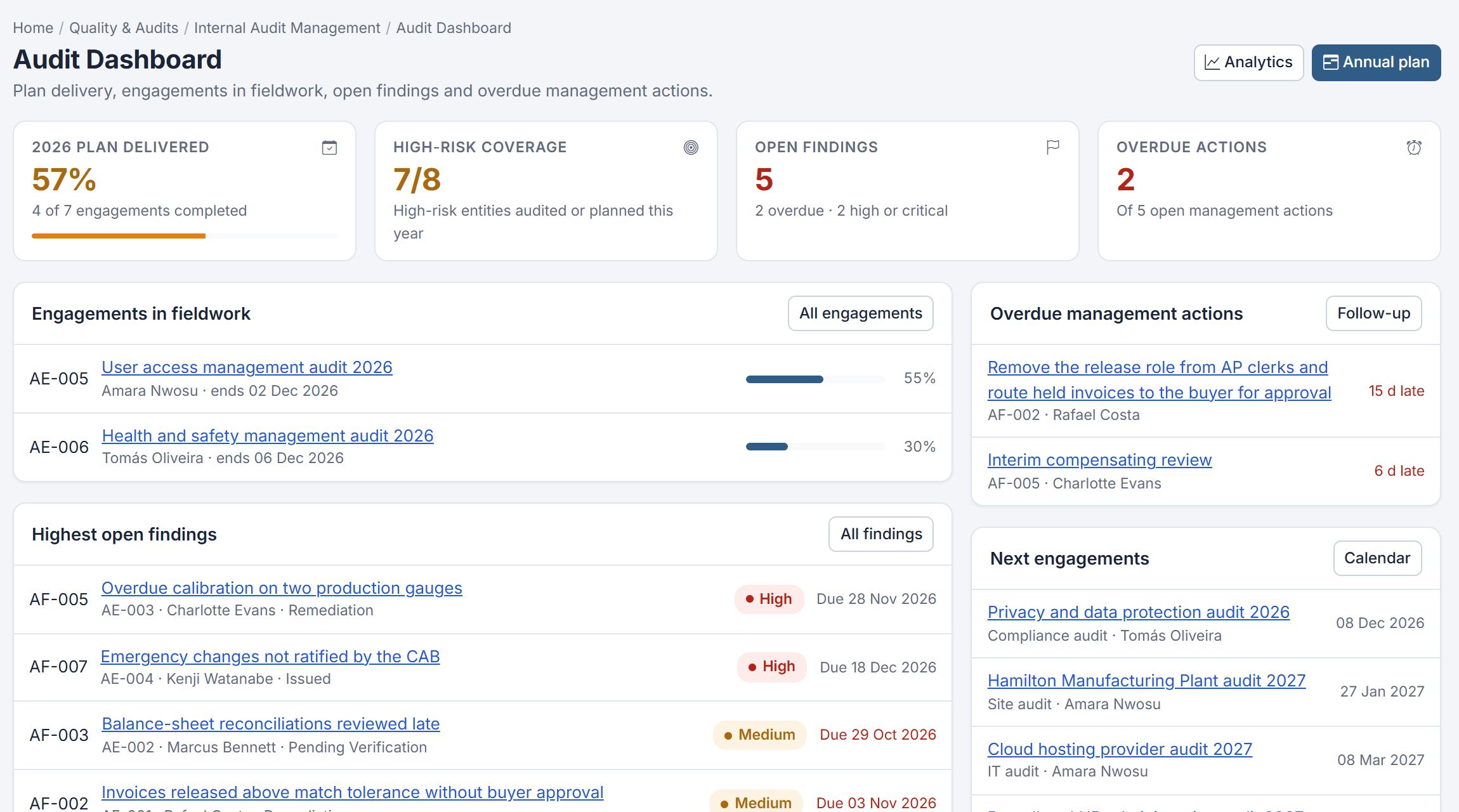
Decisions and actions are captured in the meeting and the minutes are approved in the system, so the next review starts with the status of previous actions already in place. The management review dashboard shows upcoming reviews and open actions.
Read management review outputs for how decisions and minutes are recorded.