Vulnerability management works when every severity has a deadline.
How to run vulnerability management with severity-based remediation SLAs, a system inventory, tracked exceptions and reporting, aligned with ISO/IEC 27001.
The principle
A vulnerability scan finds problems. A remediation SLA decides how long you are willing to live with them.
Most organisations scan for vulnerabilities. The results are long lists that grow faster than teams can fix them. Without clear priorities and deadlines, critical issues sit alongside cosmetic ones, and nobody can say whether the backlog is under control.
Attackers exploit known vulnerabilities routinely, often soon after they are disclosed. The question for any organisation is not whether it has vulnerabilities, because every organisation does, but whether it fixes the dangerous ones quickly enough. Severity-based SLAs turn that question into something measurable.
01 · Start with context
Technical vulnerabilities are a managed risk.
ISO/IEC 27001:2022 Annex A control 8.8, Management of technical vulnerabilities, expects organisations to obtain information about technical vulnerabilities of information systems in use, evaluate the organisation’s exposure to them, and take appropriate measures. NIST CSF 2.0 covers the same ground under its Identify function, through risk assessment, and its Protect function, through platform security.
Where vulnerability information comes from
Sources include automated scanners, penetration tests, vendor security advisories, public vulnerability databases, threat intelligence feeds and bug reports. A vulnerability management process brings these together into one list, so a critical issue found in a penetration test is handled with the same discipline as one found by a scanner.
02 · Know your systems
You cannot patch what you do not track.
- An inventory of technology systems, with owners.
- Each system’s criticality and the data it holds.
- Exposure: internet-facing, internal or isolated.
The same vulnerability is more urgent on an internet-facing system holding customer data than on an isolated test server.
Unknown systems are the biggest blind spot. Shadow IT, forgotten test servers and unmanaged cloud resources often carry the oldest, most exploitable vulnerabilities precisely because nobody is responsible for them. Regular discovery scans that compare what exists with what is in the inventory help close this gap.
03 · Set severity SLAs
Deadlines by risk.
- Classify each vulnerability by severity, such as critical, high, medium and low.
- Assign a remediation deadline to each severity level.
- Adjust for system criticality and exposure where justified.
- Start the clock when the vulnerability is identified.
Clear SLAs turn a backlog into a set of commitments with measurable compliance.
Typical SLA ranges
Organisations set their own deadlines, but common practice ranges from days for critical vulnerabilities on exposed systems, to a few weeks for high, to a month or more for medium and longer for low. Base scores such as CVSS are a useful starting point, adjusted for whether a vulnerability is known to be actively exploited and for the importance of the affected system.
04 · Track remediation
Owners, status and evidence.
Each vulnerability should have an owner, a status and a due date, with evidence when it is fixed. Overdue items should escalate automatically. Where a fix is not possible within the SLA, a time-limited exception with compensating controls should be recorded and approved.
Verification matters. A vulnerability marked fixed should be confirmed by a rescan or test, because patches sometimes fail to apply, or apply to some systems and not others.
05 · Test independently
Scans and penetration tests.
Automated scans give breadth; penetration tests give depth. Both should feed the same remediation process, so findings from either source are tracked to closure with the same discipline.
Penetration tests are most valuable when scoped around real risks, such as internet-facing applications, recent major changes or critical systems, and when findings are retested after remediation to confirm they are closed.
Common pitfalls
- Scan and forget: reports generated monthly but never turned into tracked remediation.
- No SLAs: every vulnerability treated the same, so critical issues wait behind trivial ones.
- Untracked exceptions: vulnerabilities left open indefinitely with no recorded acceptance.
- Unverified fixes: items closed without a rescan to confirm the patch worked.
06 · Certora cybersecurity management
Vulnerabilities fixed within severity SLAs.
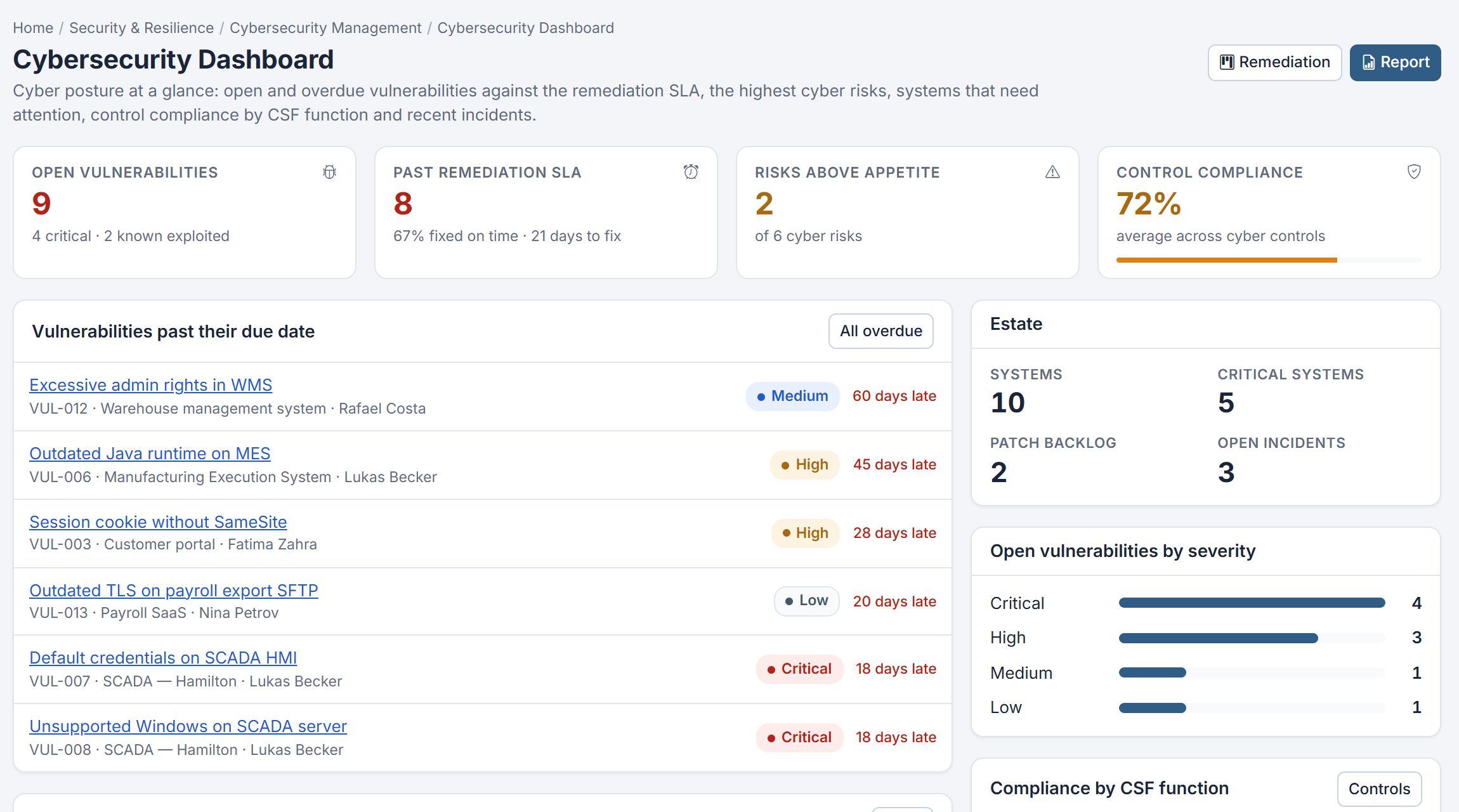
Certora Cybersecurity Management knows every technology system, scores the cyber threats against it, and fixes vulnerabilities within severity SLAs through a remediation tracker. Penetration tests and scans are tracked, cyber incidents are handled, and the cyber posture is reported.
Read running cybersecurity controls by NIST CSF 2.0 function for the controls side.