A continuity plan is only proven once it has been exercised.
How to exercise continuity and disaster recovery plans under ISO 22301, from tabletop to live recovery, and run a real crisis with situation reports.
The principle
The first time a plan is used should never be the day it is needed.
Continuity plans written for certification can look complete and still fail on contact with reality: contact numbers are out of date, the backup site has no network, the recovery team has never met. Exercises find those gaps while the cost of finding them is low.
An untested plan is a hypothesis. Exercising turns it into a capability: people who know their roles, procedures that have been tried, and technology that has been proven to recover. It also builds confidence, so that when a real disruption happens, the team responds with familiarity rather than improvisation.
01 · Start with context
ISO 22301 requires exercising.
ISO 22301 clause 8.5 requires the organisation to implement and maintain a programme of exercising and testing to validate over time the effectiveness of its business continuity strategies and solutions. Exercises must:
- Be consistent with the organisation’s business continuity objectives.
- Be based on appropriate scenarios that are well planned with clearly defined aims and objectives.
- Develop teamwork, competence, confidence and knowledge for those who have roles to perform.
- Taken together over time, validate the whole of its business continuity strategies and solutions.
- Minimise the risk of disruption of operations.
- Produce formalised post-exercise reports that contain outcomes, recommendations and actions to implement improvements.
- Be reviewed in the context of promoting continual improvement, and be performed at planned intervals and when there are significant changes.
02 · Plan a programme
Increase realism over time.
- Walkthrough: the team reads through the plan together to check it makes sense.
- Tabletop: a facilitated scenario discussion, testing decisions without moving resources.
- Functional test: specific components are tested, such as restoring a system from backup.
- Full exercise: a realistic simulation involving relocation or live recovery.
A programme that progresses through these types builds confidence step by step.
How often
A typical programme might include a tabletop exercise for each critical plan annually, functional tests of key technology recovery at least annually, and a larger exercise every one to two years. New plans and significant changes to plans should be exercised soon after approval, rather than waiting for the next scheduled cycle.
03 · Design realistic scenarios
Test what could actually happen.
- Base scenarios on risks and the business impact analysis.
- Define objectives: what the exercise should prove.
- Inject events that test decisions and communication.
- Observe and record what happens, including what goes well.
Useful scenario types
Scenarios can include loss of a site through fire or flood, loss of a key IT system, a cyber attack, unavailability of a critical supplier, a pandemic affecting staff availability, or a utility failure. Varying scenarios across the programme tests different parts of the plans, and injects that escalate the situation midway test decision-making under pressure.
04 · Learn from every exercise
Reports and actions.
A post-exercise report records what was tested, what worked, what failed and what must change. Each gap becomes an action with an owner and due date, and the plan is updated. Repeating the exercise later confirms the improvements worked.
Honesty in post-exercise reporting is essential. An exercise that "went perfectly" usually means the scenario was too easy or the observers were not looking closely. Gaps found in an exercise are successes, because each one is a gap that will not surprise the organisation in a real event.
05 · Run the real thing
Crisis management in practice.
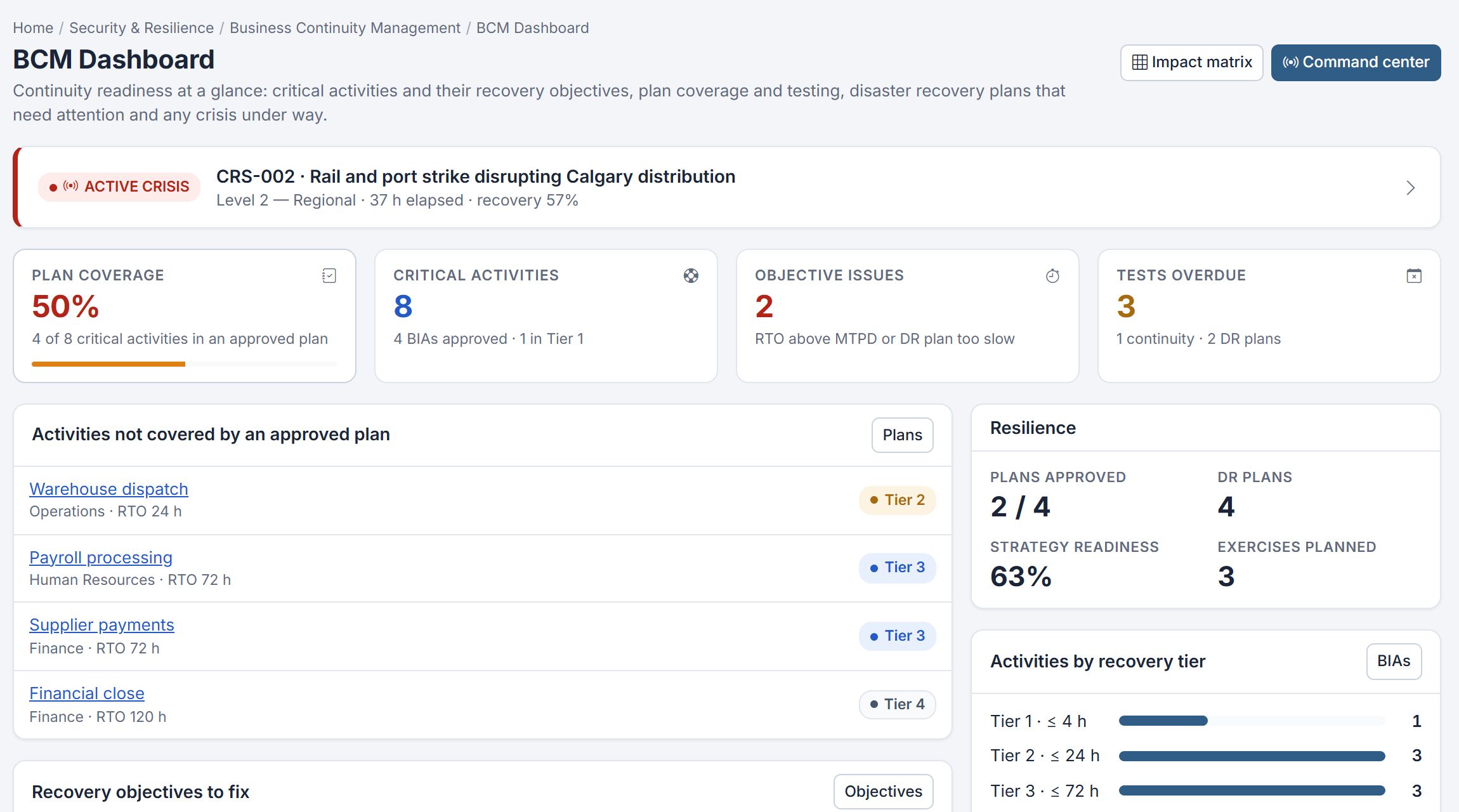
When a real disruption happens, the same discipline applies. A crisis team coordinates the response, situation reports keep stakeholders informed at regular intervals, and recovery progress is tracked against the recovery objectives for each activity.
After a real incident
A real disruption is the most valuable exercise an organisation will ever have. A structured review afterwards, using the same format as a post-exercise report, captures what worked, what did not, and what should change, while the experience is still fresh.
Common pitfalls
- Plans never exercised: documents that exist for certification and have never been tried.
- Same easy scenario: the same tabletop repeated each year, never stretching the team.
- No actions from findings: gaps identified in reports but never fixed.
- Outdated contact lists: the first thing to fail when a real incident begins.
06 · Certora business continuity management
Exercises and live crisis response.
Certora Business Continuity Management approves continuity and disaster recovery plans and exercises them, recording outcomes and actions. In a real crisis, situation reports and live recovery tracking support the response.
Plans are built on a business impact analysis with consistent recovery objectives. See business impact analysis for ISO 22301 for how objectives are set.