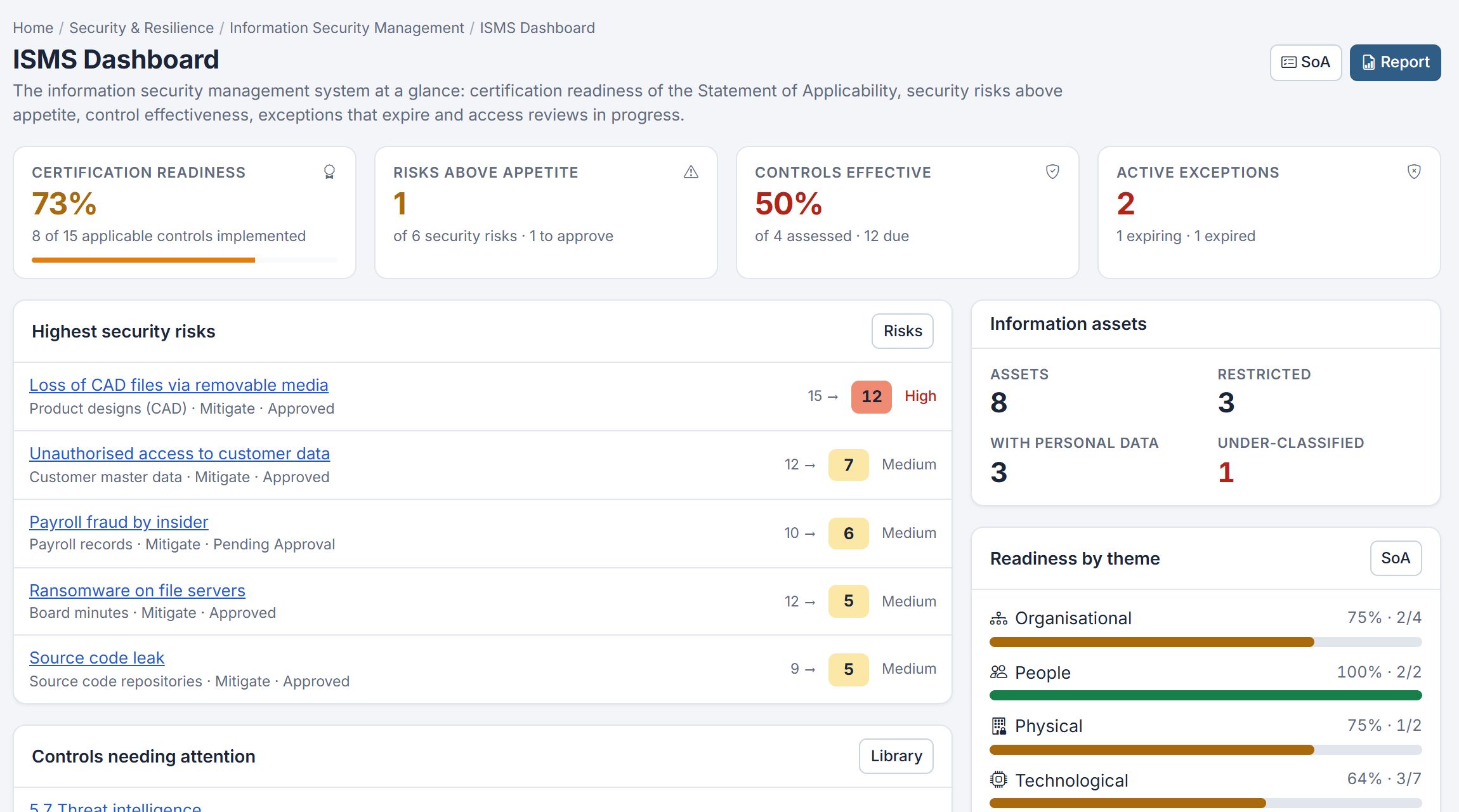
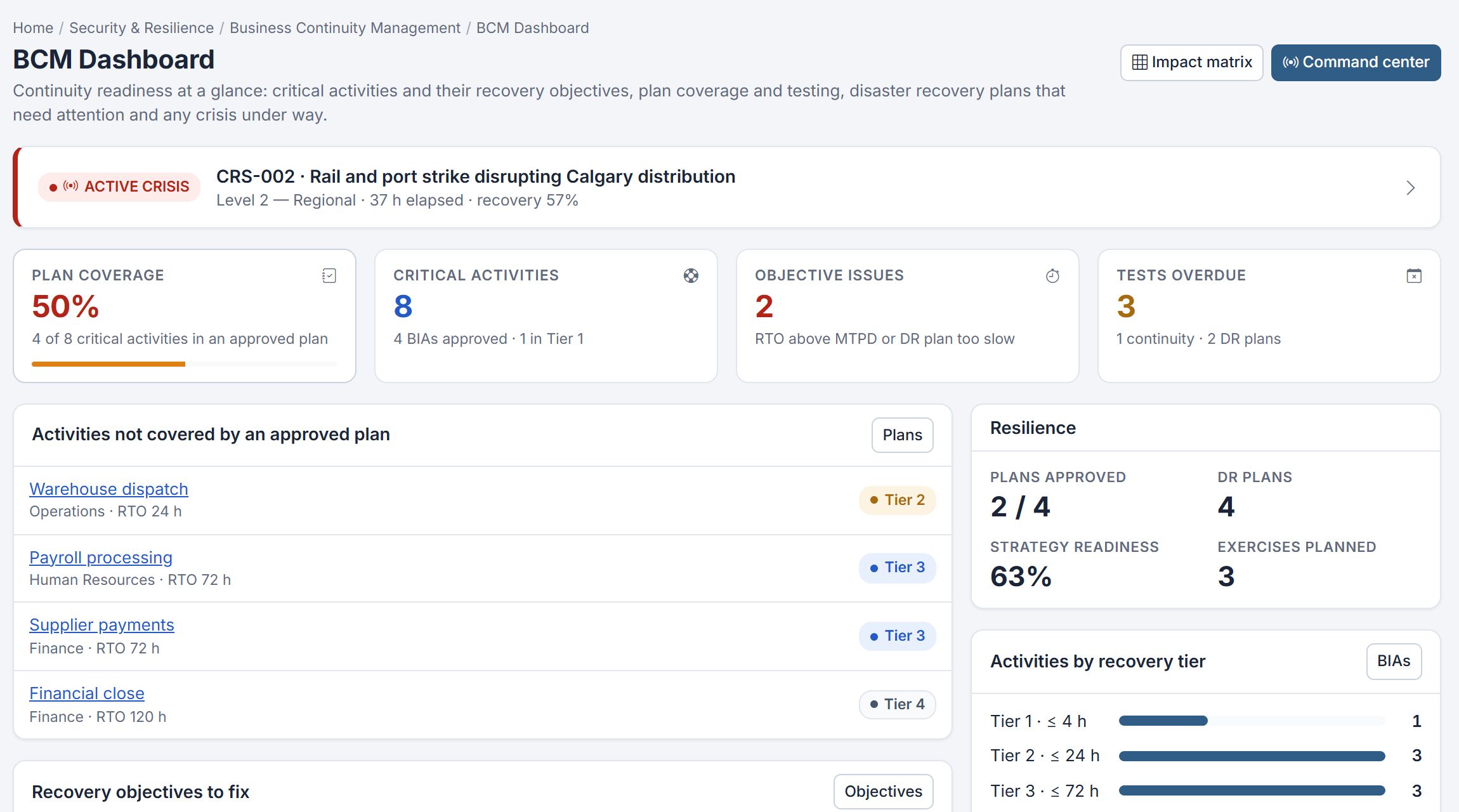
Organising cybersecurity controls by NIST CSF 2.0 function.
How to organise cybersecurity controls by the six NIST CSF 2.0 functions, Govern, Identify, Protect, Detect, Respond and Recover, alongside ISO 27001.
The principle
The six functions of NIST CSF 2.0 give leadership a simple question for every control: what part of the cyber lifecycle does this protect?
Cybersecurity programmes accumulate controls from many sources: audits, regulations, customer questionnaires and incidents. Over time, it becomes hard to see whether the programme is balanced, or whether it is strong at prevention and weak at recovery.
A framework gives that picture structure. NIST’s Cybersecurity Framework organises cybersecurity outcomes into a small number of functions that leaders without a technical background can understand, and that specialists can map detailed controls into. Version 2.0 made the framework more broadly applicable and put governance at its centre.
01 · Start with context
What changed in NIST CSF 2.0.
The NIST Cybersecurity Framework 2.0, published in February 2024, organises cybersecurity outcomes into six functions. It added Govern to the original five, recognising that cybersecurity is an enterprise risk that needs strategy, roles and oversight, and broadened the framework’s intended audience beyond critical infrastructure to organisations of all sizes and sectors.
- Govern: organisational context, risk management strategy, roles and responsibilities, policy, oversight and supply chain risk management.
- Identify: assets, risk assessment and improvement.
- Protect: identity management and access control, awareness and training, data security, platform security and technology infrastructure resilience.
- Detect: continuous monitoring and adverse event analysis.
- Respond: incident management, analysis, reporting and mitigation.
- Recover: incident recovery plan execution and communication.
CSF and ISO/IEC 27001 together
The two are complementary. ISO/IEC 27001 provides a certifiable management system with Annex A controls; NIST CSF provides an outcome-based structure that many organisations find easier to communicate. NIST publishes informative references that map CSF outcomes to other frameworks, so controls can be organised by CSF function while still satisfying ISO/IEC 27001.
02 · Map your controls
One function per control.
- List the cybersecurity controls you operate.
- Assign each to its primary CSF function.
- Note where a control also maps to ISO/IEC 27001 Annex A.
- Identify functions with few or weak controls.
The map often reveals imbalance, such as many Protect controls and few Recover controls.
Profiles and tiers
CSF 2.0 supports organisational profiles: a current profile describing outcomes achieved today and a target profile describing outcomes the organisation wants to achieve. The gap between them becomes a prioritised improvement plan. Tiers, from partial to adaptive, describe the rigour of cybersecurity risk governance and management, helping organisations decide how mature their practices need to be.
03 · Assess control effectiveness
Status and evidence.
Each control should be assessed periodically: is it implemented, is it operating, and is there evidence? Assessment results by function give a clear picture of cyber posture that non-specialists can understand.
Assessment frequency should follow risk. Controls protecting critical systems, or controls that have failed before, deserve more frequent assessment than stable, low-risk controls.
04 · Connect to risk and incidents
Controls exist for a reason.
Controls should link to the cyber risks they treat. When incidents occur, the related controls should be reviewed, and weaknesses found in incident response should feed improvement actions in the Respond and Recover functions.
This connection makes posture reporting meaningful. A control rated ineffective matters more when the report also shows which high-rated risk it was meant to treat.
05 · Report the posture
By function, over time.
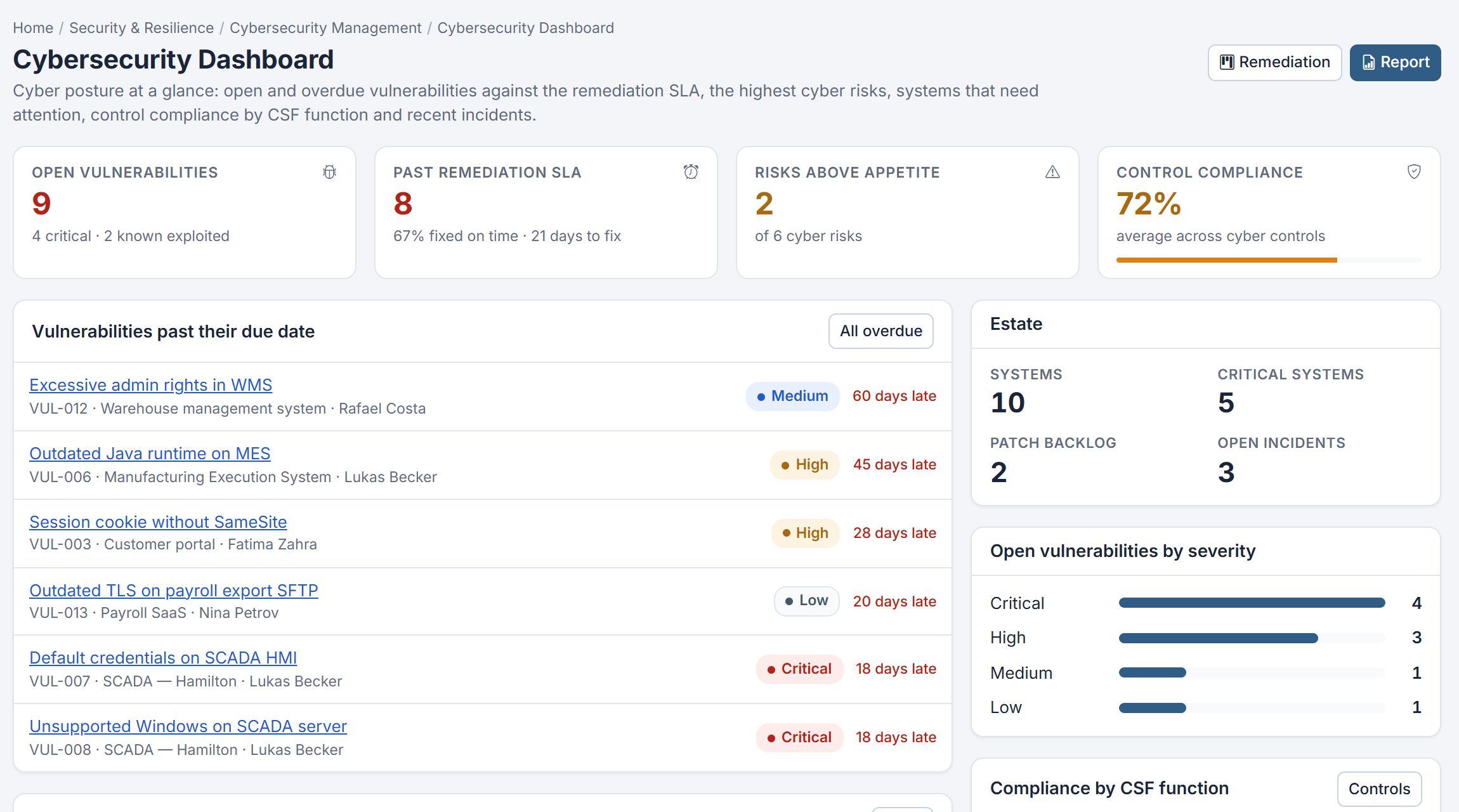
A posture report by CSF function, showing control status, open vulnerabilities, incidents and test results, gives leadership the oversight the Govern function calls for.
Trends over time show whether investment is improving posture. A board seeing Protect improving while Recover stays weak can make an informed decision about where the next budget should go.
Common pitfalls
- Prevention only: heavy investment in Protect, with little capability to Detect, Respond or Recover.
- Govern ignored: controls in place but no strategy, roles or oversight connecting them to business risk.
- Mapping without assessment: controls assigned to functions but never tested.
- Technical reporting to the board: posture reported in jargon leadership cannot act on.
06 · Certora cybersecurity management
Controls by NIST CSF 2.0 function.
Certora Cybersecurity Management runs controls by NIST CSF 2.0 function, alongside a technology system inventory, cyber risk scoring, vulnerability remediation within severity SLAs, penetration tests and scans, and cyber incident handling. The cyber posture is reported in one place.
See vulnerability management with severity SLAs for remediation.