A training matrix should show gaps before an auditor does.
How a training matrix keeps mandatory training current across departments, with plans, enrolments, certificates and expiry tracking that support ISO audits.
The principle
A training matrix is only useful if it shows who is out of date today, not who was trained last year.
Training records are one of the first things auditors sample. They pick a person, ask what training their role requires, and check whether it is current. A training matrix that answers that question instantly is one of the simplest ways to make an audit go smoothly.
A good matrix is also a management tool, not just audit evidence. Department managers use it to plan who needs what training next quarter. HR uses it to see where renewals will cluster. Safety teams use it to make sure nobody operates equipment without current authorisation. One view serves all of them.
01 · Start with context
Training is evidence of competence.
ISO 9001 clause 7.2 asks the organisation to determine the competence people need, ensure they are competent on the basis of education, training or experience, take action to acquire competence where needed, and retain documented information as evidence. ISO 45001 and ISO/IEC 27001 extend this to safety-critical and security roles, and many regulations require specific training for particular tasks.
Training is one of the most common ways to build competence, so training records carry a lot of the evidential weight.
Legal and regulatory training
Some training is not optional at all. Forklift operation, working at height, first aid, hazardous materials handling and food hygiene are typical examples where law or regulation sets requirements. These belong in the matrix with their legal basis recorded, so the consequences of a lapse are clear.
02 · Define what is mandatory
Start from roles, not courses.
A matrix compares people against requirements, so the requirements come first.
- Courses required for every employee, such as induction and code of conduct.
- Courses required by role, such as forklift operation or internal auditor training.
- Courses required by location or activity, such as site safety or hazardous materials.
Each requirement should note whether it expires and how often it must be renewed.
Linking requirements to positions rather than individuals means that when someone moves role, their new requirements appear automatically, and any training they now lack shows as a gap from day one.
03 · Plan the year
Training plans enrol whole groups.
Rather than booking training person by person, a yearly training plan can enrol a whole department or role group into the courses they need. Sessions are then scheduled with dates, trainers and capacity.
This makes the year’s training load visible early and helps managers release people at sensible times.
Planning around renewals
Renewal dates tend to cluster, because groups were often trained together. Planning ahead lets you spread renewals across the year, schedule sessions before expiry rather than after, and avoid the situation where half a team’s certificates expire in the same month.
04 · Track every enrolment
Attendance, scores and outcomes.
- People are enrolled into a session.
- Attendance is recorded after the session.
- Where an assessment applies, the score and pass or fail result are recorded.
- Successful completion issues a certificate with an expiry date where relevant.
Recording outcomes, not just attendance, is what turns a training log into competence evidence.
External training should be recorded the same way. Certificates from outside providers belong on the person’s record with their expiry dates, so the matrix reflects all training, not only courses run internally.
05 · Watch expiry
Most problems are renewals, not first-time training.
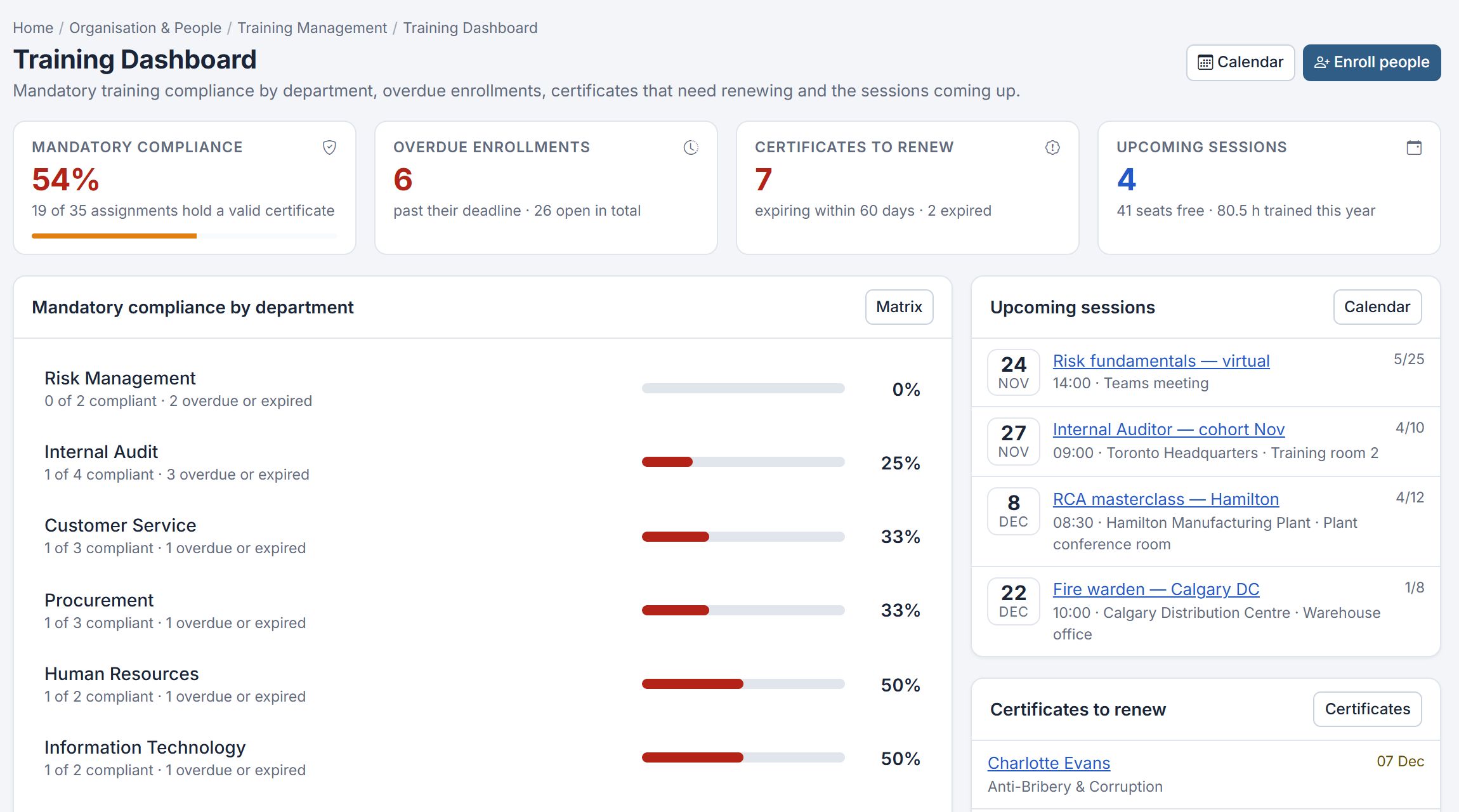
The most common gap in a training matrix is an expired certificate. Tracking expiry dates and showing what is due in the next thirty or sixty days lets managers book renewals before they lapse.
A matrix that colours each cell as valid, expiring, overdue or not required gives a department manager the full picture at a glance, and gives an auditor confidence the system is under control.
Common pitfalls
- Spreadsheet matrices: maintained by one person, updated irregularly, and out of date by the time anyone looks.
- Attendance only: sign-in sheets with no record of whether people passed or can apply what they learned.
- No expiry tracking: certificates that lapse silently until an audit or an incident reveals them.
- Course-led requirements: mandatory training defined by what courses exist rather than what roles need.
06 · Certora training management
Plans, sessions, certificates and the matrix.
Certora Training Management runs the training programme from approved courses that develop competencies, through yearly training plans that enrol whole departments, to scheduled sessions with attendance and scores. Assessments are recorded, and certificates are issued with expiry and renewal dates.
The training matrix shows every person against the mandatory courses as valid, expiring, overdue or not required, with compliance by department, and can be printed or exported as CSV. Read measuring training effectiveness for what comes after attendance.