Context of the organisation: turning clause 4 into records you can maintain.
How to meet ISO clause 4 in practice: internal and external issues, interested parties and their requirements, and a management system scope that stays current.
The principle
Clause 4 is not a one-off workshop. It is the reference every other part of the management system depends on.
Clause 4 is where every ISO management system begins, and often where it is treated most lightly. A SWOT analysis and a stakeholder list are prepared for certification, filed, and never looked at again. Yet risk planning, objectives and scope all depend on it.
When clause 4 is done well, it becomes the reference point for the whole system. Risks trace back to the issues that create them. Objectives respond to what interested parties need. The scope reflects how the organisation actually operates. When it is done poorly, the rest of the system floats free of the business it is meant to serve.
02 · Map the issues
Internal and external, kept current.
Issues are the conditions that can affect your ability to achieve intended results. External issues include markets, regulation, technology, competition, the economy and the environment. Internal issues include culture, capabilities, resources, values, knowledge and performance.
Recording issues in a structured way, and reviewing them at least at each management review, keeps them alive. Changes in issues are a required management review input.
Tools such as SWOT or PESTLE are useful for generating issues, but the output should be specific to the organisation. "Economic uncertainty" helps nobody. "Two of our largest customers are consolidating suppliers in 2027" is an issue that can drive real risk and objective decisions.
03 · Identify interested parties
And what they actually require.
- List the parties relevant to the system: customers, regulators, employees, suppliers, owners, the community.
- For each, record their relevant needs and expectations.
- Decide which of those requirements become compliance obligations.
- Assign an owner to monitor each party and how its requirements change.
Requirements identified here feed directly into the risk register and the compliance register.
Relevant, not exhaustive
The standard asks for relevant interested parties and their relevant requirements. A long list of every conceivable stakeholder dilutes attention. Focus on parties whose requirements affect the management system’s ability to deliver conforming products and services, or the organisation’s environmental, safety or security performance.
04 · Define the scope
Boundaries that match how you operate.
The scope states which sites, activities, products and services the management system covers. It must consider the issues and interested parties, and any requirement of the standard that you decide is not applicable must be justified.
A scope linked to the organisation’s actual structure, its legal entities, sites and departments, is easier to keep accurate as the organisation changes.
Scope statements also appear on certificates, so wording matters. A scope that is too narrow may not satisfy customers who expect certification of the activities they buy from you. A scope that is too broad includes activities the system does not really control, which auditors will find.
05 · Keep it connected
Context should inform planning.
The value of clause 4 comes from its connections. Issues and requirements should lead to risks and opportunities under clause 6.1, to objectives under 6.2, and to obligations in the compliance register. When those links exist, a change in context flows through to the rest of the system.
Common pitfalls
- One-off workshop: issues identified for certification and never reviewed again.
- Generic issues: statements that could apply to any organisation, which drive no decisions.
- Disconnected requirements: interested party needs listed but never turned into obligations or objectives.
- Outdated scope: new sites, products or activities added without updating the scope.
06 · Certora organisation management
Model the organisation once, reuse it everywhere.
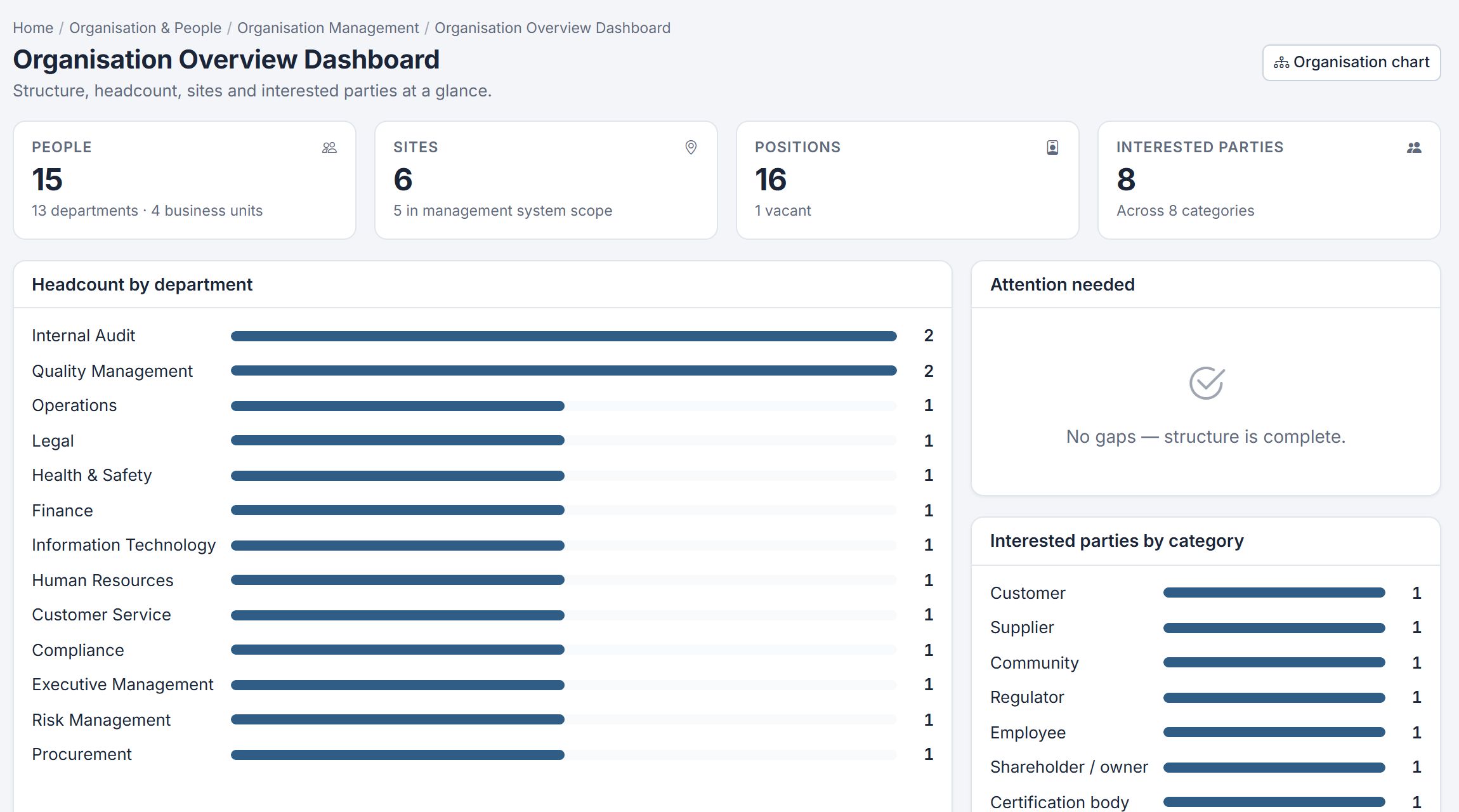
Certora Organisation Management models the organisation once: legal profile, business units, departments, sites, people, positions and reporting lines. Interested parties and the management system scope are recorded alongside, so every other module, from documents to audits and risks, reuses the same structure.
When a site is added or a department reorganised, the change is made once and reflected across Certora. Read roles, responsibilities and authorities for how clause 5.3 builds on the same organisational model.