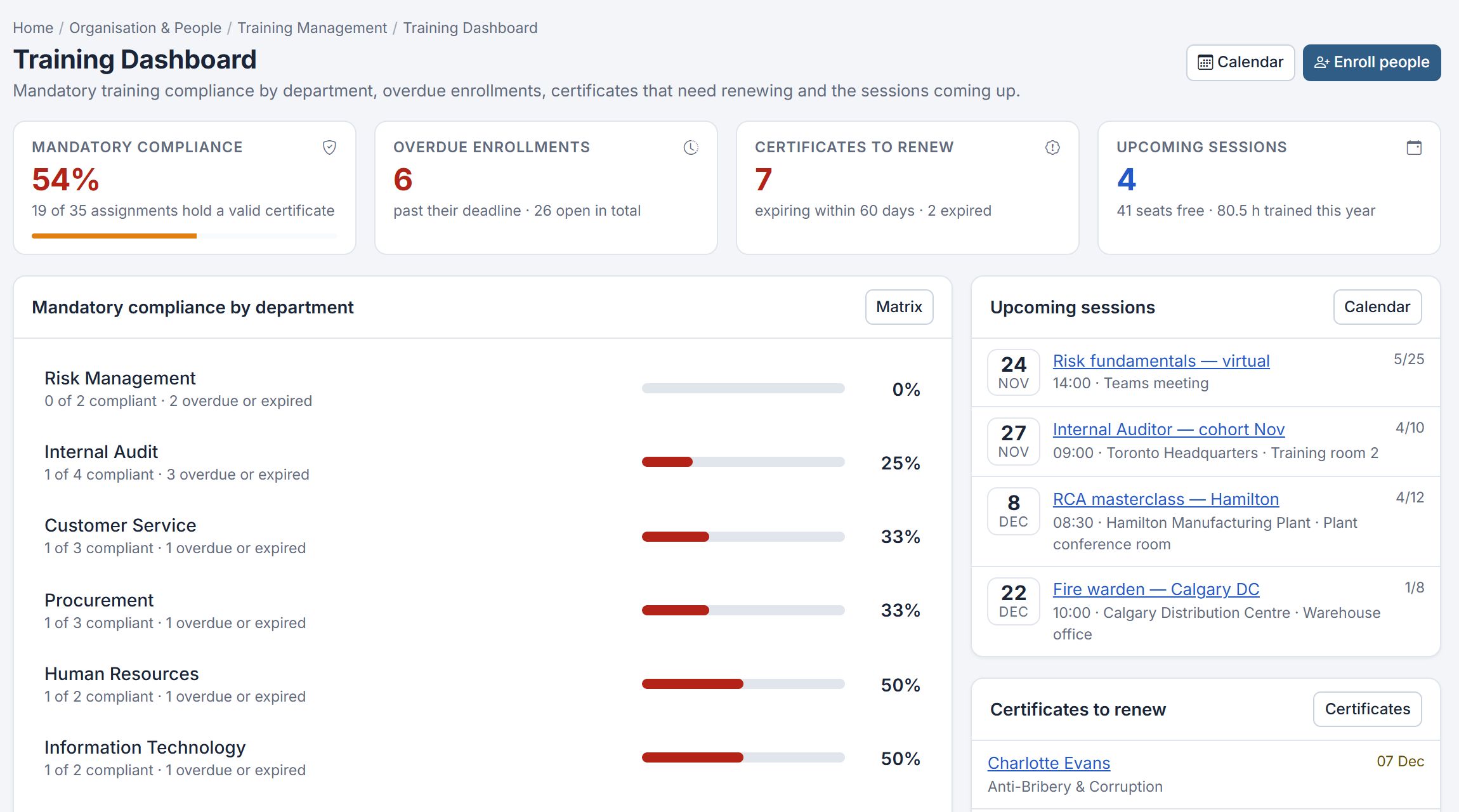
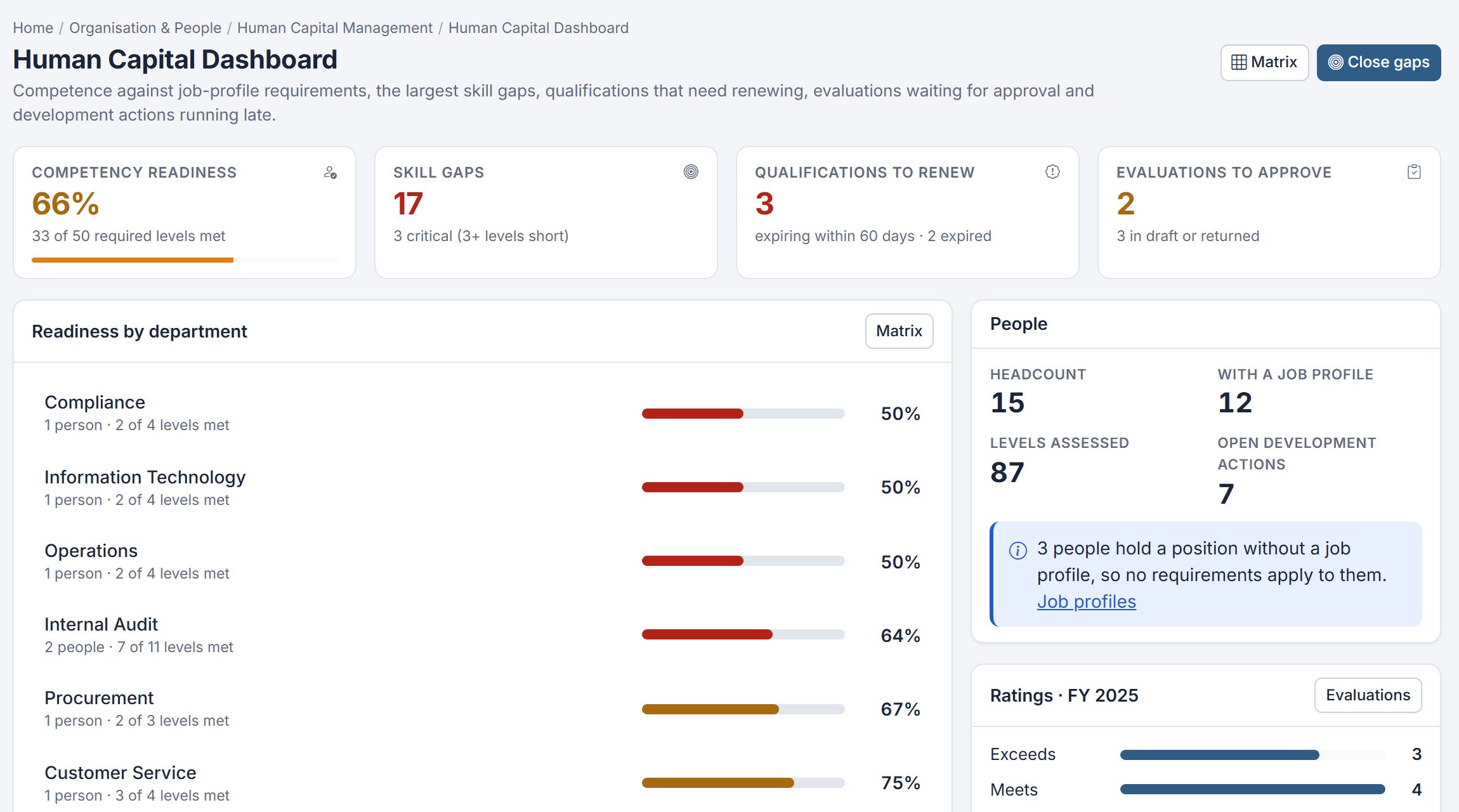
Roles, responsibilities and authorities should be visible, not buried in job descriptions.
How to meet ISO clause 5.3 by assigning and communicating roles, responsibilities and authorities through positions, reporting lines and process ownership.
The principle
When ownership is unclear, actions wait. Clause 5.3 exists so that every part of the system has someone accountable for it.
Auditors test clause 5.3 in a simple way. They ask who is responsible for a process, then ask that person whether they know it. When the answers do not match, or when responsibility sits with a role that no longer exists, the finding writes itself.
Clear responsibility is also what makes the rest of the management system work. Corrective actions need owners. Documents need owners. Risks need owners. Audit findings need someone to respond. When ownership is vague, every one of these processes slows down while people work out whose job it is.
01 · Start with context
What clause 5.3 requires.
ISO 9001 clause 5.3 requires top management to ensure that responsibilities and authorities for relevant roles are assigned, communicated and understood within the organisation. It specifically requires assigning responsibility and authority for:
- Ensuring the quality management system conforms to the standard.
- Ensuring processes are delivering their intended outputs.
- Reporting on the performance of the system and opportunities for improvement, in particular to top management.
- Ensuring the promotion of customer focus throughout the organisation.
- Ensuring the integrity of the system is maintained when changes are planned and implemented.
The same requirement appears across ISO management system standards. The 2015 revision of ISO 9001 removed the mandatory "management representative", giving organisations flexibility in how these responsibilities are distributed, but they must still be clearly assigned.
02 · Assign to positions
Not only to people.
Responsibilities assigned to named individuals break every time someone leaves or moves. Assigning them to positions, and then filling positions with people, keeps the structure stable.
- Positions describe the role, its responsibilities and its authorities.
- People are assigned to positions, with start and end dates.
- Vacant positions are visible, so gaps in responsibility can be addressed.
Responsibility versus authority
The two are different and both matter. Responsibility is what a role must make happen. Authority is what a role is permitted to decide. A process owner responsible for on-time delivery but without authority to change schedules or approve overtime has been set up to fail. Clause 5.3 asks for both to be assigned together.
03 · Show reporting lines
Who reports to whom, and why it matters.
Reporting lines determine escalation paths, approval chains and who can be independent of whom, for example in auditing or verification. An up-to-date organisational chart, derived from the position structure, communicates this at a glance.
Independence is a practical concern. An internal auditor should not audit their own department. A verifier of corrective actions should not report to the action owner. Reporting lines make these relationships visible, so independence can be checked rather than assumed.
04 · Assign process ownership
Every process needs an accountable owner.
- List the processes of the management system.
- Assign each process an owner position.
- Define what the owner is accountable for: performance, documents, risks, improvement.
- Communicate ownership through induction, process maps and the document system.
Process owners are often the people who present at management review and respond to audit findings, so ownership should be clear well before the audit.
Cross-functional processes
Some processes cross departments: order-to-cash, new product introduction, complaint handling. These need a single owner for the end-to-end process, even though several departments perform parts of it. Without one, each department optimises its own step and nobody owns the outcome the customer experiences.
05 · Communicate and confirm
Assigned is not the same as understood.
The standard asks that responsibilities are understood, not just written down. Including responsibilities in role descriptions, discussing them at induction and in appraisals, and referencing them in procedures all help. Periodic review keeps them current as the organisation changes.
A useful check is to ask a sample of people to describe their responsibilities within the management system, then compare the answers with what is documented. Gaps reveal where communication has not worked.
Common pitfalls
- Names in procedures: "John approves the specification", which breaks the day John leaves.
- Responsibility without authority: owners accountable for outcomes they cannot influence.
- Orphaned processes: cross-functional processes owned by everyone and therefore by no one.
- Outdated charts: an organisation chart that reflects last year’s structure.
06 · Certora organisation management
Positions, reporting lines and responsibilities.
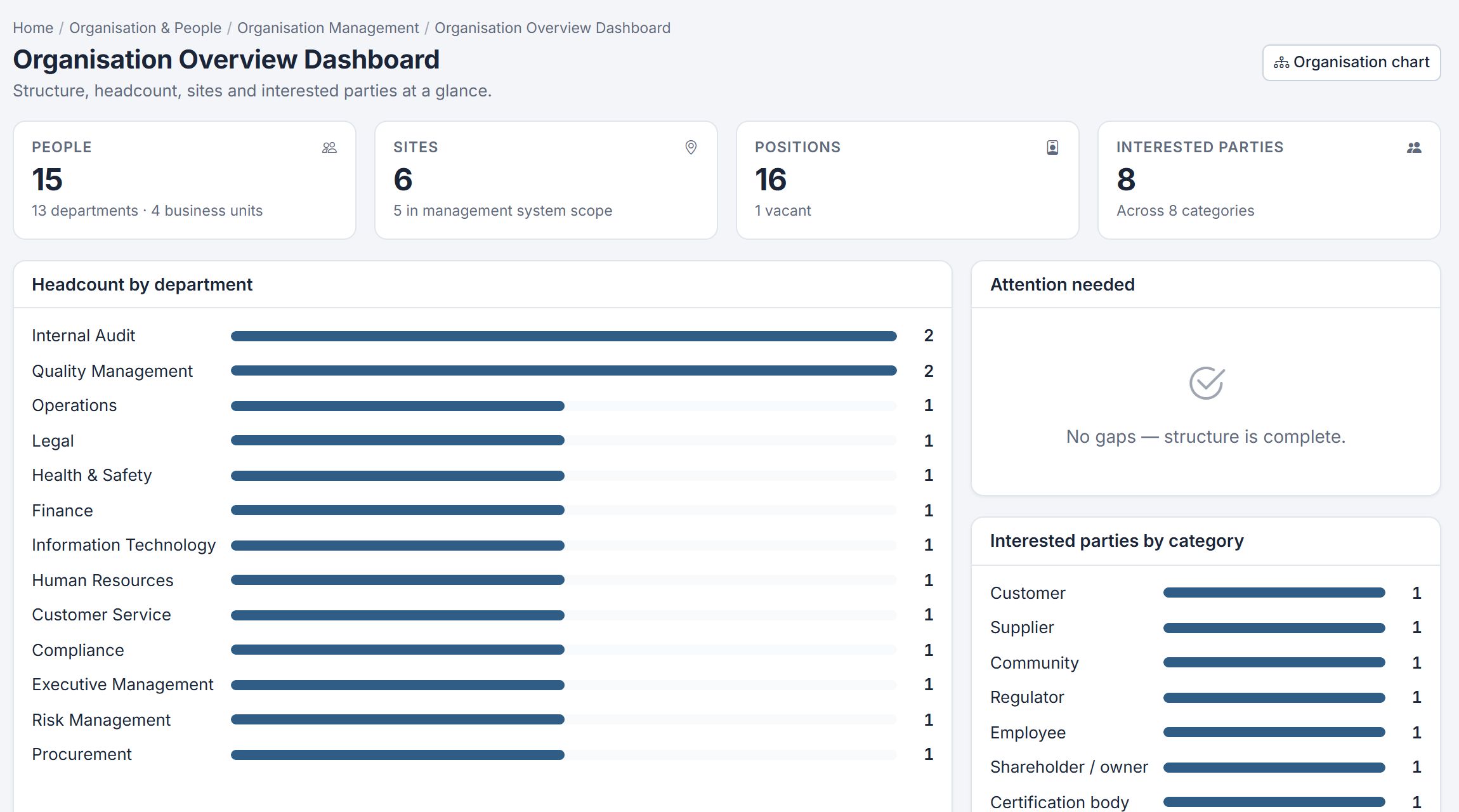
Certora Organisation Management models people, positions and reporting lines, together with the responsibilities each position carries. The organisation chart is generated from that structure, so it always reflects current assignments, and vacant positions are visible.
Because every module reuses the same organisation model, process owners, document owners, risk owners and auditors all come from one source. See context of the organisation for how scope and interested parties fit in.