Attendance proves someone was in the room. Effectiveness proves they learned.
How to evaluate training effectiveness for ISO 9001 clause 7.2 using assessments, observed performance and follow-up, not just attendance sheets.
The principle
The standard does not ask whether training happened. It asks whether the action taken to build competence worked.
Signed attendance sheets are the most common training evidence in quality systems. They show that a session took place. They say nothing about whether anyone can now do the task better, which is what the standard is actually concerned with.
Training is a significant investment of time and money. Without evaluating effectiveness, an organisation has no way of knowing whether that investment works, which courses deliver results, or which should be redesigned or dropped. Evaluation turns training from a cost into something that can be managed.
01 · Start with context
Clause 7.2 asks you to evaluate effectiveness.
ISO 9001 clause 7.2 c) asks organisations, where applicable, to take actions to acquire the necessary competence and to evaluate the effectiveness of the actions taken. Training is the most common such action, so its effectiveness should be evaluated in proportion to the importance of the competence.
Evaluation does not need to be elaborate. It needs to be appropriate.
What auditors look for
Auditors typically pick a training event and ask how its effectiveness was evaluated. A good answer shows the objective the training was meant to achieve, the method used to check it, the result, and what happened for anyone who did not meet the standard. A feedback form alone rarely satisfies them for important competencies.
02 · Set the objective
Decide what the training should change.
Effectiveness is easiest to judge when the intended outcome is clear before the training starts.
- "Operators can carry out the new torque check without supervision."
- "Internal auditors can write findings with criteria, condition and evidence."
- "Warehouse staff can identify and quarantine damaged goods correctly."
An objective written in terms of what people will be able to do leads naturally to how it will be checked.
Objectives also help trainers. A course designed around specific, observable outcomes tends to include more practice and less presentation, because the trainer knows what participants must be able to do by the end.
03 · Choose the evaluation method
Match the method to the risk.
A common way to think about evaluation, associated with Kirkpatrick’s model, is in levels, from reaction to learning to behaviour to results.
- Reaction: feedback on the session. Useful, but weak evidence on its own.
- Learning: a test or assessment with a pass mark.
- Behaviour: observation of the person doing the task afterwards.
- Results: a change in the related measure, such as fewer errors.
Low-risk awareness training may only need an assessment. Safety-critical or quality-critical skills justify observation in the workplace.
Timing the evaluation
Learning assessments happen at the end of the session. Behaviour is best checked a few weeks later, once people have had a chance to apply the training on the job. Results may take months to show. A sensible plan schedules the later checks at the time of training, so they are not forgotten.
04 · Record the outcome
Scores and judgements are evidence too.
The result of each evaluation should be recorded against the person and the course: the assessment score, whether the person passed, and any observation notes. Where someone does not reach the required standard, the record should show what happens next, such as retraining or supervised practice.
These records turn training from an activity into evidence of competence.
A failed assessment is not a failure of the system. It is the system working, identifying someone who needs more support before they perform the task unsupervised. The record of what happened next is what demonstrates control.
05 · Use the results
Effectiveness data improves the programme.
Across many sessions, effectiveness data shows which courses work and which need redesigning. A course with a high failure rate, or skills that decline quickly afterwards, points to changes in content, format or refresher frequency.
Common pitfalls
- Feedback forms as evidence: "the course was useful" presented as proof of competence.
- No objectives: training delivered without a clear statement of what it should change.
- No follow-up for failures: people who failed an assessment left to work unsupervised.
- Evaluation never reviewed: data collected but never used to improve courses.
06 · Certora training management
Assessments and outcomes on every enrolment.
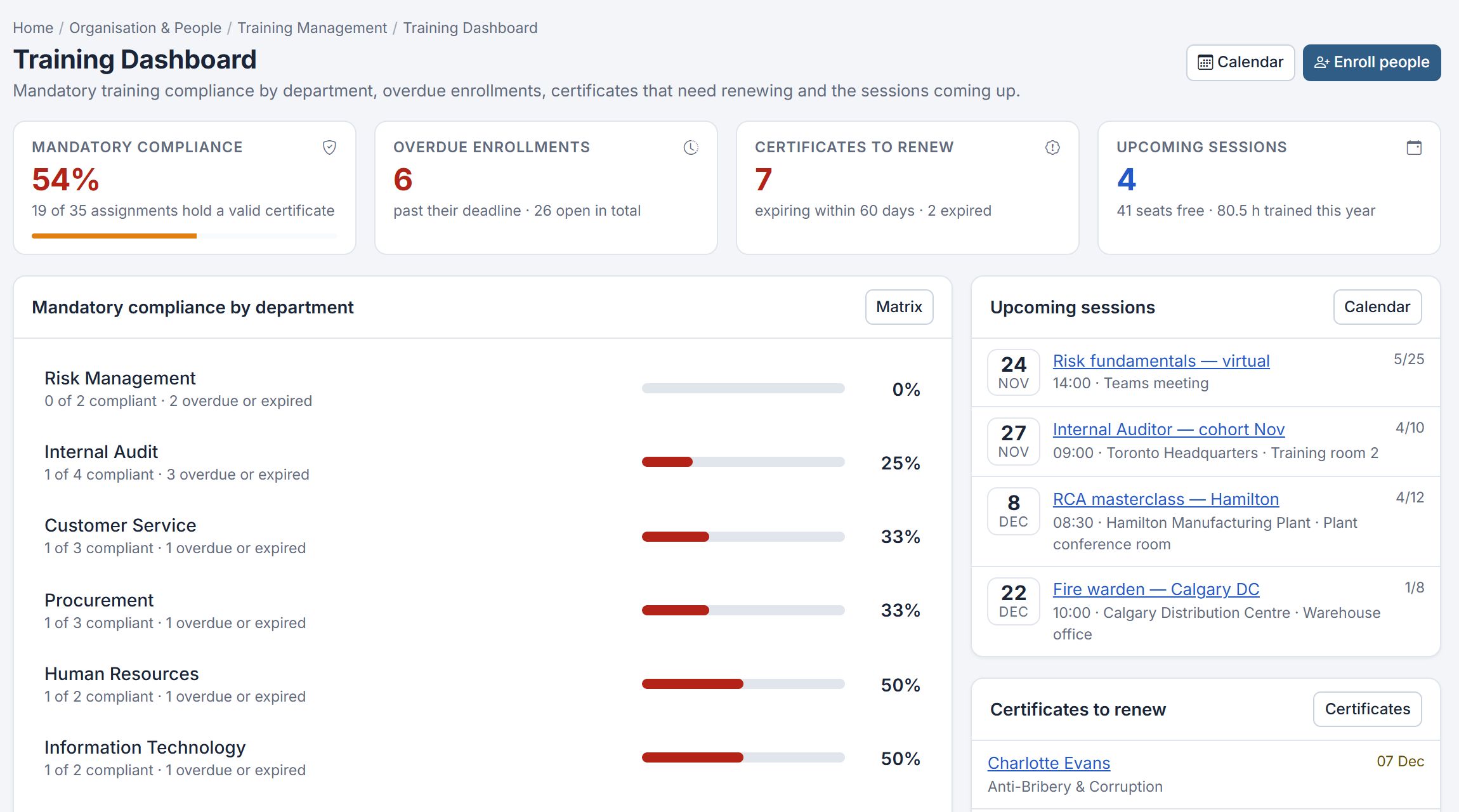
Certora Training Management records attendance and scores on each enrolment, and training assessments capture results against a pass mark. Certificates are issued only on successful completion, with expiry and renewal tracked.
Training and competency reports show compliance by department and the competencies held across the organisation, and the training matrix highlights where action is needed. See keeping mandatory training current for the matrix itself.