Supplier evaluation under ISO 9001 should follow the risk each supplier brings.
How to meet ISO 9001 clause 8.4 with supplier evaluation criteria, selection, performance monitoring and re-evaluation proportionate to supplier criticality.
The principle
Evaluating every supplier the same way spends effort where it matters least.
Many organisations meet ISO 9001’s supplier requirements with an approved supplier list and an annual questionnaire sent to everyone. It is easy to administer and hard to defend, because it treats the supplier of office stationery like the supplier of a critical component.
The standard actually asks for something more targeted: controls proportionate to the impact each supplier has on your ability to meet customer and regulatory requirements. Getting that proportionality right reduces effort on low-risk suppliers and focuses attention where a failure would really hurt.
01 · Start with context
What clause 8.4 requires.
ISO 9001 clause 8.4 covers the control of externally provided processes, products and services. The organisation must ensure they conform to requirements, determine the controls to apply, and determine and apply criteria for the evaluation, selection, monitoring of performance and re-evaluation of external providers, based on their ability to provide processes or products and services in accordance with requirements. Documented information of these activities and any necessary actions must be retained.
The type and extent of control should depend on the potential impact on your ability to consistently meet customer and applicable statutory and regulatory requirements, and on the effectiveness of the controls the supplier applies itself.
Outsourced processes count too
Clause 8.4 covers more than purchased materials. It includes outsourced processes, such as a subcontracted heat treatment or an external calibration laboratory, and services provided directly to your customers on your behalf. These often carry more risk than purchased parts, because the supplier is effectively performing part of your process.
02 · Classify by criticality
Not all suppliers are equal.
- Critical: suppliers whose failure would directly affect product conformity, safety or delivery.
- Important: suppliers with significant but manageable impact.
- Standard: low-impact suppliers of general goods and services.
Criticality drives how much due diligence, monitoring and re-evaluation each supplier receives.
Criticality should consider more than spend. A low-value supplier of a single-source component can be far more critical than a high-value supplier of commodity items available from many sources. Questions to ask include: could we switch quickly, does the supplier affect product safety, and would a failure stop production or delivery?
03 · Evaluate before you select
Due diligence in proportion.
- Define evaluation criteria: quality capability, certifications, financial stability, capacity, compliance.
- Scale the depth of due diligence with criticality, from a questionnaire to an on-site audit.
- Record the evaluation result and the approval decision.
- Note any conditions on approval, such as additional incoming inspection.
Using certification wisely
A supplier’s ISO 9001 certificate is useful evidence, but not a substitute for evaluation. Check the certificate is valid, issued by an accredited body, and that its scope covers what you are buying. For critical suppliers, combine certification with your own assessment of their process capability and performance.
04 · Monitor performance
Scorecards based on real data.
Ongoing monitoring should use objective measures where possible: on-time delivery, quality rejection rates, responsiveness to issues, and SLA performance under the contract. Regular scoring makes deteriorating performance visible early.
Supplier performance is also a required input to management review under clause 9.3.2.
Sharing scorecards with suppliers improves results. Many supplier problems persist simply because nobody told the supplier how they were performing against expectations. A quarterly scorecard review with critical suppliers turns monitoring into improvement.
05 · Re-evaluate on schedule
And after significant events.
Re-evaluation confirms a supplier remains suitable. Critical suppliers may be reassessed annually; standard suppliers less often. Events such as a major quality failure, a change of ownership or a missed delivery should trigger reassessment regardless of schedule.
The outcome of re-evaluation can be continued approval, approval with conditions, a supplier development plan, or removal from the approved list. Each outcome should be recorded with the reason.
Common pitfalls
- One questionnaire for all: the same evaluation for every supplier regardless of risk.
- Approved forever: suppliers approved years ago and never re-evaluated.
- Spend-based criticality: critical single-source suppliers overlooked because their spend is small.
- Monitoring without feedback: scores collected but never shared with suppliers or acted on.
06 · Certora third-party risk management
Due diligence proportionate to criticality.
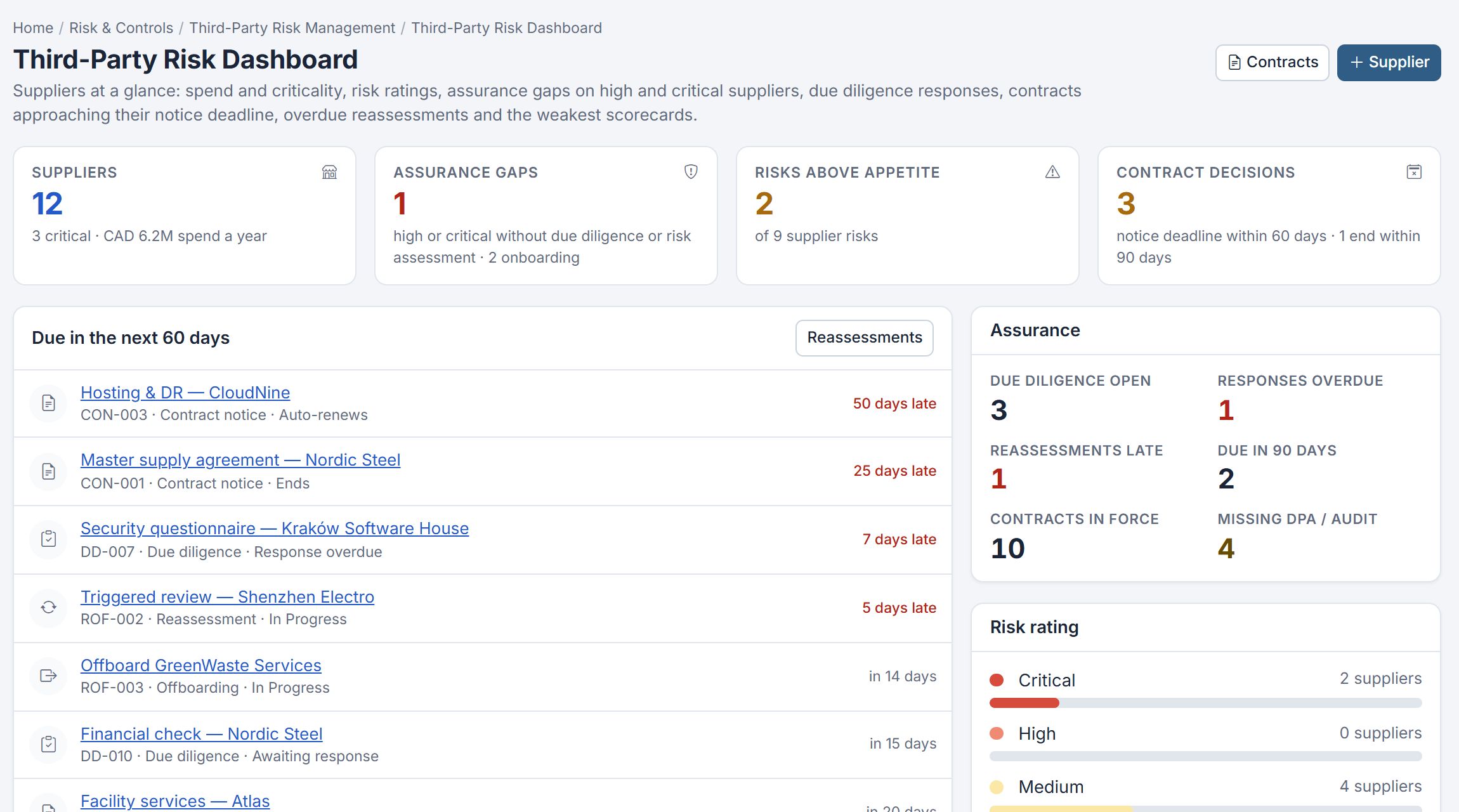
Certora Third-Party Risk Management onboards suppliers with due diligence and risk assessment in proportion to their criticality, manages contracts and SLAs, and scores supplier performance. Suppliers are reassessed on schedule or after events, and the supplier register shows criticality, status and upcoming reassessments.
Supplier nonconformities can be raised in Certora Nonconformity & CAPA, and supplier performance flows into management review. Read third-party risk from onboarding to offboarding for how the full supplier lifecycle is managed.