A delegation of authority matrix keeps every approval within limits.
How to design and maintain a delegation of authority matrix: decision types, limits by role, sub-delegation, review cycles and evidence for auditors.
The principle
Authority that is not written down is exercised by whoever is available.
Most organisations have approval limits somewhere: in a board resolution, a finance policy, a spreadsheet maintained by one person. When an auditor asks who could approve a contract of a given value last March, the answer is often harder to find than it should be.
Unclear authority causes problems in both directions. Decisions get made by people who should not make them, creating risk. And decisions wait because nobody is sure who can make them, creating delay. A well-maintained delegation of authority solves both, and gives auditors a clear standard to test approvals against.
01 · Start with context
Why delegated authority matters.
A delegation of authority (DoA) defines who can make which decisions, up to what limit, on behalf of the organisation. It supports governance, internal control and segregation of duties, and it is a direct way to meet the expectation in ISO management system standards, such as ISO 9001 clause 5.3, that authorities for relevant roles are assigned, communicated and understood.
Corporate governance frameworks place similar emphasis on clear delegation. The board retains certain decisions and delegates the rest through a documented framework, so that authority flows from the top in a controlled way.
Delegation is not abdication
Delegating authority does not remove accountability. The person who delegates remains accountable for ensuring the delegate is competent and that the delegation is used appropriately. A DoA framework should make clear that responsibility and authority travel together.
02 · Define the decision types
Start from what needs approving.
- Capital and operating expenditure.
- Contracts and commitments with customers and suppliers.
- Hiring, remuneration and organisational changes.
- Write-offs, discounts and credit limits.
- Policy approvals and exceptions.
Each decision type can have different limits and different approval chains.
Non-financial decisions belong in the matrix too. Who can approve a new supplier for critical materials? Who can accept a risk above appetite? Who can release product under concession? Who can approve a change to a safety-critical procedure? These decisions often matter more to quality and compliance than monetary limits do.
03 · Set limits by role
Positions, not personalities.
- Assign limits to positions, such as department head, finance director or chief executive.
- Set monetary or qualitative thresholds for each decision type.
- Define when dual approval or committee approval is required.
- Record any decisions reserved for the board.
Linking limits to positions means the matrix stays valid when people change.
Avoiding common design flaws
Watch for limits that can be bypassed by splitting transactions, for example two purchase orders of $9,000 to stay below a $10,000 threshold. Rules on aggregation, and periodic analysis of approvals just below limits, help detect this. Also check that the matrix supports segregation of duties: the person who requests a payment should not be the one who approves it.
04 · Control sub-delegation
Temporary authority with an end date.
People go on leave, and authority sometimes needs to be delegated temporarily. Sub-delegation should be recorded with the delegate, the scope, the limits and an end date, and it should never exceed the delegator’s own authority.
Without a recorded end date, temporary delegations tend to become permanent by default. A system that lets delegations expire automatically, and shows who currently holds delegated authority, prevents that drift.
05 · Review and evidence
Keep the matrix current and provable.
A DoA should be reviewed at least annually and whenever the organisation changes. Each version should be approved and kept, so you can show which limits applied at any point in time.
Comparing actual approvals against the matrix, for example as part of internal control testing, shows whether the DoA is followed in practice.
Common pitfalls
- Matrix nobody can find: limits buried in an old board pack, unknown to the people approving transactions.
- Named individuals: authority granted to people rather than positions, broken every time someone leaves.
- Open-ended delegations: temporary authority with no end date that quietly becomes permanent.
- No version history: nobody can prove which limits applied when a past decision was made.
06 · Certora governance & internal controls
Delegated authority in the control system.
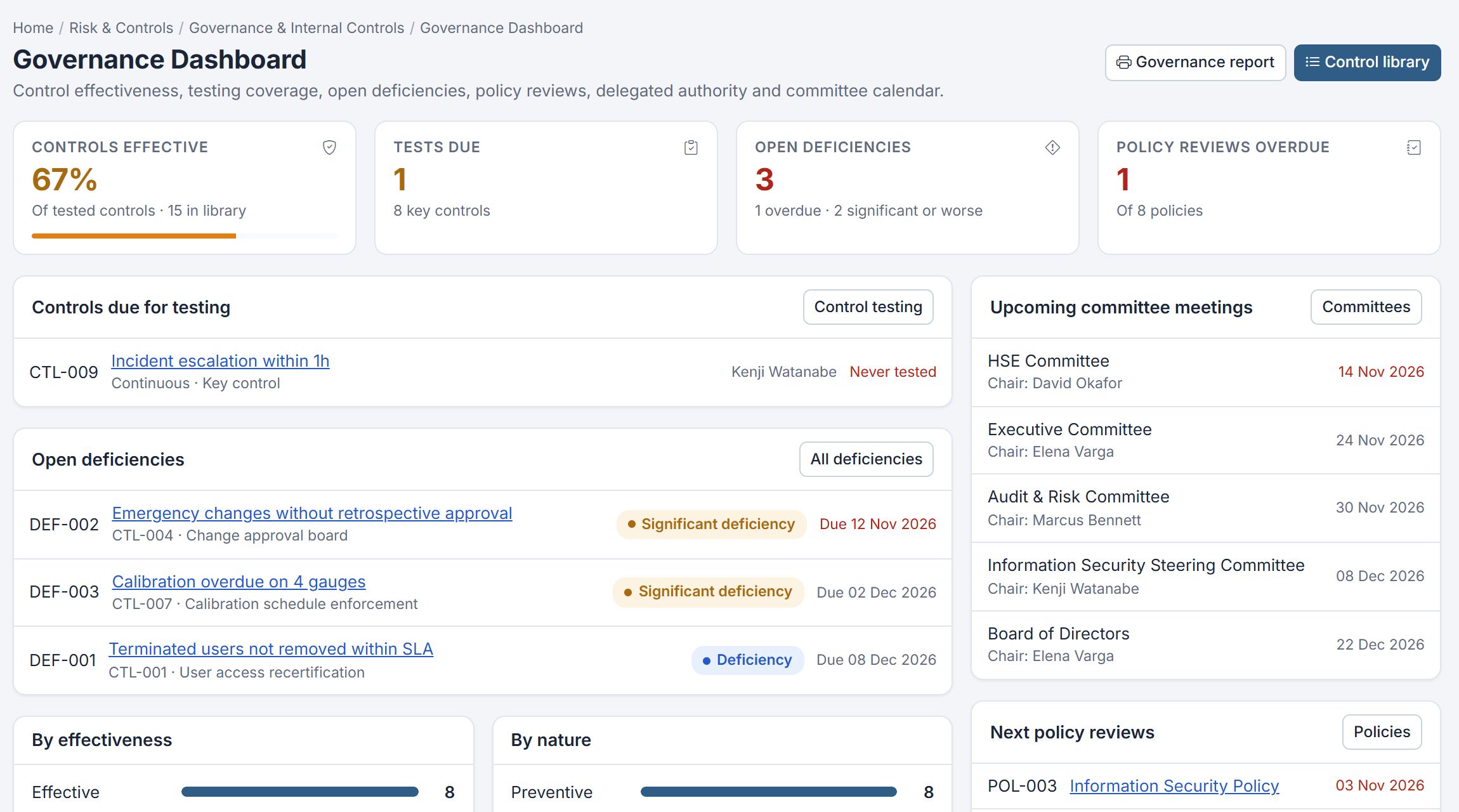
Certora Governance & Internal Controls manages delegated authority alongside policies, the control library, control testing and governance committees. Authority is defined against positions from Organisation Management, so it reflects the current structure as people join, move and leave.
Controls over approvals can be tested for design and operating effectiveness, with deficiencies tracked to verified remediation, and governance committees are recorded with their terms of reference and meetings. See testing internal controls for the testing approach.