Inherent, residual and appetite: a risk register leadership can act on.
How to score inherent and residual risk, define risk appetite, use a heatmap and record risk acceptance so the register supports real decisions.
The principle
A risk score only means something when it is compared with what the organisation is willing to accept.
A risk register can list dozens of carefully scored risks and still leave leadership unsure what to do. The missing piece is usually not more analysis. It is a clear link between the scores and the organisation’s appetite for risk.
Without that link, every high score looks equally urgent, and every discussion of risk becomes a debate about whether a risk is "really" a 16 or a 12. With it, the register becomes a decision tool: a short list of risks above what the organisation is willing to carry, each with a plan and an owner.
01 · Start with context
Three numbers that tell a story.
A well-structured register records three positions for each risk.
- Inherent risk: the level of risk before any controls, showing how serious the exposure is.
- Residual risk: the level of risk with current controls working as intended.
- Target risk: the level the organisation wants to reach after planned treatments.
The gap between residual and target is what treatment plans exist to close.
Why inherent risk still matters
Some organisations skip inherent risk as theoretical. It is worth keeping. A risk with a high inherent score and a low residual score is one where the organisation depends heavily on its controls. If those controls fail, exposure jumps. Inherent ratings show which controls are critical and therefore deserve the most frequent testing.
02 · Define appetite
Say how much risk is acceptable.
Risk appetite is the amount and type of risk the organisation is willing to pursue or retain in pursuit of its objectives. Without it, every high score looks equally urgent.
- Set an appetite threshold on the scoring matrix, for example any residual score of 15 or above.
- Vary it by category if needed: appetite for safety or compliance risk is usually lower than for commercial risk.
- Approve the appetite at leadership level and review it periodically.
Risks above appetite then become a clear, short list for attention.
Appetite and tolerance
Appetite is usually expressed as a broad statement and a matrix threshold. Tolerance translates it into measurable limits for specific indicators, such as "no more than 2% of deliveries late" or "zero unplanned outages of the ERP longer than four hours". Tolerances connect naturally to key risk indicators and KPIs.
03 · Visualise the position
Heatmaps for inherent and residual risk.
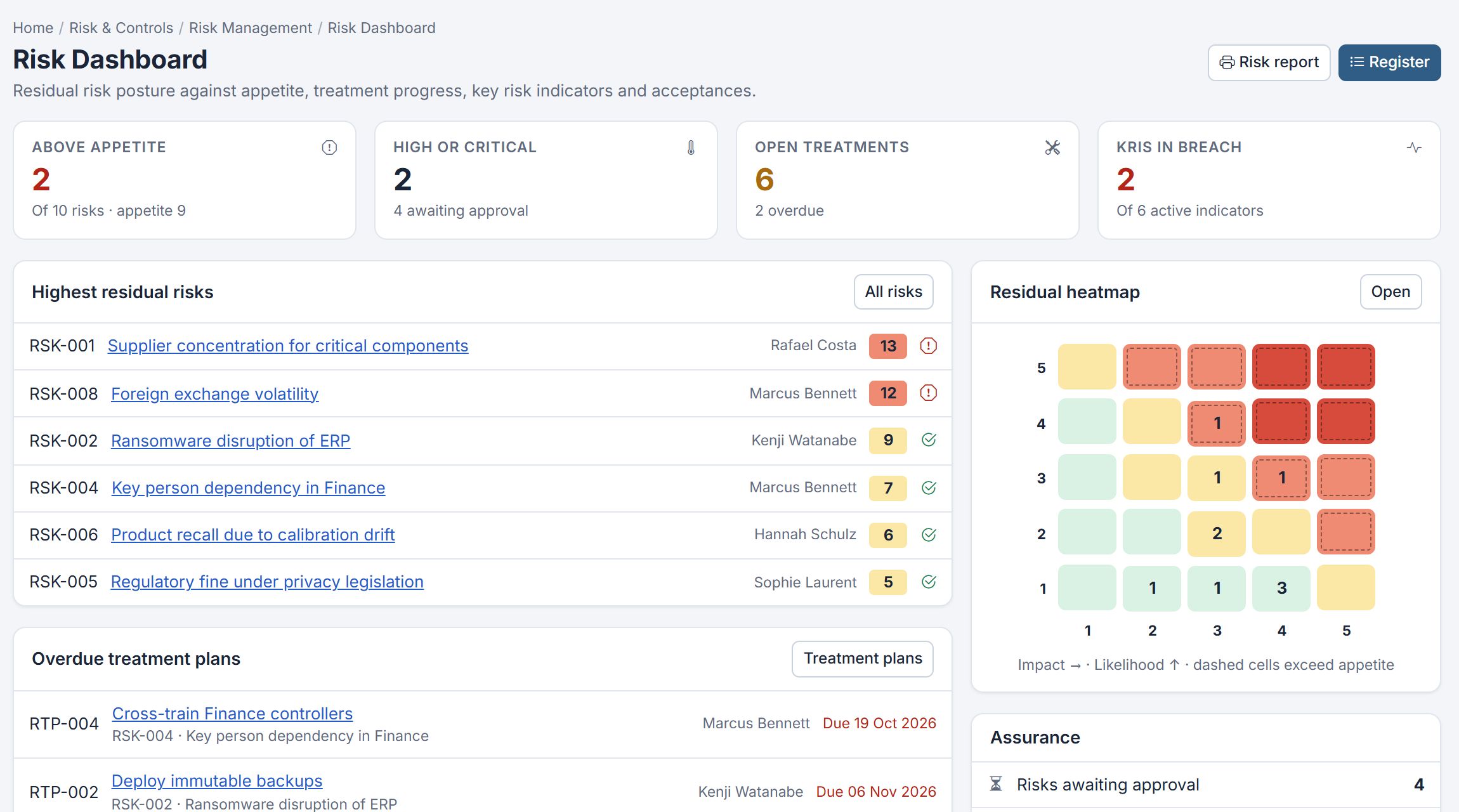
A five-by-five heatmap places each risk by likelihood and impact. Comparing the inherent and residual heatmaps shows how much controls are reducing exposure, and cells above appetite can be marked so they stand out.
Heatmaps are most useful when they lead back to the underlying risks. A cell with three risks should let you see which three, who owns them and what is being done.
Filtering heatmaps by department, category or owner also helps. A board wants the enterprise view; a department head wants to see only their risks; a risk committee may want to see only compliance risks. One register, viewed several ways, serves all of them.
04 · Accept deliberately
Some risks are retained on purpose.
Not every risk can or should be reduced below appetite. Sometimes the cost of treatment is too high, or the risk is part of a strategic choice. In those cases, acceptance should be a recorded decision.
- Who accepted the risk, and with what authority.
- The rationale and any conditions.
- An expiry or review date for the acceptance.
Recorded acceptance protects both the organisation and the people making the decision.
Acceptance authority should scale with the risk. A residual score just above appetite might be accepted by a director; one far above it might need the executive committee or the board. Defining this in advance prevents high risks being quietly accepted at too low a level.
05 · Monitor with indicators
Key risk indicators give early warning.
Key risk indicators (KRIs) track measurable signals that a risk is moving: supplier delivery performance, staff turnover in a critical team, or system downtime. Thresholds on each KRI trigger review before the risk materialises.
Combined with scheduled risk reviews, KRIs keep the register current between formal assessments.
Common pitfalls
- No appetite statement: scores with no threshold, so nobody knows which risks need action.
- Score inflation: every risk rated high to attract attention, which makes the register meaningless.
- Silent acceptance: risks above appetite left untreated with no recorded decision.
- Static ratings: scores unchanged for years despite new controls, incidents or business changes.
06 · Certora risk management
Scores, appetite and acceptance, all traceable.
Certora Risk Management scores each risk for inherent and residual position on a likelihood and impact matrix, with appetite thresholds marked on the inherent and residual heatmaps. Treatment plans close the gap to target, KRI monitoring gives early warning, and risk acceptances are recorded with their rationale.
Every rating change and decision is kept in the risk’s history, so leadership can see why a score moved, and the risk dashboard shows risks above appetite at a glance. Read risk-based thinking in ISO 9001 for how this connects to clause 6.1.