A skills gap analysis is only finished when the gaps close.
How to run a skills gap analysis that leads to action: role requirements, assessments, prioritised development plans and follow-up that closes the gaps.
The principle
Identifying a gap is the cheap part. The value is in closing the ones that matter most.
Skills gap analyses are often run once, produce a large spreadsheet, and then sit untouched. The analysis was accurate. What was missing was prioritisation and follow-through.
The organisations that get value from gap analysis treat it as a cycle rather than a project: define requirements, assess, prioritise, develop, reassess. Each cycle closes the gaps that matter most and reveals the next set, so capability improves steadily rather than in occasional bursts before audits.
01 · Start with context
Why gaps matter to the management system.
Gaps between what a role requires and what a person can do affect quality, safety and compliance directly. ISO 9001 clause 7.2 expects organisations to take action to acquire the necessary competence where gaps exist, and to evaluate whether those actions worked. ISO 45001 and ISO/IEC 27001 carry the same expectation for safety-critical and security roles.
A gap analysis is the structured way to find where action is needed.
Gaps beyond the individual
Gap analysis also reveals organisational weaknesses. If only one person in the company can perform a critical calibration, that is a gap even if that person is fully competent. Key-person dependency is a risk worth recording in the risk register, with succession or cross-training as the treatment.
02 · Set the baseline
Requirements by role, assessments by person.
The analysis depends on two inputs.
- Role requirements: the competencies and levels each position needs.
- Current assessments: each person’s assessed level against those competencies.
Where requirements are missing or vague, the analysis will be too. Investing in clear role definitions pays off across every future assessment.
Who assesses
Self-assessment is quick but tends towards optimism. Manager assessment is more reliable but can miss technical detail. Assessment by a qualified peer or subject expert is strongest for technical competencies. Many organisations combine self-assessment with manager review, and use expert assessment for critical skills.
03 · Prioritise the gaps
Not every gap is equally urgent.
A long list of gaps needs ranking before anyone acts on it.
- Criticality: gaps in safety-critical or quality-critical competencies first.
- Exposure: how many people share the gap, and in which teams.
- Dependency: roles where only one person holds a key skill.
- Timing: upcoming changes, audits or projects that need the skill.
This turns a spreadsheet into a short, defensible development priority list.
Budgets are finite, so prioritisation also determines where training money is spent. Showing management the ranked list, with the risk each gap carries, makes the case for investment far more effectively than a general request for a training budget.
04 · Plan development
Match the action to the gap.
Development plans should combine methods: formal training for knowledge, on-the-job coaching for skills, job rotation to spread critical expertise, and certification programmes where qualifications are required. Each plan needs an owner, a timeframe and a way of checking progress.
The 70-20-10 idea
A widely used rule of thumb suggests most learning at work comes from experience, a smaller share from learning through others, and the smallest share from formal courses. The exact proportions are debated, but the point is useful: development plans that rely only on courses miss the methods that build practical skill fastest.
05 · Reassess and report
Close the loop.
After development actions are complete, reassess the person against the requirement. A closed gap is one where the assessed level now meets the role, not one where a course was booked.
Reporting gaps by department, competency and trend gives leadership a view of workforce capability and the resources needed, a natural input to management review.
Common pitfalls
- Analysis without action: a detailed gap report that never becomes development plans.
- Everything is a priority: hundreds of gaps addressed equally, so none is closed properly.
- Courses as closure: gaps marked closed when training is booked, not when competence is shown.
- Ignoring key-person risk: critical skills held by one person with no succession plan.
06 · Certora human capital management
From role requirements to closed gaps.
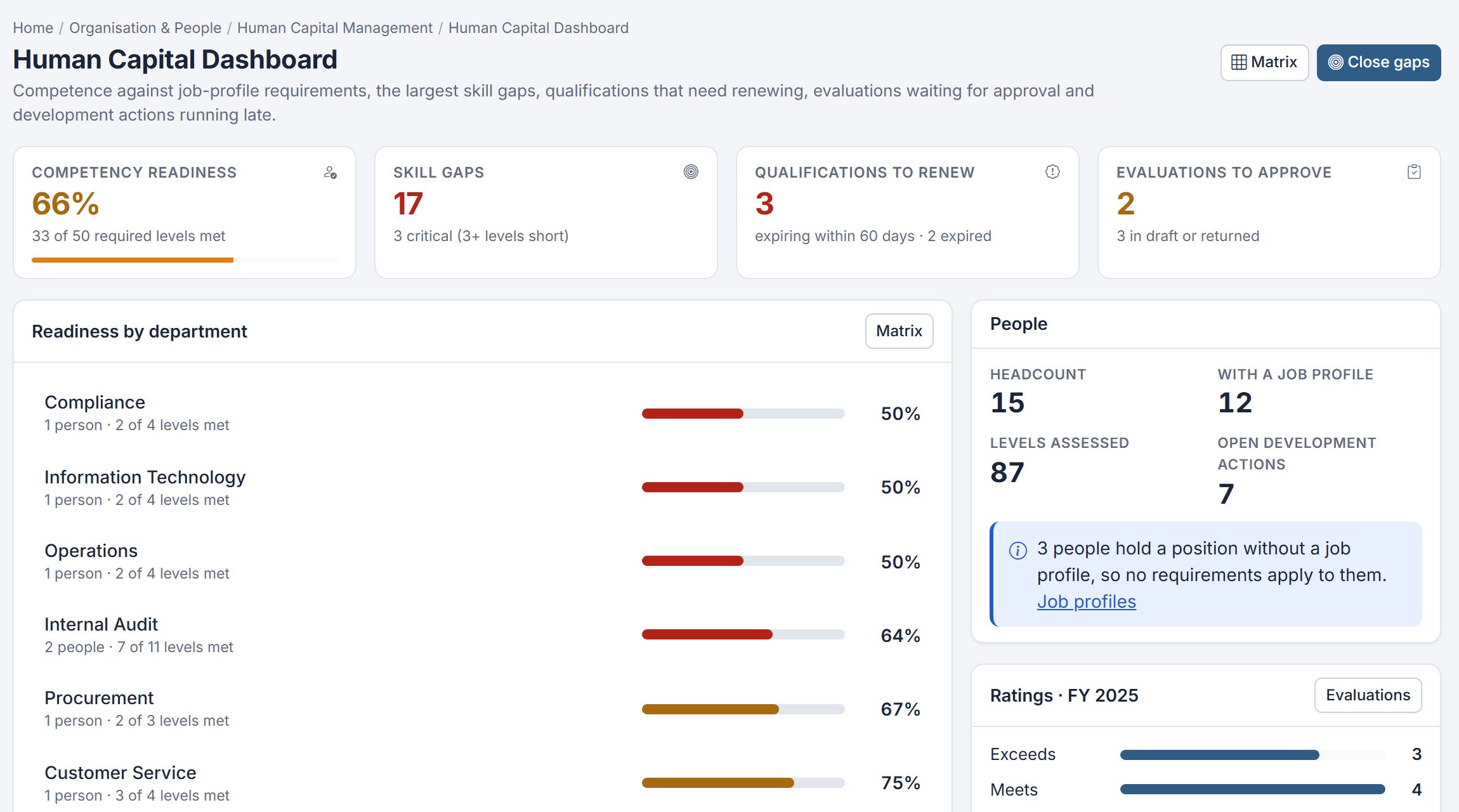
Certora Human Capital Management defines what every role needs, assesses people against it, and closes skill gaps through training and development. Gaps are visible by person and department, and development actions are tracked through to reassessment.
Qualifications and performance evaluations are kept current alongside, and training actions connect to Certora Training Management, so competence evidence stays complete. See competence under ISO 9001 for how role requirements are defined.