Competence under ISO 9001 is defined by the role, then proven for the person.
How to define competence requirements by role, assess people against them and keep the evidence ISO 9001 clause 7.2 asks for, beyond training certificates.
The principle
You cannot show someone is competent until you have written down what competent means for their role.
When an auditor asks how you know a person is competent, the weakest answer is a folder of certificates. Certificates show training happened. Competence is about whether the person meets the requirements of their role, and that starts with defining the role.
This is one of the areas where quality systems most often look complete on paper and thin in practice. Training records exist, but there is no statement of what each role actually requires, so nobody can say whether the training was the right training, or whether anything is missing.
01 · Start with context
What clause 7.2 asks for.
ISO 9001 clause 7.2 asks the organisation to:
- Determine the necessary competence of people doing work under its control that affects the performance and effectiveness of the quality management system.
- Ensure these people are competent on the basis of appropriate education, training or experience.
- Where applicable, take actions to acquire the necessary competence, and evaluate the effectiveness of the actions taken.
- Retain appropriate documented information as evidence of competence.
Training is one route. Education, experience, mentoring and qualifications are others, and the evidence should reflect all of them. The standard’s notes give examples of actions, including providing training, mentoring, reassigning people, or hiring or contracting competent people.
"Work under its control"
The phrase covers more than employees. Contractors, temporary staff and agency workers doing work that affects quality are within scope. Their competence must be determined and evidenced too, which is often overlooked when the focus is on the permanent workforce.
02 · Define the role
Competence requirements belong to positions.
Each role should state the competencies it needs and the level required.
- Technical skills: for example, reading engineering drawings or operating a CMM.
- Knowledge: product standards, regulations, internal procedures.
- Qualifications: licences or certifications the role legally requires.
- Behavioural skills: communication, leadership, problem solving.
A competency framework that is reused across roles keeps definitions consistent and makes comparisons possible.
Levels make requirements testable
A requirement such as "knowledge of statistical process control" is hard to assess. Defining levels, for example aware, practitioner, expert, with a description of what each looks like in practice, turns it into something a manager can judge. A quality technician might need practitioner level; a quality engineer might need expert.
03 · Assess the person
Compare actual capability with requirements.
- Assess each person against the competencies their role requires.
- Record the current level and the evidence for it.
- Identify gaps where the current level is below what is required.
- Agree how each gap will be closed and by when.
Assessments should be repeated when people change roles, when requirements change, and at regular intervals.
Evidence for an assessment can include qualifications, training records, observed work, sign-off by a qualified assessor, work samples or performance reviews. The strongest evidence usually combines more than one source: a certificate plus an observed demonstration, for example.
04 · Close the gaps
Training is one option among several.
The right action depends on the gap. A knowledge gap may be closed with a course. A skill gap may need supervised practice or mentoring. A qualification gap needs a formal programme. Each action should be tracked to completion and its effectiveness evaluated.
Interim controls matter while gaps are being closed. A person who is not yet fully competent for a task may be able to perform it under supervision, or with an additional check by a competent colleague. Recording these arrangements shows the organisation manages the risk rather than ignoring it.
05 · Keep evidence current
Qualifications and evaluations expire.
Competence is not permanent. Licences expire, skills fade and roles evolve. Keeping qualifications with their expiry dates, and performance evaluations on a regular cycle, keeps the evidence current rather than historic.
Common pitfalls
- Certificates without requirements: training records with no definition of what the role needs.
- Contractors forgotten: competence evidenced for employees but not for contractors doing the same work.
- One-off assessments: people assessed at hiring and never again, despite role changes.
- Training as the only answer: every gap closed with a course, even when mentoring or practice would work better.
06 · Certora human capital management
Role requirements, assessments and evidence.
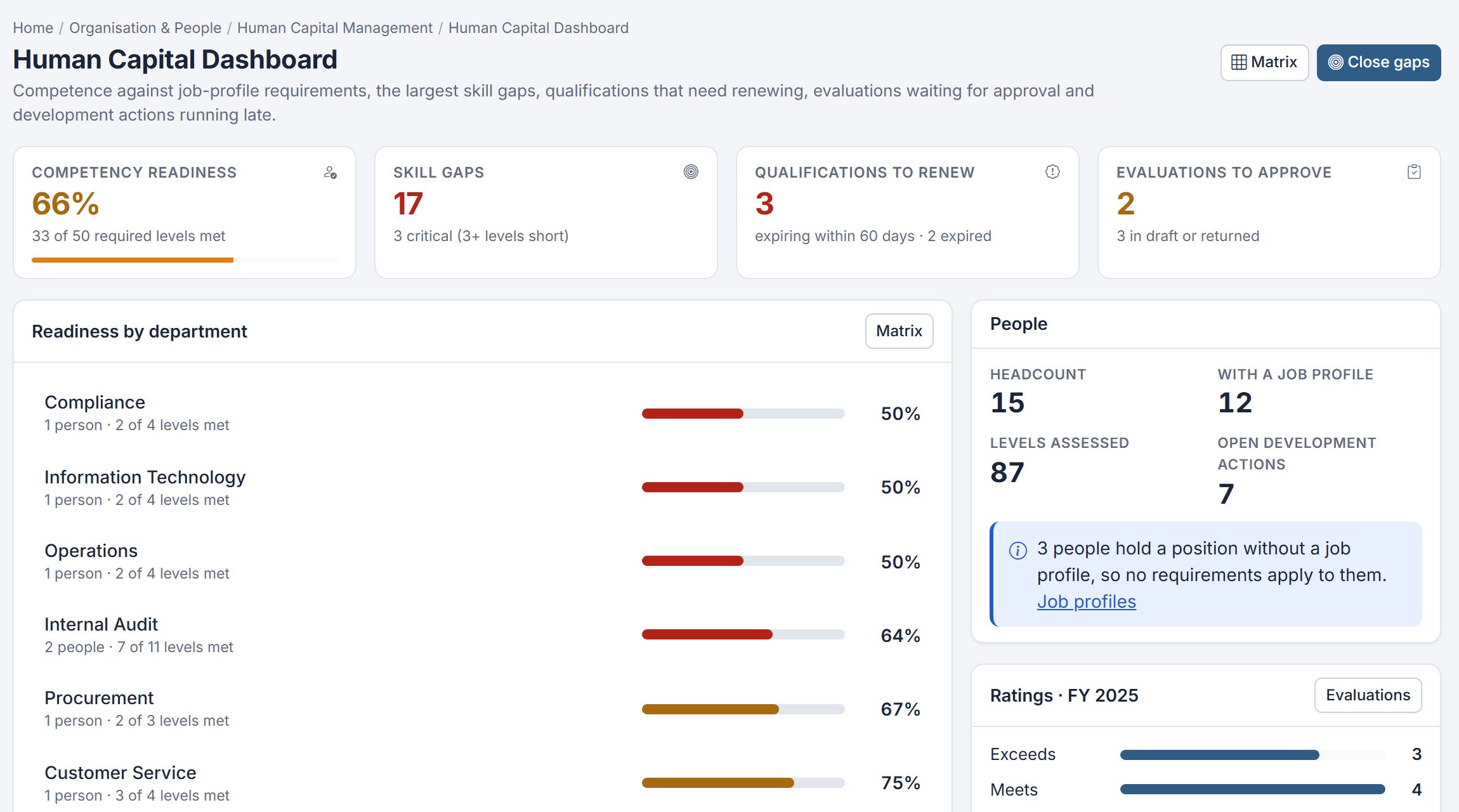
Certora Human Capital Management defines what every role needs, assesses people against it, and closes skill gaps through training and development. Qualifications and performance evaluations are kept current, giving the evidence of competence the ISO standards ask for.
Training plans and courses connect to Certora Training Management, so actions to close gaps are tracked in one place, and the human capital dashboard shows gaps and expiring qualifications. Read running a skills gap analysis for the assessment process in more detail.