Self-assessments become reliable when answers need evidence and a second opinion.
How to make self-assessments reliable: evidence-based answers, independent validation, clear scoring rules and an audit trail from answer to score.
The principle
People are rarely dishonest in self-assessments. They are optimistic. Evidence and validation correct for optimism.
Self-assessments are efficient: the people closest to the work answer the questions. Their weakness is equally clear. Without evidence and review, scores drift upward, and leadership ends up with a confident picture that does not match reality.
The aim is not to distrust respondents. Most people answer honestly; they simply see their own area through the lens of intention and effort rather than evidence. A self-assessment process that asks for evidence and adds independent validation keeps the efficiency of self-assessment while correcting for that natural optimism.
01 · Start with context
Where self-assessments fit.
Self-assessments are widely used for maturity models, control self-assessment, readiness reviews and compliance checks. They complement, rather than replace, independent audit. Used well, they extend coverage between audits and build ownership in the business.
In a "three lines" model, self-assessment by the business sits in the first line, validation by a quality, risk or compliance function in the second, and internal audit in the third. Each line adds a different kind of assurance.
When self-assessment works best
Self-assessment is most reliable where practices are observable and evidence exists naturally, such as whether documents are reviewed on schedule or whether supplier scorecards are produced. It is least reliable for judgements about effectiveness, culture or capability, where independent assessment adds more value.
02 · Require evidence
Every answer should point to something real.
- A document, record or report that supports the answer.
- A description of how the practice works in reality.
- The date the evidence was produced.
Evidence requirements change how people answer. "We always review supplier performance" becomes "here is the last quarterly scorecard."
Proportionate evidence
Not every question needs heavy evidence. Low-risk questions might accept a short description; high-risk or high-scoring answers might require a document or record. A simple rule, such as "any answer at level 4 or above must attach evidence", focuses effort where optimism is most likely and most consequential.
03 · Validate independently
A second person checks the answer.
- A validator reviews each answer and its evidence.
- The validator accepts the answer, adjusts the score or asks for more evidence.
- Disagreements are discussed and the final position recorded.
- Validation results are kept alongside the original answer.
Validators can come from quality, internal audit or a peer department.
Peer validation, where departments validate each other, has a useful side effect: it spreads good practice. A validator who sees how another department evidences supplier reviews often takes the idea back to their own team.
04 · Score consistently
Rules, not judgement on the day.
Scoring rules should be defined before the assessment: how each answer maps to a maturity level, how domain scores are calculated, and how unanswered questions are treated. Consistent rules make results comparable across departments and over time.
Weighting questions
Some questions matter more than others. Weighting allows critical practices, such as those affecting product safety or legal compliance, to count more towards a domain score. Weights should be agreed in advance and kept stable between assessment cycles, otherwise apparent improvement may simply reflect a change in weighting.
05 · Keep the audit trail
From answer to score.
Leadership and auditors may want to know why a domain scored as it did. An audit trail from each answer, through evidence and validation, to the final score makes the result defensible and shows where improvement is needed.
The trail also supports learning across cycles. Comparing this year’s answers and evidence with last year’s shows not just whether scores changed, but what actually changed in practice.
Common pitfalls
- Answers without evidence: confident scores supported by nothing.
- Rubber-stamp validation: validators approving everything to finish quickly.
- Changing rules: scoring methods altered between cycles, making trends meaningless.
- Lost history: previous answers overwritten, so improvement cannot be traced.
06 · Certora business assessment
Evidence-based answers, validated independently.
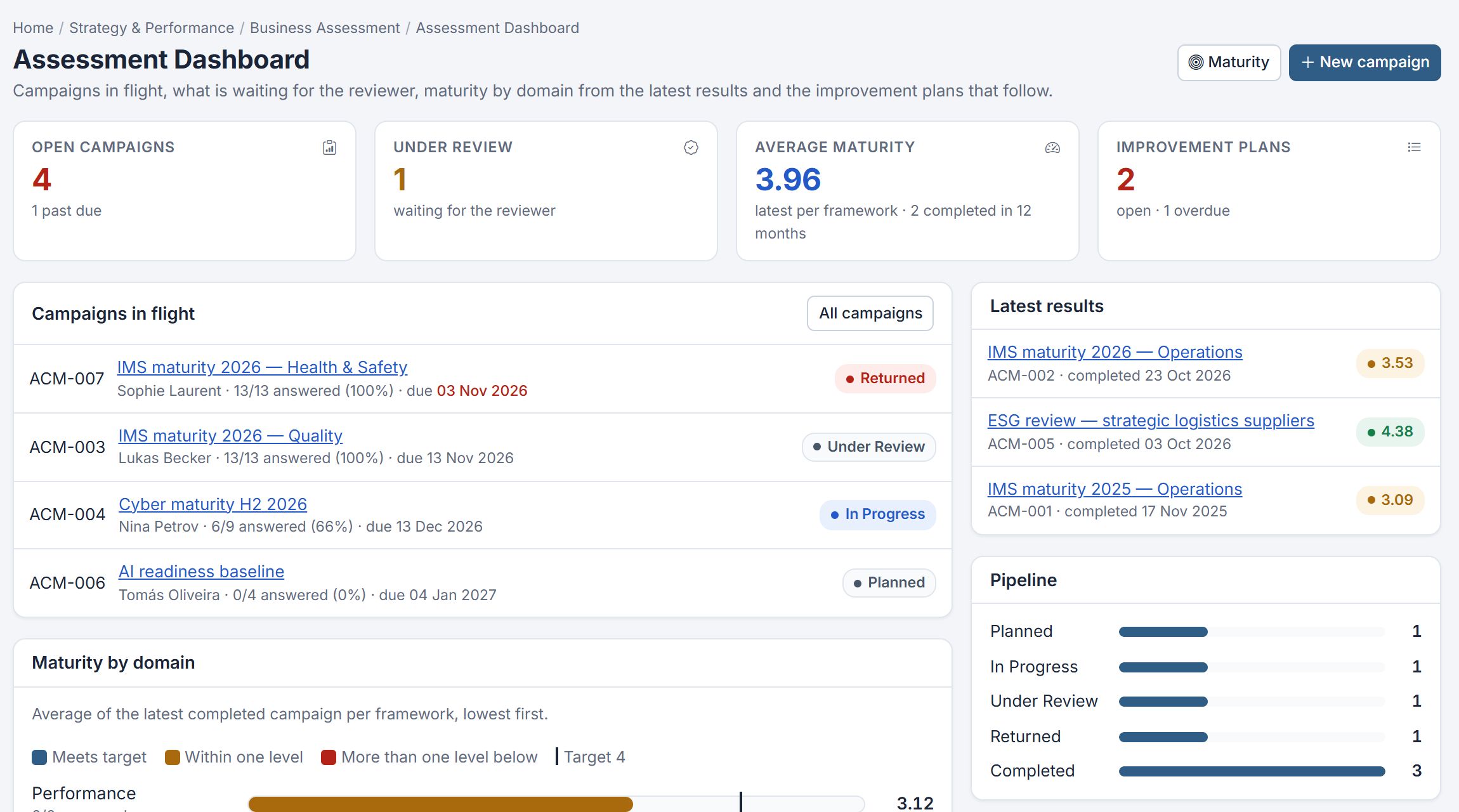
Certora Business Assessment runs assessment campaigns per department, with answers supported by evidence and validated independently. Maturity is scored by domain, gaps are analysed against target, and improvement plans are tracked.
Every answer keeps its evidence and validation history, so results can be explained and compared across cycles. See maturity assessments that drive an improvement plan for the overall approach.