Balanced scorecard and OKRs: connecting strategy to quarterly execution.
How to combine a balanced scorecard for multi-year strategy with OKRs for quarterly execution, using weighted objectives, strategy maps and initiatives.
The principle
The balanced scorecard says where you are going. OKRs say what you will move this quarter to get there.
Strategy often fails in the gap between the annual plan and the work people do each week. The balanced scorecard and OKRs are sometimes presented as alternatives. Used together, they cover both ends of that gap.
The balanced scorecard answers the long-term question: what does success look like across the whole organisation over the next few years? OKRs answer the short-term question: what will we move this quarter to get there? Organisations that use only the first tend to have plans that drift; those that use only the second tend to have busy quarters without clear direction.
01 · Start with context
Two tools, two time horizons.
The balanced scorecard, developed by Robert Kaplan and David Norton in the early 1990s, organises strategy into perspectives, commonly financial, customer, internal process, and learning and growth, with objectives and measures in each. It suits multi-year direction and balances financial results with the drivers of future performance.
Objectives and key results (OKRs), popularised in the technology industry, set a small number of ambitious objectives for a short period, usually a quarter, each with measurable key results. They suit focused execution and frequent adjustment.
Connecting to ISO 9001
For organisations with a quality management system, quality objectives under clause 6.2 fit naturally into this structure. Customer and internal process objectives on the scorecard often are quality objectives, and quarterly OKRs provide the regular monitoring the standard asks for.
02 · Build the scorecard
Weighted objectives across perspectives.
- Define a handful of strategic objectives per perspective.
- Weight objectives by importance so the overall score reflects priorities.
- Assign each objective an owner and one or more measures.
- Link measures to KPIs where possible.
Choosing perspectives
The four classic perspectives work for many organisations, but they are not fixed. Some add a sustainability or people perspective; public sector organisations often place stakeholder outcomes at the top instead of financial results. The perspectives should reflect what the organisation genuinely needs to balance.
03 · Map cause and effect
Show how objectives connect.
- Learning and growth objectives build capability.
- Capability improves internal processes.
- Better processes improve customer outcomes.
- Customer outcomes drive financial results.
A strategy map makes these links explicit and helps explain why a capability investment matters.
Strategy maps are also a test of the strategy itself. If an objective has no plausible link to anything above it, it may not belong in the strategy. If a financial objective has no supporting customer or process objectives, the plan for achieving it is missing.
04 · Deliver through initiatives
Projects with milestones.
Strategic objectives are delivered by initiatives: projects and programmes with milestones, budgets and owners. Tracking initiatives alongside the objectives they support shows whether effort is aimed at what matters.
It also reveals imbalances. An objective with no initiatives is unlikely to move. An initiative linked to no objective is consuming resources without a strategic reason. Reviewing the portfolio of initiatives against the scorecard, at least annually, keeps investment aligned.
05 · Steer quarterly with OKRs
Focus the next ninety days.
Each quarter, teams set OKRs that move the strategic objectives forward. Key results are measured through the quarter and scored at the end. This keeps the strategy alive between annual reviews and surfaces problems early.
Writing good OKRs
An objective should be qualitative and motivating: "Make onboarding effortless for new customers." Key results should be measurable outcomes, not tasks: "Reduce onboarding time from 30 to 15 days" and "Raise onboarding CSAT from 3.8 to 4.5", rather than "launch a new onboarding guide". Three to five key results per objective is typical, and many teams expect to achieve around 70% of an ambitious OKR.
Common pitfalls
- Scorecard as wallpaper: a strategy map produced once and never used in decisions.
- OKRs as task lists: key results that describe activities rather than outcomes.
- No link between them: quarterly OKRs that do not connect to strategic objectives.
- Too many objectives: scorecards with dozens of objectives, diluting focus.
06 · Certora strategy management
Scorecard, strategy map, initiatives and OKRs.
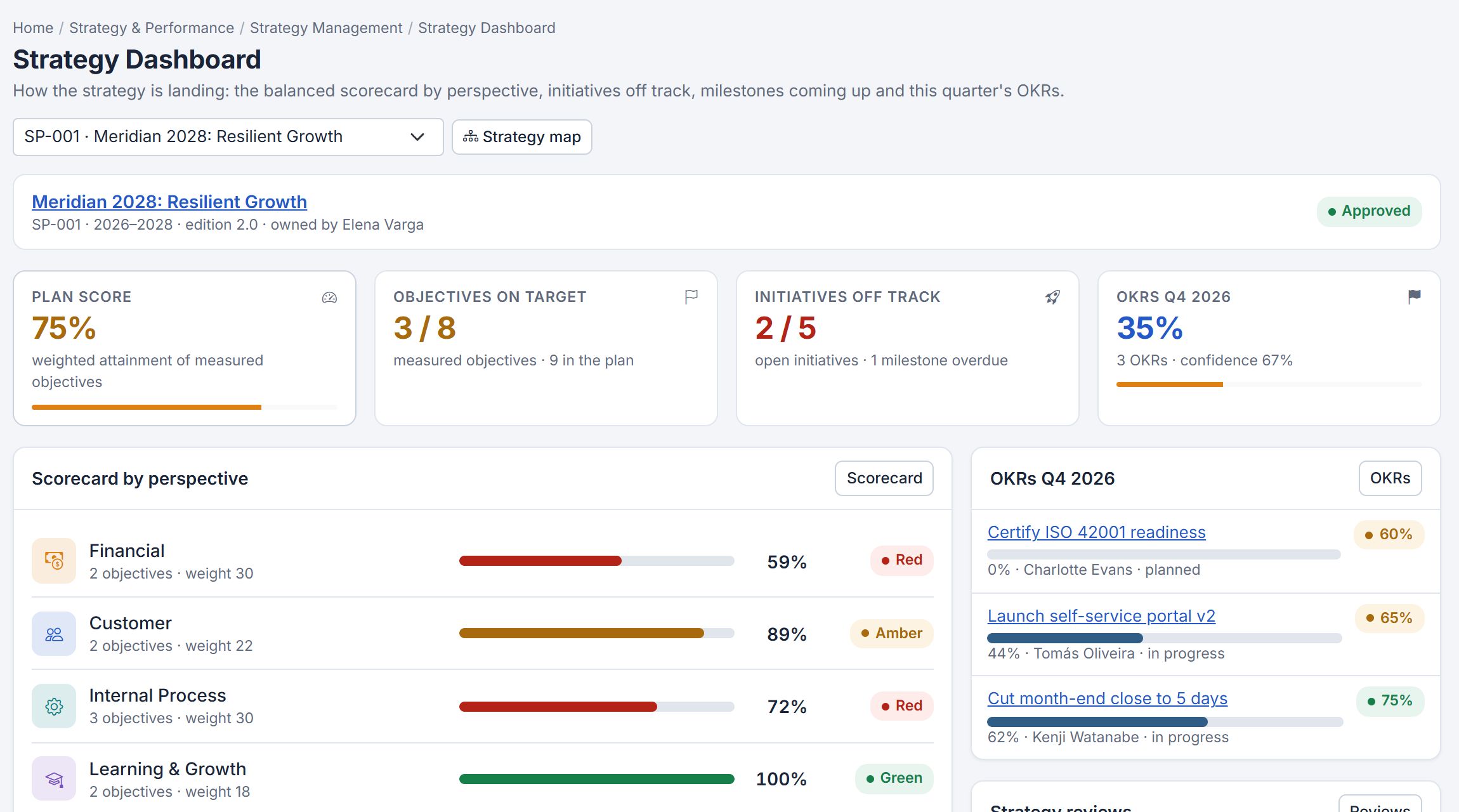
Certora Strategy Management sets multi-year strategic plans with weighted balanced-scorecard objectives, maps cause and effect, and measures results. Delivery runs through initiatives and milestones, steering happens quarterly with OKRs, and the plan is reviewed with a frozen scorecard snapshot.
See quality objectives under ISO 9001 for how objectives meet clause 6.2.