A maturity assessment is worth running only if it drives an improvement plan.
How to run a maturity assessment and gap analysis: questionnaires by domain, scoring against target maturity and improvement plans that close the gaps.
The principle
A maturity score tells you where you are. The gap to target tells you where to invest.
Maturity assessments are popular before certification projects, digital transformations and audits. Many produce an impressive radar chart and then stall. The assessment was sound; the link to a funded improvement plan was missing.
The value of a maturity assessment lies almost entirely in what happens next. A clear picture of current capability, compared with a realistic target, tells leadership where investment will make the most difference. Without that comparison and the plan that follows, the assessment is just a description.
01 · Start with context
Why assess maturity.
Maturity models describe how well a capability is established, typically on a scale from initial or ad hoc, through repeatable, defined and managed, to optimised. Assessing maturity across domains, such as risk, documentation, audit or supplier management, shows where the organisation is strong and where it is fragile.
ISO 9001 clauses 9.1 and 10.3 expect organisations to evaluate performance and continually improve. A maturity assessment is a structured way to do both, and ISO 9004, which gives guidance on achieving sustained success, includes a self-assessment tool built on the same idea.
Maturity versus compliance
Compliance asks whether a requirement is met. Maturity asks how well, how consistently and how sustainably. An organisation can be compliant with ISO 9001 at a low level of maturity, relying on a few individuals and heroic effort before each audit. Maturity assessment reveals that fragility, which a compliance audit may not.
02 · Design the questionnaire
Domains, questions and scales.
- Group questions into domains that match how the organisation works.
- Write questions that describe observable practice, not intentions.
- Use a consistent maturity scale with clear descriptions for each level.
- Ask for evidence to support each answer.
Writing good maturity questions
Weak: "Do you manage supplier risk?" Strong: "How are critical suppliers identified and reassessed?", with level descriptions ranging from "no formal identification" at level 1 to "criticality reviewed annually with data-driven reassessment and performance trends shared with suppliers" at level 5. Describing each level concretely is what makes answers consistent across respondents.
03 · Run the campaign
Department by department.
- Launch the assessment to the departments in scope.
- Respondents answer each question and attach evidence.
- Answers are reviewed and validated independently.
- Scores are calculated by domain and department.
Running campaigns by department reveals differences that an organisation-wide average hides.
A department scoring high on documentation and low on measurement tells a different story from one with the reverse profile. Department-level results also give managers ownership: they can see their own position and the gap to target, rather than an abstract corporate score.
04 · Analyse the gaps
Actual against target.
Set a target maturity for each domain based on the organisation’s needs. Not every domain needs to be optimised. The gap between actual and target, weighted by importance, shows where improvement matters most.
Setting realistic targets
Targets should reflect strategy and risk. An organisation in a regulated industry may need a high target for compliance and document control, but a moderate one for innovation management. Moving more than one level in a year is ambitious for most domains; a target that requires a three-level jump usually needs a multi-year plan.
05 · Plan and track improvement
Close the gaps that matter.
Each priority gap becomes an improvement plan with actions, owners and timelines. Reassessing after a period, typically a year, shows whether maturity has moved and whether the investment worked.
Improvement plans work best when they focus on a small number of high-priority gaps at a time. Trying to raise every domain simultaneously spreads resources thinly and usually delivers less than concentrating on two or three.
Common pitfalls
- Radar chart and stop: results presented and admired, with no improvement plan.
- Optimistic self-scoring: answers without evidence or validation, inflating maturity.
- Same target everywhere: every domain aimed at level 5, regardless of need.
- No reassessment: improvement plans delivered but maturity never measured again.
06 · Certora business assessment
From questionnaire to improvement plan.
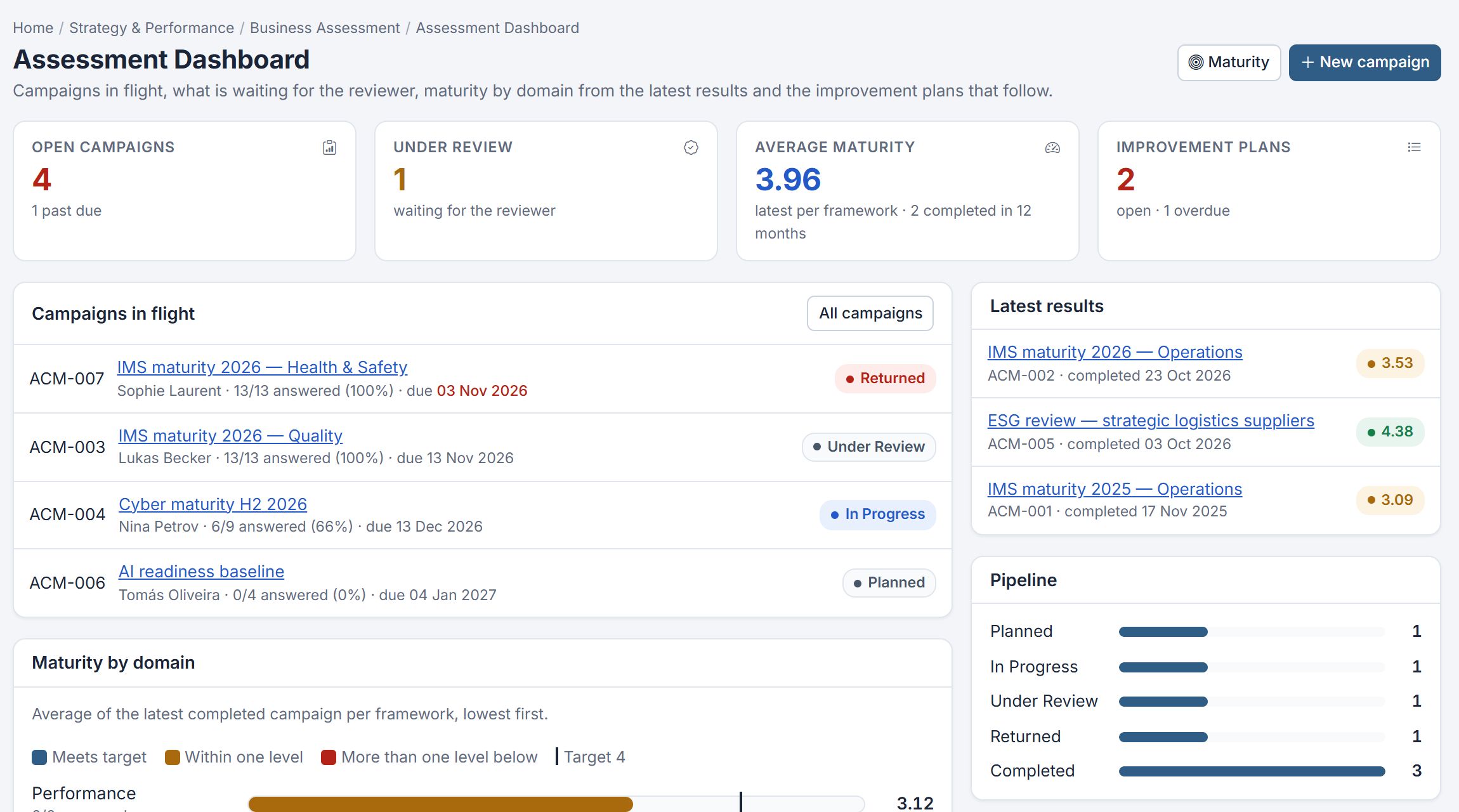
Certora Business Assessment builds questionnaires, runs assessment campaigns per department, and collects answers with evidence. Answers are validated independently, maturity is scored by domain, gaps are analysed against target, and improvement plans that close them are tracked.
The assessment dashboard shows campaigns in flight, average maturity and open improvement plans. Read self-assessments with evidence and validation for how answers are made reliable.