Regulatory change management: from new rule to owned obligation.
A practical process for regulatory change management: monitoring sources, assessing impact, updating obligations and controls, and reporting to management.
The principle
A regulation coming into force is a deadline. Regulatory change management makes sure you see it before it arrives.
Regulations rarely change overnight. They are proposed, consulted on, published and given an effective date, often months or years ahead. Organisations that miss a change usually had time to prepare. What they lacked was a process for noticing and acting on it.
The volume of change makes this harder every year. Data protection, sustainability reporting, product safety, cybersecurity and artificial intelligence have all seen major new rules recently, and each brings obligations that ripple through policies, processes, contracts and training. A structured process is the only realistic way to keep up.
01 · Start with context
Why change is a compliance risk.
ISO 37301 asks organisations to have processes to identify new and changed compliance obligations, evaluate their impact and implement any changes in the management of compliance obligations. ISO 14001 and ISO 45001 have similar expectations for legal and other requirements, and require the organisation to keep this information up to date.
Without a structured process, change monitoring depends on individuals reading the news, and the organisation’s obligations quietly fall behind the law.
The cost of late discovery
Discovering a change after its effective date compresses months of preparation into weeks, or puts the organisation in breach from day one. Even when no penalty follows, the scramble diverts people from other work and often produces hurried, poorly integrated changes that need revisiting later.
02 · Monitor the sources
Know where change will come from.
Start by listing the sources relevant to your operations.
- Regulators and government gazettes.
- Industry associations and standards bodies.
- Legal advisers and subscription services.
- Customer contract updates and supplier notices.
Each source should have someone responsible for watching it and logging relevant changes.
Horizon scanning should look beyond rules already published. Consultations, draft regulations and announced policy directions signal what is coming. Logging these early, even with low certainty, gives the organisation time to plan and sometimes the chance to respond to consultations.
03 · Assess the impact
Not every change matters equally.
Each logged change should be assessed before anyone starts updating procedures.
- Does the change apply to us, and to which sites, products or activities?
- Which existing obligations, policies or controls does it affect?
- How significant is the impact: high, medium or low?
- When does it come into force, and is there a transition period?
The assessment turns a news item into a decision about whether and how to act.
Involving the right people
Impact assessment needs both legal understanding and operational knowledge. The compliance function can interpret the rule; business owners know how it affects their processes. Bringing them together early produces a realistic assessment and builds ownership of the response.
04 · Act before the deadline
Update obligations, controls and documents.
For changes that apply, the response usually touches several parts of the system.
- New or amended obligations in the compliance register.
- Updated procedures, training or controls.
- Changes to contracts or supplier requirements.
- Communication to affected teams.
Each action needs an owner and a due date tied to the effective date, with high-impact changes tracked most closely.
Large changes, such as a new data protection regime or a new sustainability reporting requirement, are effectively projects. Treating them as projects, with a plan, milestones and regular status reporting, gives them the structure they need.
05 · Report the horizon
Management needs to see what is coming.
A regular view of upcoming changes, their impact and the readiness of the response helps management allocate resources early. Changes already in force with incomplete actions should stand out clearly.
This reporting also provides input to management review on changes in external issues, a required topic under ISO management system standards.
Common pitfalls
- Monitoring by chance: changes found because someone happened to read an article.
- Assessment without action: changes logged and rated but never turned into owned actions.
- Register not updated: procedures changed but the obligations register still reflects the old rule.
- No effective dates: changes tracked without deadlines, so urgent items look the same as distant ones.
06 · Certora compliance management
Regulatory change tracked to the obligations it affects.
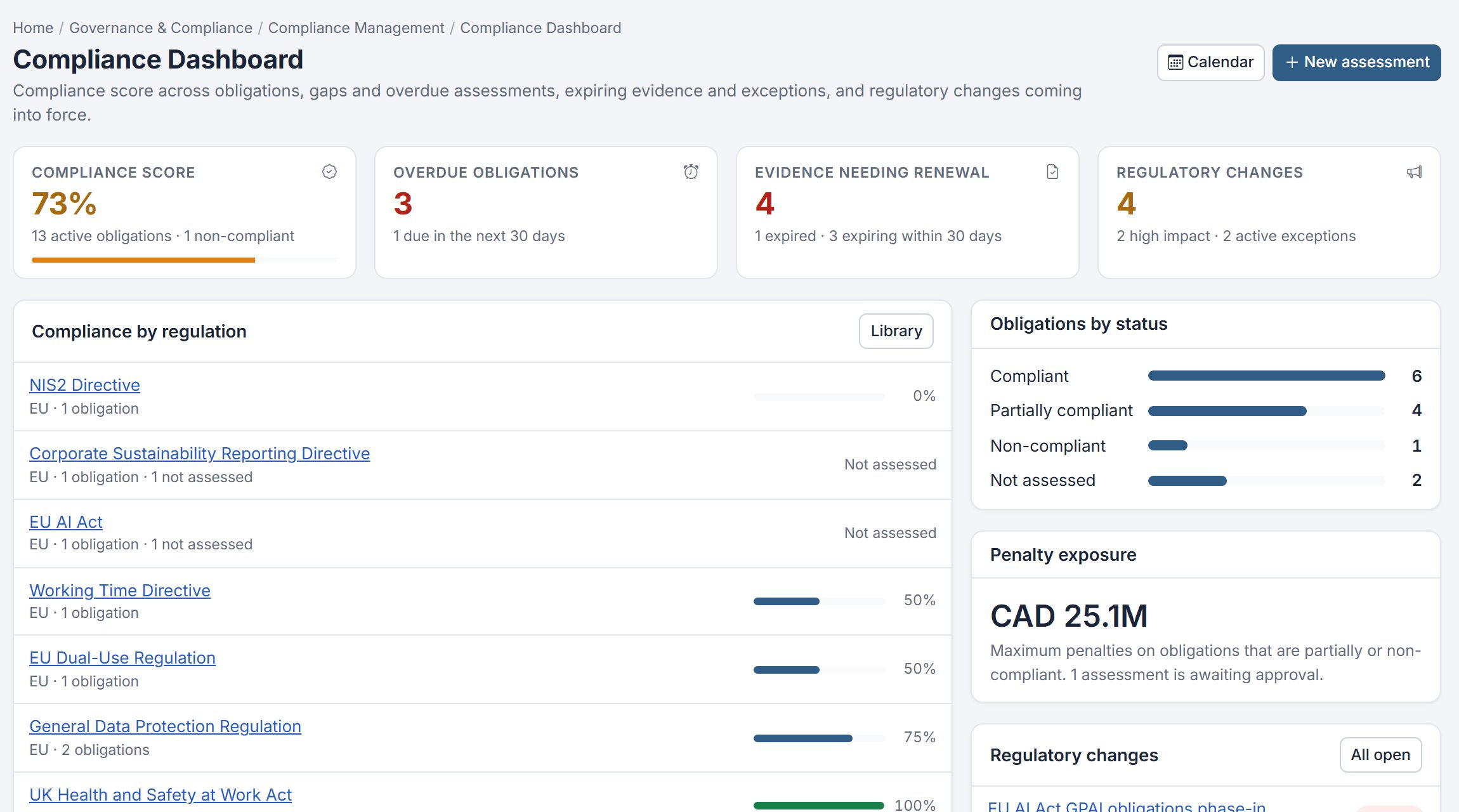
Certora Compliance Management records regulatory changes with their impact and effective date, so changes coming into force are visible on the compliance dashboard. Changes link to the regulations in the regulatory library and to the obligations they affect, keeping the obligations register current.
The compliance calendar and reports show what is due and what is overdue, and assessments against evidence confirm when the organisation is compliant with the new requirement. See building a compliance obligations register for how obligations are owned and assessed.