Model cards and AI risk assessments support decisions, not just documentation.
How model cards with fairness and validation gates, and structured AI risk assessments, support AI clearance decisions under ISO/IEC 42001 and the EU AI Act.
The principle
A model card should answer the questions a reviewer would ask before trusting the model.
AI documentation is easy to produce and easy to ignore. A model card filled in after deployment, or a risk assessment completed to satisfy a checklist, adds little. Used before deployment, as gates, the same documents become real controls.
The difference is timing and consequence. A document written after a decision records it. A document that must be complete, and must meet defined criteria, before a model can be released shapes the decision. AI governance works when documentation sits on the path to production, not beside it.
01 · Start with context
Documentation the frameworks expect.
ISO/IEC 42001 requires AI risk assessment and AI system impact assessment as part of an AI management system, and its Annex A includes controls on documentation, data, and the AI system life cycle. The EU AI Act requires technical documentation, a risk management system, data governance, record-keeping, transparency, human oversight, and accuracy, robustness and cybersecurity for high-risk AI systems.
Model cards, a format proposed by researchers in 2019 and widely adopted since, are a practical way to capture much of this information in a consistent, readable structure.
Impact assessment versus risk assessment
An AI risk assessment considers risks to the organisation and its objectives. An AI system impact assessment, required by ISO/IEC 42001, considers potential consequences for individuals, groups and society. Both matter, and they often surface different issues: a system can pose little risk to the organisation while having significant effects on the people it makes decisions about.
02 · Document the model
What a model card covers.
- Purpose and intended use: and uses that are out of scope.
- Data: training and evaluation data, sources and limitations.
- Performance: metrics, including across relevant subgroups.
- Fairness: tests performed and results.
- Limitations and risks: known failure modes.
- Ownership and version: who is accountable, and which version is described.
Procured models
For models bought rather than built, the organisation may not have access to training data or internal details. Model cards can still record what the vendor discloses, the organisation’s own evaluation results on representative data, and the residual uncertainty. Asking vendors for their own model documentation should be part of AI procurement.
03 · Gate on validation
Fairness and performance before release.
- Define acceptance criteria for performance and fairness before testing.
- Run validation against those criteria.
- Record results on the model card.
- Block clearance when criteria are not met, unless a documented exception is approved.
Gates make the model card a decision record rather than a description.
Fairness criteria need careful definition. There are several mathematical definitions of fairness, and they cannot always be satisfied simultaneously. Choosing which definition fits the use case, and recording why, is itself a governance decision that should involve people beyond the technical team.
04 · Assess AI risk
Impacts on people and the organisation.
An AI risk assessment considers risks such as bias, errors, misuse, privacy, security and lack of transparency, rating likelihood and impact and identifying controls. Rolling AI risks up into the enterprise risk register keeps them visible to leadership alongside other risks.
Human oversight is often the most important control. Defining when a person must review an AI output, what authority they have to override it, and what information they need to do so effectively turns oversight from a principle into a practice.
05 · Monitor after deployment
Models change in use.
Performance and fairness can drift as data changes. Monitoring, periodic revalidation and a route for reporting AI incidents keep documentation and risk ratings current. Under the EU AI Act, providers of high-risk systems must report serious incidents to market surveillance authorities within set deadlines, and deployers must inform providers.
Common pitfalls
- Documentation after release: model cards written once the model is already in production.
- Aggregate metrics only: overall accuracy reported without checking performance across groups.
- Oversight in name only: human review required but with no time, information or authority to intervene.
- No post-deployment monitoring: models validated once and assumed to stay accurate.
06 · Certora AI governance
Model cards with fairness and validation gates.
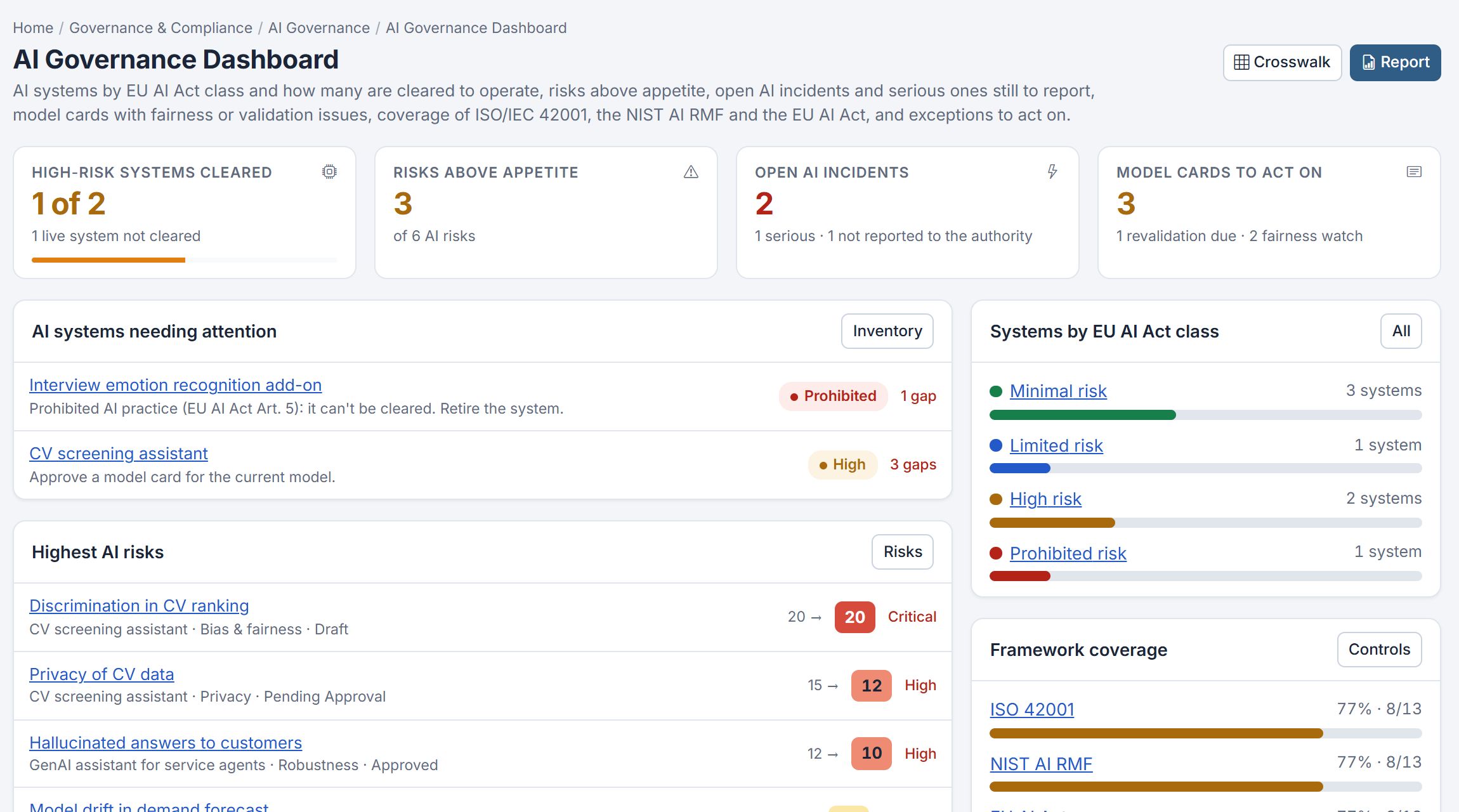
Certora AI Governance provides model cards with fairness and validation gates, and AI risk assessments rolled up to enterprise risks. The AI inventory carries EU AI Act classification and clearance, controls are crosswalked across ISO/IEC 42001, NIST AI RMF and the EU AI Act, and AI incidents are managed with authority reporting deadlines.
See starting AI governance with an inventory for classification.