A compliance obligations register only works if every obligation has an owner.
How to build a compliance obligations register that stays current: sources, owned obligations, scheduled assessments, evidence and exceptions.
The principle
Knowing which laws apply is the start. Knowing who owns each obligation, and whether it is met today, is the point.
Most organisations can produce a list of the laws and regulations that apply to them. Far fewer can say, for each requirement, who is responsible, when it was last checked, and what evidence shows it is met. That second picture is what a compliance obligations register provides.
The difference becomes obvious when something goes wrong. A regulator asks for evidence that a requirement has been met for the past two years. With a list of laws, the answer is a scramble. With an obligations register, the answer is a report: the obligation, its owner, its assessment history and the evidence attached to each assessment.
01 · Start with context
Obligations come from more than legislation.
ISO 37301, the compliance management system standard, uses the term compliance obligations for both requirements an organisation must meet and commitments it chooses to adopt. ISO 14001 and ISO 45001 use the same idea for legal and other requirements.
- Laws and regulations, national and local.
- Permits, licences and authorisations.
- Contractual requirements from customers.
- Industry codes and voluntary commitments.
- Internal policies the organisation has committed to.
A register that only lists legislation misses obligations that auditors and customers will check.
Identifying what applies
Start from the organisation’s activities, products, sites and markets. Each one brings obligations: operating a site brings environmental and safety permits, selling to a regulated customer brings contractual quality requirements, processing personal data brings data protection duties. Legal advisers, industry associations and regulator websites help, but the business owners of each activity usually know more about their obligations than anyone else.
02 · Break sources into obligations
One regulation, many requirements.
A regulation is not an obligation you can assess. Its individual requirements are. Breaking each source into specific, testable obligations is the most valuable step in building the register.
- Record the source, such as a data protection act or an environmental permit.
- Extract each requirement that applies to the organisation.
- Write it as an obligation someone can assess: "Respond to data subject access requests within the statutory period."
- Note the potential consequence of non-compliance, such as a penalty or licence risk.
Rating obligations
Not all obligations carry the same risk. Rating each by the consequence of non-compliance and the likelihood of a breach helps decide how often to assess it and how much evidence is needed. A permit condition with a criminal penalty deserves more attention than an administrative filing with a small fine.
03 · Assign ownership
A named owner for every obligation.
Each obligation needs an owner who understands it and has the authority to keep it met. Ownership should sit with the business area doing the work, not only with the compliance function.
The compliance team then oversees the whole register, challenges assessments and reports the overall position. This "three lines" approach, with the business owning compliance, a compliance function overseeing it and internal audit providing assurance, keeps responsibility clear.
04 · Assess on schedule
Compliance is checked, not assumed.
Obligations should be assessed at a frequency that reflects their risk. High-impact obligations may need quarterly checks; stable, low-risk ones annually.
- The owner assesses status: compliant, partially compliant or non-compliant.
- Evidence is attached to support the conclusion.
- Assessments are reviewed and approved independently where the risk justifies it.
Evidence often expires, such as a permit renewal or an annual inspection certificate, so the register should show when evidence needs to be renewed.
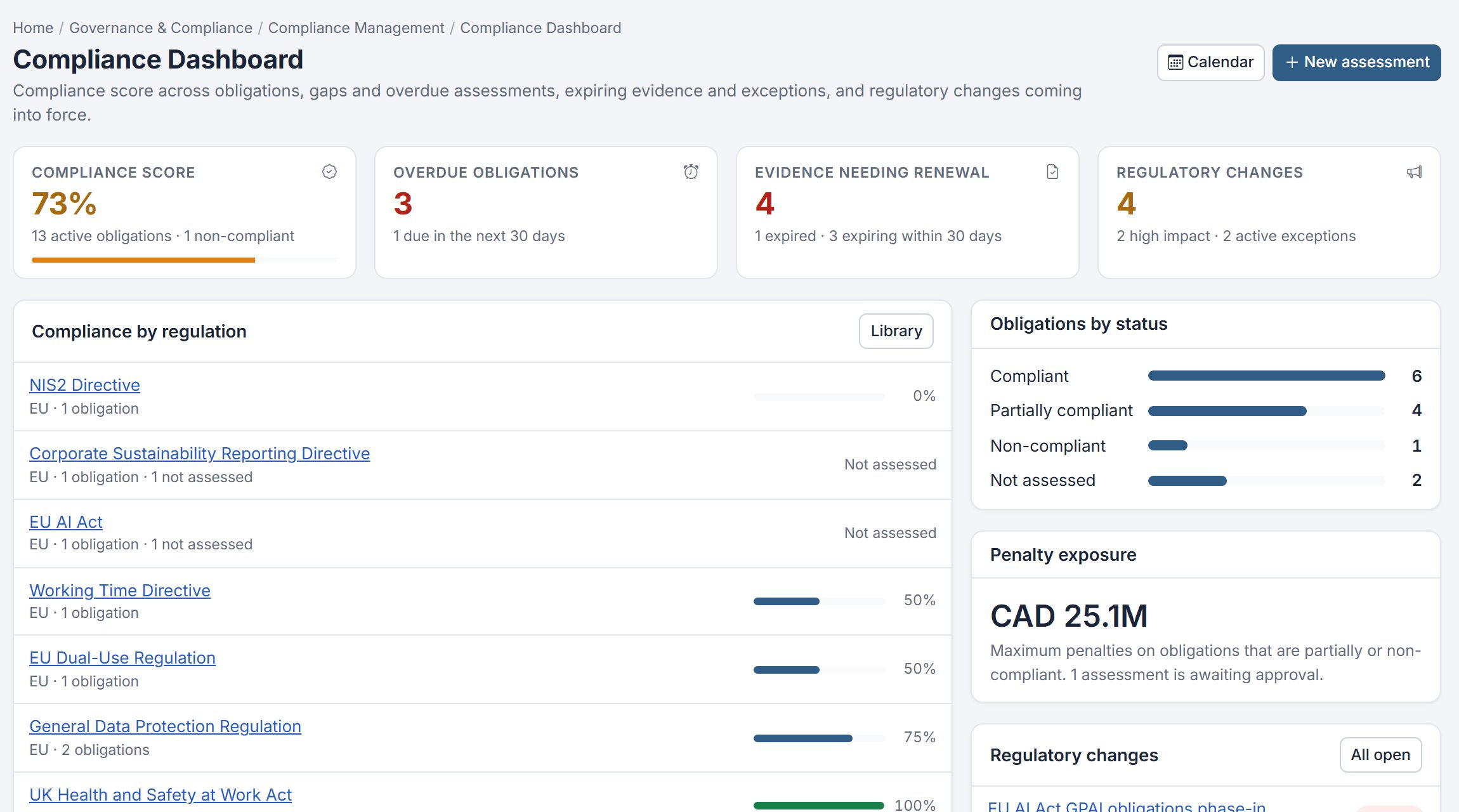
A compliance score, the share of obligations currently assessed as compliant, gives management a simple headline. It should always be read alongside the list of non-compliant and overdue items, because a high score can hide a single critical gap.
05 · Manage exceptions
Temporary non-compliance needs a plan.
Sometimes an obligation cannot be met immediately. Rather than leaving it silently non-compliant, record a time-boxed exception with the reason, the compensating measures, an approver and an end date. Expired exceptions should surface automatically.
Common pitfalls
- A list of laws: sources recorded but never broken into assessable obligations.
- Compliance owns everything: the compliance team assessing obligations it does not control.
- Evidence-free assessments: "compliant" ticked with nothing to support it.
- Forgotten exceptions: temporary non-compliance that becomes permanent because nobody tracked the end date.
06 · Certora compliance management
Owned obligations, assessed against evidence.
Certora Compliance Management keeps a regulatory library of the laws, regulations and commitments that apply, and turns them into owned obligations in an obligations register. Obligations are assessed on schedule against evidence held in an evidence register, with renewal dates tracked.
Time-boxed exceptions, regulatory change and a compliance calendar complete the picture, and the compliance dashboard reports the score across obligations alongside overdue items and penalty exposure. Read regulatory change management for how new requirements enter the register.