One control, many frameworks: mapping an integrated management system.
How to run an integrated management system across ISO 9001, ISO 14001, ISO 45001 and ISO 27001 by mapping one set of controls to many requirements.
The principle
Every framework asks for evidence. An integrated system collects it once and shows it many times.
Organisations certified to several ISO standards often run them as separate systems: separate document sets, separate audits, separate evidence. Much of that work overlaps, because the standards were designed to fit together.
The cost of separation adds up. The same internal audit team visits the same department three times a year for three standards. The same corrective action process exists in three slightly different versions. Management sits through three management reviews covering largely the same ground. An integrated management system removes that duplication while keeping each standard’s specific requirements intact.
02 · Find the overlaps
Common requirements, common processes.
- Documented information (7.5): one document control process for all standards.
- Competence and awareness (7.2, 7.3): one competence framework.
- Internal audit (9.2): one programme covering every standard.
- Management review (9.3): one review with inputs for each standard.
- Nonconformity and corrective action (10.2): one CAPA process.
Running these once is the foundation of an integrated management system.
Context and leadership integrate well too. One set of internal and external issues, one register of interested parties and their requirements, and one policy framework, with discipline-specific commitments, give the whole system a consistent starting point.
03 · Map controls to requirements
One control, many references.
- Break each standard into clause-level requirements.
- Define your internal controls and processes once.
- Map each control to every requirement it satisfies, across frameworks.
- Attach evidence to the control, not to each framework separately.
A supplier evaluation control might satisfy ISO 9001 clause 8.4, ISO 14001 clause 8.1 for outsourced processes and ISO/IEC 27001 supplier controls at once.
Evidence once, shown many times
When evidence lives on the control, one supplier evaluation record serves the quality auditor, the environmental auditor and the security auditor. Nobody has to produce three copies or three versions. When the evaluation is updated, every framework that relies on it sees the current evidence.
04 · Keep differences visible
Integration does not mean ignoring specifics.
Each standard also has requirements of its own: environmental aspects in ISO 14001, hazard identification and worker consultation in ISO 45001, the Statement of Applicability in ISO/IEC 27001, the business impact analysis in ISO 22301. An integrated system keeps these specific requirements clearly mapped alongside the shared ones, so nothing is lost in the merge.
A useful check is to run a coverage report per standard, not only across the integrated system. Each standard should show every requirement mapped to at least one control or process, with any exclusions justified.
05 · Audit the integrated system
Fewer audits, better coverage.
Integrated internal audits can cover several standards in one visit to a process, using the mapping to make sure every relevant requirement is sampled. Many certification bodies also offer combined audits for integrated systems, which can reduce total audit days.
Auditor competence matters. An auditor covering quality, environment and safety in one visit needs knowledge of all three, or the audit team needs to combine the skills. Planning integrated audits around competent teams avoids superficial coverage of the less familiar standard.
Common pitfalls
- Integration on paper only: a combined manual over three separate ways of working.
- Lost specifics: environmental or security requirements diluted because they do not fit the shared process.
- Uneven competence: integrated audits led by auditors who know only one of the standards well.
- Mapping without maintenance: mappings built once and never updated when controls or editions change.
06 · Certora knowledge hub
Map once for many frameworks.
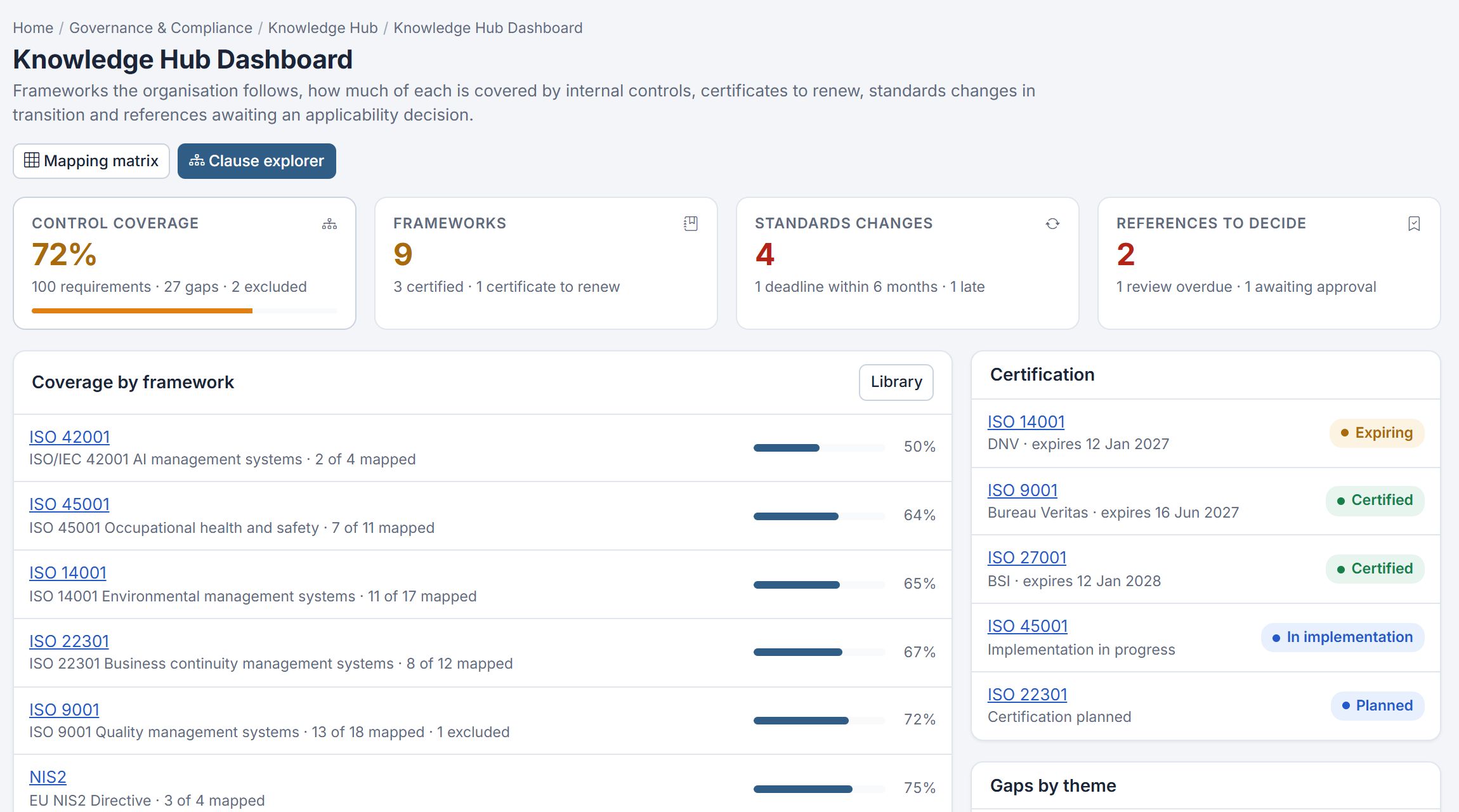
Certora Knowledge Hub breaks each standard into clause-level requirements and maps them to internal controls once for many frameworks. The same controls, documents and evidence then serve ISO 9001, ISO 14001, ISO 45001, ISO/IEC 27001 and the other frameworks you follow.
New editions and guidance are managed in the same library, and because audits, CAPA, documents and management review are single processes across Certora, the integrated system runs as one. Read breaking standards into clause-level requirements for how the library is built.