Read-and-understood: proving people know the current procedure.
How read-and-understood acknowledgements turn document publication into audit evidence that the right people know the current procedure.
The principle
Publishing a procedure tells people it exists. An acknowledgement shows they have read the version that is actually in force.
Auditors rarely ask whether a procedure exists. They ask the operator at the workstation how a task is done, then compare the answer with the current revision. When the two differ, the finding is not about the document. It is about awareness.
That moment, the gap between what the procedure says and what the person does, is one of the most common sources of audit findings in otherwise well-run quality systems. It usually has a simple cause: a revision was published, an email went out, and nobody checked whether the people who depended on it ever read it.
01 · Start with context
Why awareness is where document control often fails.
Most organisations control the writing and approval of documents reasonably well. The weak point comes after publication. A revised procedure goes live, an announcement goes out, and nobody can say afterwards who actually read it.
ISO 9001 clause 7.3 expects people to be aware of what affects their work and the implications of not following it. ISO 45001 and ISO/IEC 27001 carry the same expectation for safety procedures and security policies. Evidence of awareness is therefore part of document control, not an optional extra.
There is also a practical cost. When people work from an outdated version, the organisation loses the benefit of the improvement the revision was meant to deliver, whether that was a tighter inspection step, a corrected tolerance or a new safety precaution. The document changed; the work did not.
02 · Define the audience
Decide who must read each document.
Not everyone needs to acknowledge everything. Asking the whole organisation to confirm every revision creates noise, and people start clicking without reading.
- Role-based audiences: a calibration procedure goes to technicians and supervisors who use the equipment.
- Department audiences: a purchasing procedure goes to procurement and the approvers who sign orders.
- Organisation-wide: the quality policy, code of conduct and key security policies.
Defining the audience on the document itself means each new revision reaches the same people automatically.
Keep the audience accurate
Audiences drift as people move roles. Basing them on positions or departments, rather than lists of named people, keeps them current when the organisation changes. A new starter joining the warehouse should automatically be asked to acknowledge the warehouse procedures, without anyone remembering to add them.
03 · Trigger on revision
Every new revision restarts the clock.
An acknowledgement belongs to a revision, not to a document. When revision 4 replaces revision 3, the confirmations given for revision 3 no longer prove anything about the current text.
- The new revision is approved and published.
- Everyone in the audience receives an acknowledgement request.
- The previous revision’s confirmations remain on record as history.
- Outstanding acknowledgements are visible to the document owner.
This makes it clear, at any moment, who is working from the current version.
It also helps to tell readers what changed. A short summary of the change, such as "added a second check of the batch number before release", lets people focus on the difference rather than rereading the whole document, and makes acknowledgement a meaningful act rather than a formality.
04 · Make it meaningful
Acknowledgement is not training, and should not pretend to be.
A read-and-understood confirmation suits procedural changes that people can absorb by reading. It does not replace training where a skill must be demonstrated.
For significant changes, such as a new inspection method or a new safety-critical step, pair the revision with a training session and record attendance and competence separately. The acknowledgement then confirms the person has the current text; the training record confirms they can apply it.
Deciding which is needed
A useful rule of thumb is to ask whether a competent person could apply the change correctly just by reading it. Clarifications, updated contact details, reordered steps and minor additions usually pass that test. New equipment, new techniques, changed acceptance criteria and anything safety-critical usually do not, and deserve training or a briefing as well.
05 · Follow up
Outstanding confirmations are an operational risk.
An acknowledgement list nobody looks at is just another report. Owners should review outstanding confirmations regularly and follow up with the people concerned.
- Set a reasonable completion window, such as ten working days.
- Escalate overdue confirmations to line managers.
- Report the acknowledgement rate for key documents at management review.
A high acknowledgement rate is a useful indicator of how well changes land in practice.
Common pitfalls
- Acknowledging everything at once: sending the entire document library to every new starter in their first week, which guarantees nobody reads any of it. Prioritise what they need for their role.
- No link to the revision: confirmations stored separately from the document, so nobody can tell which version was acknowledged.
- Silent expiry: people who have not acknowledged a revision for months, with nothing flagged to their manager.
- Treating it as a checkbox: no summary of changes, so people confirm without knowing what to look for.
06 · Certora document management
Acknowledgements tied to the revision in force.
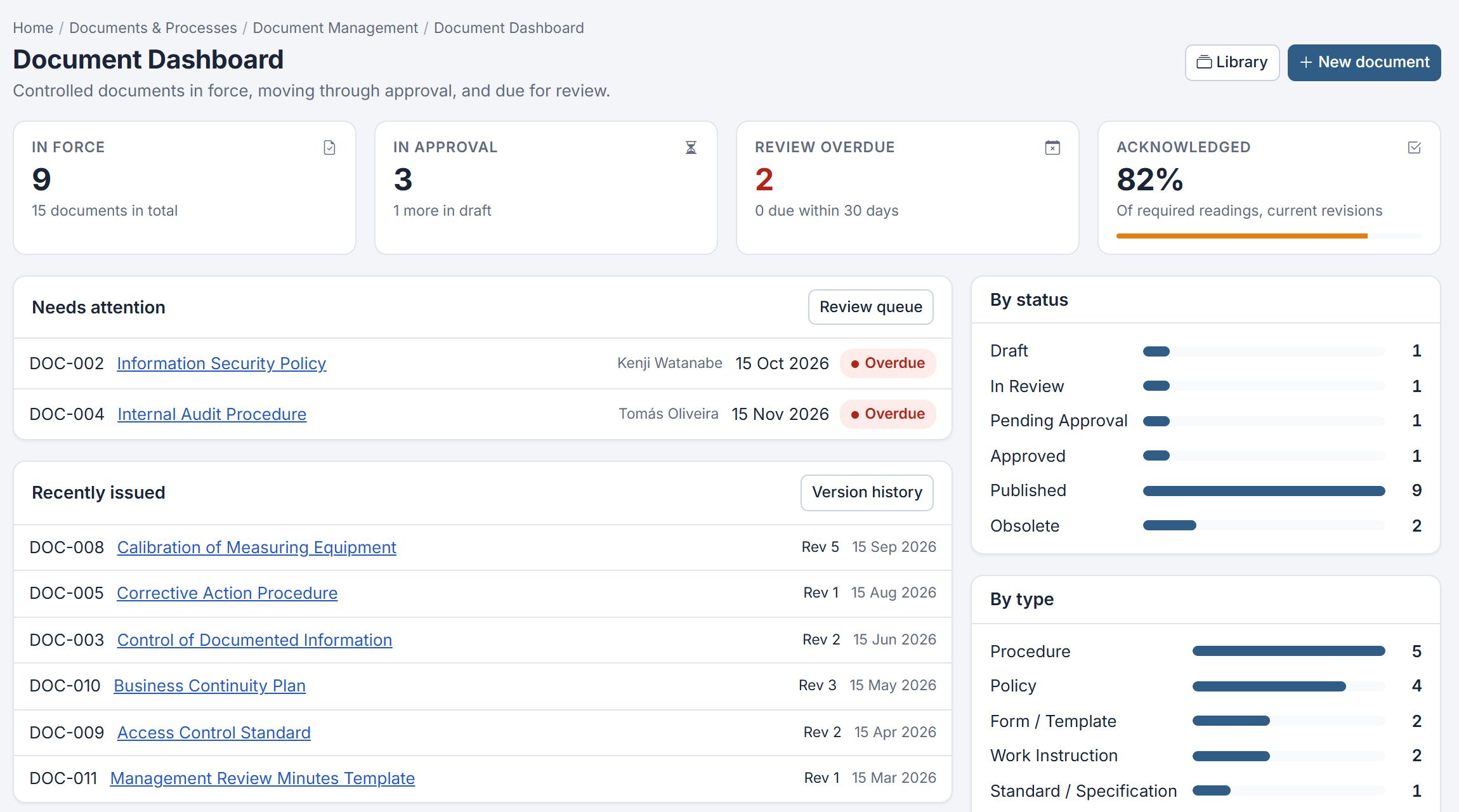
In Certora Document Management, readers confirm new revisions with read-and-understood acknowledgements, and the document dashboard shows the acknowledgement rate against what is required. Each confirmation is tied to the revision it was given for, so history is preserved when a new revision is published.
Combined with classified access, a distribution register for issued copies and review cycles that flag overdue documents, it gives you evidence of awareness alongside evidence of control. Where a change needs more than reading, the related training can be run and recorded in Certora Training Management.
The Document Management user guide walks through the acknowledgement workflow in detail, and document control under ISO 9001 covers the wider requirements of clause 7.5.