Process change requests keep process maps true to how work is done.
How to manage process changes with change requests: impact assessment, approval, implementation and updated process maps, in line with ISO 9001 6.3 and 8.5.6.
The principle
An undocumented change is not an improvement. It is a difference between the system and reality.
Processes change constantly: a new system is introduced, a team is reorganised, a step is added after a complaint. When changes are made informally, process maps and procedures drift away from reality, and the next audit finds the gap.
Uncontrolled change also carries risk beyond audit findings. A step removed to save time may have been the control that prevented a recurring defect. A new system may skip an approval that the old one enforced. Change control exists so that someone asks those questions before the change, not after the problem.
01 · Start with context
The standard expects planned change.
ISO 9001 clause 6.3 asks that, when the organisation determines the need for changes to the quality management system, the changes are carried out in a planned manner. It must consider the purpose of the change and its potential consequences, the integrity of the quality management system, the availability of resources, and the allocation or reallocation of responsibilities and authorities.
Clause 8.5.6 adds review and control of changes for production and service provision, to ensure continuing conformity with requirements, with documented information describing the results of the review, the person authorising the change and any necessary actions.
A change request process is the practical way to meet both.
02 · Capture the request
Every change starts with a reason.
- What is changing, and in which process?
- Why: an improvement, a correction, a new requirement?
- Who is requesting it, and who owns the process?
- What benefit or risk reduction is expected?
Capturing changes formally also creates a useful log of improvement over time.
Where change requests come from
Requests arise from many places: corrective actions, audit findings, customer requirements, new regulations, technology upgrades, employee suggestions and management review decisions. Recording the source on each request shows how the improvement system works in practice, and makes it easy to link the change back to the problem it solves.
03 · Assess the impact
Look beyond the process itself.
- Which documents, forms and work instructions must change?
- Which risks and controls are affected?
- Which roles need new training or communication?
- Are customers, regulators or certification bodies affected?
Impact assessment prevents the classic failure where a process changes but its procedure, training and controls do not.
A quick example
A warehouse decides to move from paper picking lists to handheld scanners. The process model changes, but so do the work instructions, the training for pickers, the controls that previously checked paper lists, the data retention rules and possibly the IT security risks. Without an impact assessment, the scanners might go live while the old paper procedure remains the controlled version, and an auditor would find the two in conflict on day one.
04 · Approve and implement
Authority proportional to impact.
Minor changes may be approved by the process owner. Significant changes, such as those affecting product conformity, safety or customers, may need wider review. Once approved, implementation is tracked as a set of tasks: update the model, revise documents, train people, adjust controls.
Some changes need to be piloted before full roll-out. A trial in one team or one shift, with clear success criteria, reduces the risk of a change that looks good on paper but fails in practice. The results of the pilot should be recorded and considered before wider approval.
05 · Update the map
The model is part of the change.
The change is complete only when the process model reflects the new way of working and linked documents are revised. Keeping a history of model versions shows how the process evolved and why.
Change data is also valuable management information: frequent changes in one process can signal instability worth investigating.
Common pitfalls
- Change by email: decisions made in conversations and never recorded, so nobody can later explain why the process works the way it does.
- Documents last: the process changes immediately but procedures are updated months later, if at all.
- No post-change check: nobody confirms the change delivered the expected benefit.
- Approval by the requester: people approving their own changes, with no independent view of the impact.
06 · Certora business process management
Change requests through to implementation.
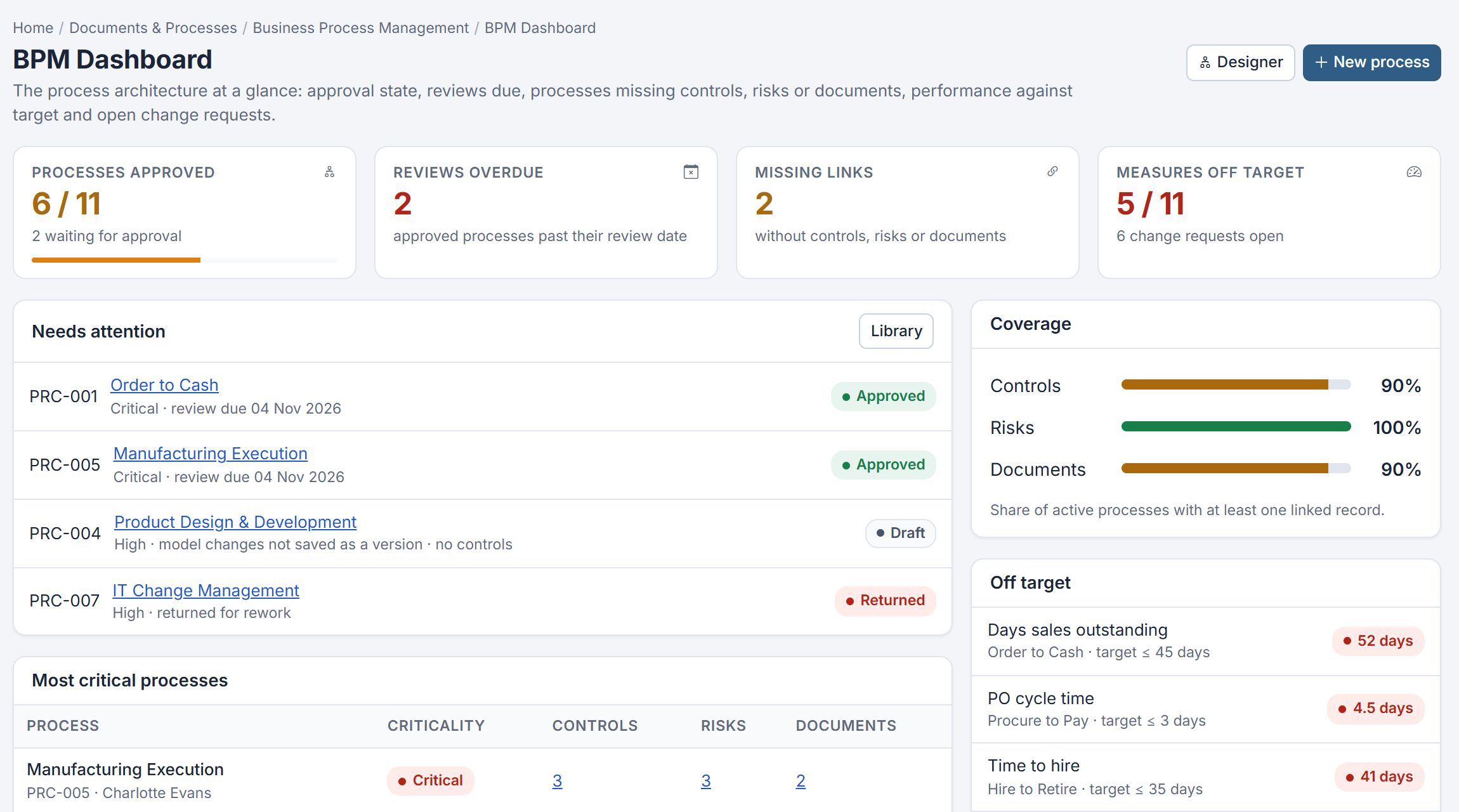
Certora Business Process Management manages change requests through to implementation, alongside the process architecture and swimlane models they affect. Each process links to its controls, risks and documents, so the impact of a change is visible before it is approved.
Process performance measures show whether the change delivered the intended result, and revised documents move through Certora Document Management’s review and approval with read-and-understood acknowledgements for the people affected.
See the process approach in ISO 9001 for how processes are modelled in the first place.