Document control under ISO 9001 is about control, not storage.
What ISO 9001 clause 7.5 actually asks of documented information, and how document control software keeps one approved revision in force, read and retained.
The principle
A shared drive stores documents. A document control system decides which revision is in force, who approved it, and who has read it.
Most organisations preparing for ISO 9001 already have their procedures written down. The difficulty is rarely writing them. It is keeping one approved version in use, making sure the right people have read it, and being able to show an auditor the history behind every change.
That gap between having documents and controlling them is where many first certification audits find their minor nonconformities: an outdated form still in use on the shop floor, a procedure approved by someone who left two years ago, or a work instruction that exists in three slightly different versions on three different drives. None of these are writing problems. They are control problems.
01 · Start with context
What clause 7.5 actually requires.
Clause 7.5 of ISO 9001 covers documented information: the documents you maintain, such as policies and procedures, and the records you retain as evidence. The standard asks you to control both, and it is specific about what control means.
- Identification and description: a title, a reference number, an owner and a revision.
- Review and approval: documents are checked for suitability and adequacy before they are issued.
- Availability: the current version is available where and when it is needed.
- Protection: documents are protected from loss of confidentiality, improper use and loss of integrity.
- Change control: changes are controlled, and superseded versions are not used by mistake.
- Retention and disposition: records are kept for a defined period and then disposed of deliberately.
The same requirements appear in ISO 14001, ISO 45001 and ISO/IEC 27001, so one approach to document control serves every standard you certify against.
It is also worth noting what the standard does not ask for. ISO 9001:2015 removed the requirement for a documented quality manual and a set of mandatory procedures. You decide how much documentation your processes need, based on their complexity and the competence of the people doing the work. What you must do is control whatever you decide to keep.
02 · Define the scope
Decide what is controlled and what is a record.
Not every file needs the same treatment. A useful first step is to separate three groups.
- Controlled documents: policies, procedures, work instructions, forms and templates. These change over time and need review, approval and revision history.
- Records: completed forms, audit reports, inspection results and minutes. These should not change after they are created; they need retention, not revision.
- External documents: standards, regulations, customer specifications and supplier manuals. You do not write them, but you still need to know which edition applies.
Writing this down as a short document matrix, with owners and review cycles, gives everyone a shared answer to "is this controlled?"
A practical numbering scheme
A simple, consistent reference scheme makes documents easier to find and audit. Many organisations use a prefix for the document type, such as POL for policies, PRO for procedures, WI for work instructions and FRM for forms, followed by a sequence number. The revision number then sits alongside the reference rather than inside the file name, so links and references stay valid when a new revision is issued.
03 · Control the lifecycle
Route every revision through review and approval.
A controlled document moves through predictable states: draft, in review, approved, published and eventually superseded or obsolete. Each transition should be deliberate and recorded.
- The author drafts the change and states the reason for it.
- Reviewers check content and suitability, and their comments are resolved.
- An approver with the right authority signs it off.
- The new revision is published, and the previous one is withdrawn but kept on record.
The value is not the workflow itself. It is that, months later, anyone can see who changed what, why, and who approved it.
Approval authority deserves attention. The approver should be someone with responsibility for the process the document governs, not simply the quality manager approving everything by default. A purchasing procedure approved by the head of procurement carries more weight, and is more likely to be followed, than one approved by someone outside the process.
04 · Prove awareness
Approval is not the same as people knowing.
ISO 9001 clause 7.3 asks that people are aware of the quality policy, their contribution to the system and the implications of not conforming to it. In practice that means knowing the procedures that govern their work, and publishing a new revision does not make that true on its own.
A read-and-understood acknowledgement closes the gap. When a revision is published, the people who depend on it are asked to confirm they have read it, and outstanding acknowledgements are visible to the document owner. During an audit, this turns "we told everyone" into evidence.
For significant changes, acknowledgement is not enough on its own. A change to a safety-critical step or an inspection method usually justifies a short briefing or training session, recorded separately, so you can show people can apply the change and not only that they read it.
05 · Keep it current
Review cycles and retention prevent quiet decay.
Documents age. Equipment changes, teams reorganise and regulations move on, while the procedure stays the same. Assigning every controlled document a review cycle, for example every one or two years, means someone confirms it still reflects reality.
Retention needs the same discipline in reverse. Each record type should have a retention period and a disposition rule, so records are kept for as long as contracts, regulations or the standard require, and no longer.
Common pitfalls
- Uncontrolled copies: printed procedures pinned to walls that are never withdrawn when a new revision is issued. A distribution register of issued copies prevents this.
- Review by rubber stamp: a document "reviewed" every year with no changes, while the process has moved on. A review should involve the people who do the work.
- Records that can be edited: completed inspection records stored as editable spreadsheets, so nobody can prove they have not changed.
- Orphaned documents: documents whose owner has left, so nobody reviews or updates them.
06 · Certora document management
One current revision, approved, read and retained.
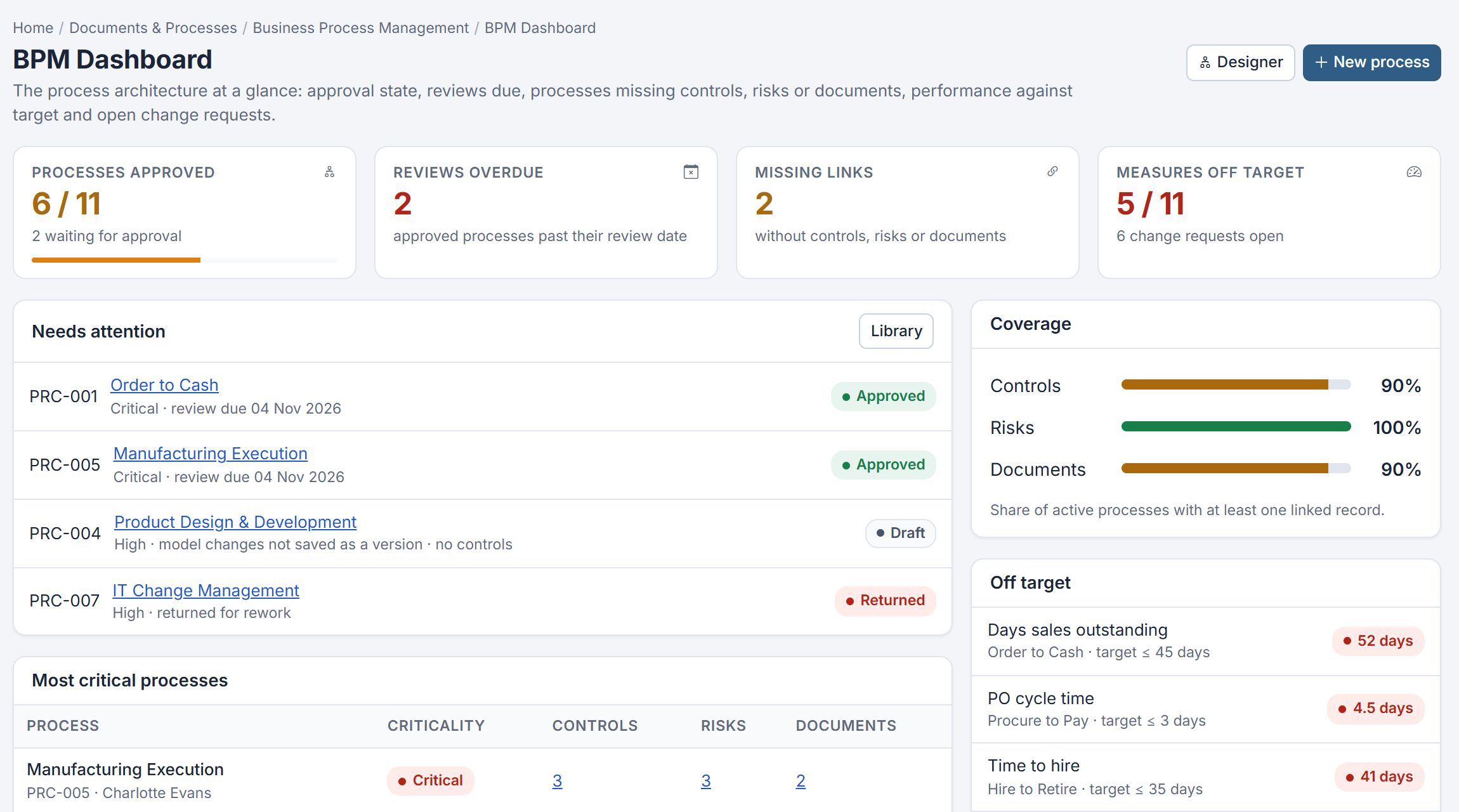
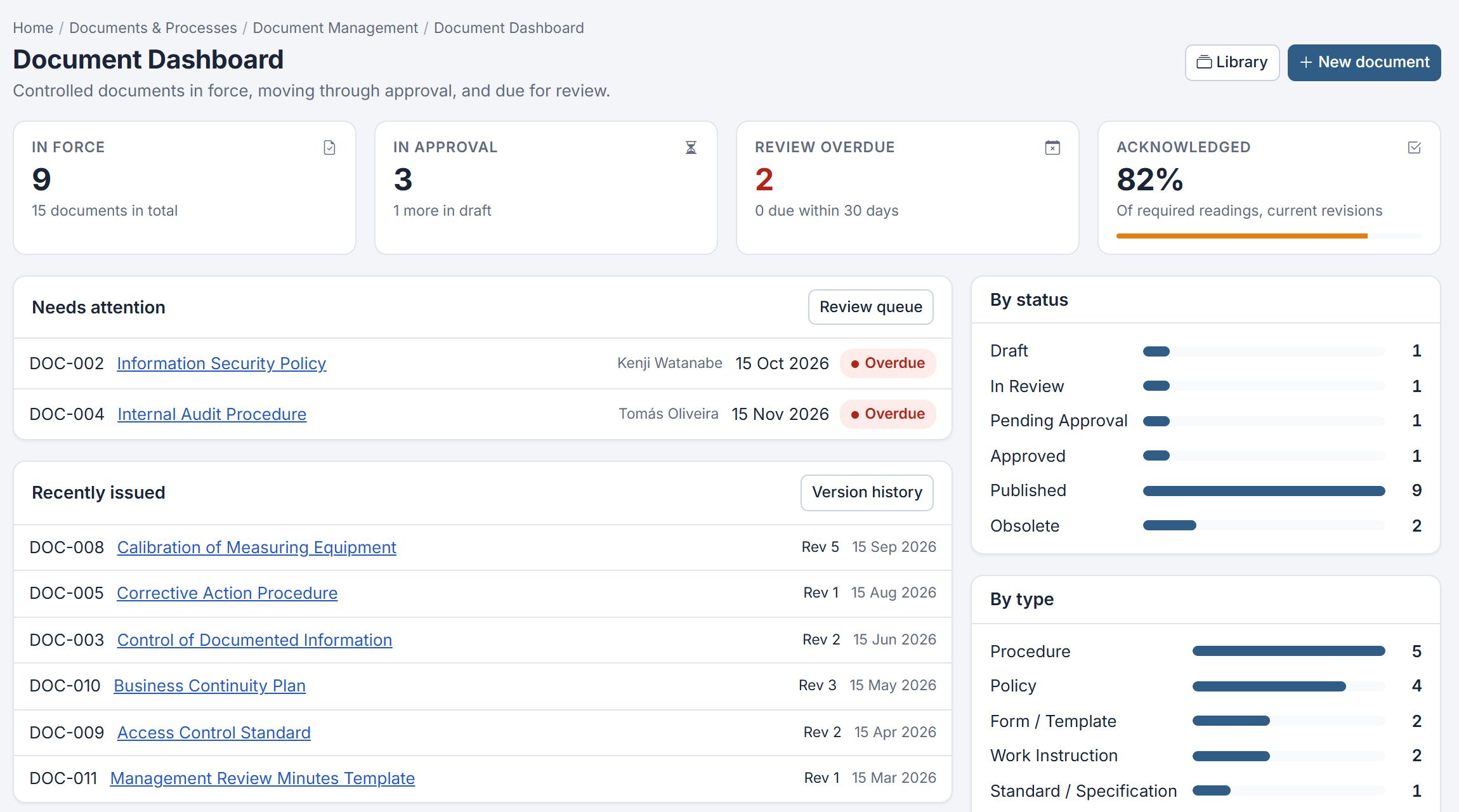
Certora Document Management keeps every controlled document in a single library with its current revision, classification, owner and next review date. Revisions move through review and approval queues, superseded versions stay on record with what changed, and readers acknowledge new revisions with read-and-understood confirmations.
Access is controlled by classification and role, distribution of copies is registered, and retention schedules show what is due for disposition. Overdue reviews are flagged on the document dashboard, so the library stays current long after the initial certification effort.
Because documents live in the same system as audits, nonconformities and training, a corrective action can revise a procedure and the revision can trigger acknowledgements, all with the links preserved. See the features overview, the Document Management user guide, or read proving people know the current procedure for the awareness side in depth.