The process approach: mapping processes an auditor can follow.
How to apply the ISO 9001 process approach (clause 4.4): process architecture, swimlane maps, owners, controls, risks and performance measures.
The principle
A process map is useful when it shows who does what, which controls apply, and how you know it is working.
The process approach sits at the heart of ISO 9001, yet many organisations show it with a single diagram of boxes and arrows produced for certification. Auditors then follow a real transaction and find that the diagram describes a process nobody recognises.
The process approach is meant to be practical. It asks you to manage your organisation as a set of connected processes, each with an owner, inputs, outputs, controls and measures, so that you understand how work flows and where it can go wrong. When it is done well, it becomes the backbone for audits, risk management, documentation and improvement.
01 · Start with context
What clause 4.4 requires.
ISO 9001 clause 4.4 asks the organisation to determine the processes needed for the quality management system and their application throughout the organisation. For each process, it should:
- Determine the inputs required and the outputs expected.
- Determine the sequence and interaction of processes.
- Determine and apply criteria and methods for effective operation and control, including monitoring, measurement and performance indicators.
- Determine the resources needed and ensure their availability.
- Assign responsibilities and authorities.
- Address the risks and opportunities determined under clause 6.1.
- Evaluate the processes and implement changes needed to achieve intended results.
- Improve the processes and the quality management system.
That is a lot of information per process, and it is far easier to manage as structured data than as a set of diagrams.
02 · Start with architecture
Processes in levels.
- Level 1: the main process groups, such as management, core and support processes.
- Level 2: the processes within each group, such as order handling or purchasing.
- Level 3: detailed procedures or activities where needed.
A process architecture gives everyone the same map of how the organisation works, and shows how processes connect.
Core, support and management processes
Core processes create value directly for customers: sales, design, production, delivery, service. Support processes enable them: purchasing, maintenance, HR, IT, calibration. Management processes direct and improve the system: strategy, management review, internal audit, corrective action. Grouping processes this way makes the architecture easier to read and helps decide where audit and improvement effort matters most.
03 · Model each process
Swimlanes and decisions.
A swimlane diagram shows the steps of a process, who performs each one, and where decisions branch the flow. It answers the auditor’s first question, "who does this?", directly.
Keep models readable. A process with forty steps on one diagram is usually several processes, or detail that belongs in a work instruction.
Modelling tips
- Start each process with a clear trigger, such as "customer order received", and end with a clear output, such as "order delivered and invoiced".
- Use one lane per role, not per person, so the model stays valid when people change.
- Show decision points explicitly, with each outcome labelled.
- Model how the process actually runs today before redesigning it. A map of the ideal process that nobody follows has little value.
04 · Link what governs it
Controls, risks and documents.
The process map becomes much more valuable when it links to the elements that govern it.
- Documents: the procedures and work instructions for each step.
- Risks: what could go wrong in the process.
- Controls: the checks that manage those risks.
- Owner: the position accountable for the process.
These links answer clause 4.4’s requirements for control criteria, responsibilities and risks in one place.
They also make the system navigable. An internal auditor planning an audit of purchasing can see the process, its procedures, its risks and its controls together, and plan the audit around them. A new process owner can understand their responsibilities in an afternoon rather than discovering them over months.
05 · Measure performance
Know whether the process works.
Each process needs at least one measure of whether it achieves its intended output: on-time delivery, first-pass yield, purchase order cycle time. Measures with targets feed process performance into management review under clause 9.3.
Good process measures focus on outputs and outcomes, not just activity. "Number of purchase orders raised" says little. "Percentage of purchase orders delivered on time and in full" says whether the process works for the people who depend on it.
Common pitfalls
- One diagram for everything: a single high-level map with no detail beneath it, which cannot support audits or improvement.
- Maps that drift: process models that are never updated when the process changes.
- No owner: processes that cross departments with nobody accountable for the whole.
- Measures without targets: indicators that are tracked but never compared against an expectation.
06 · Certora business process management
Architecture, models and performance.
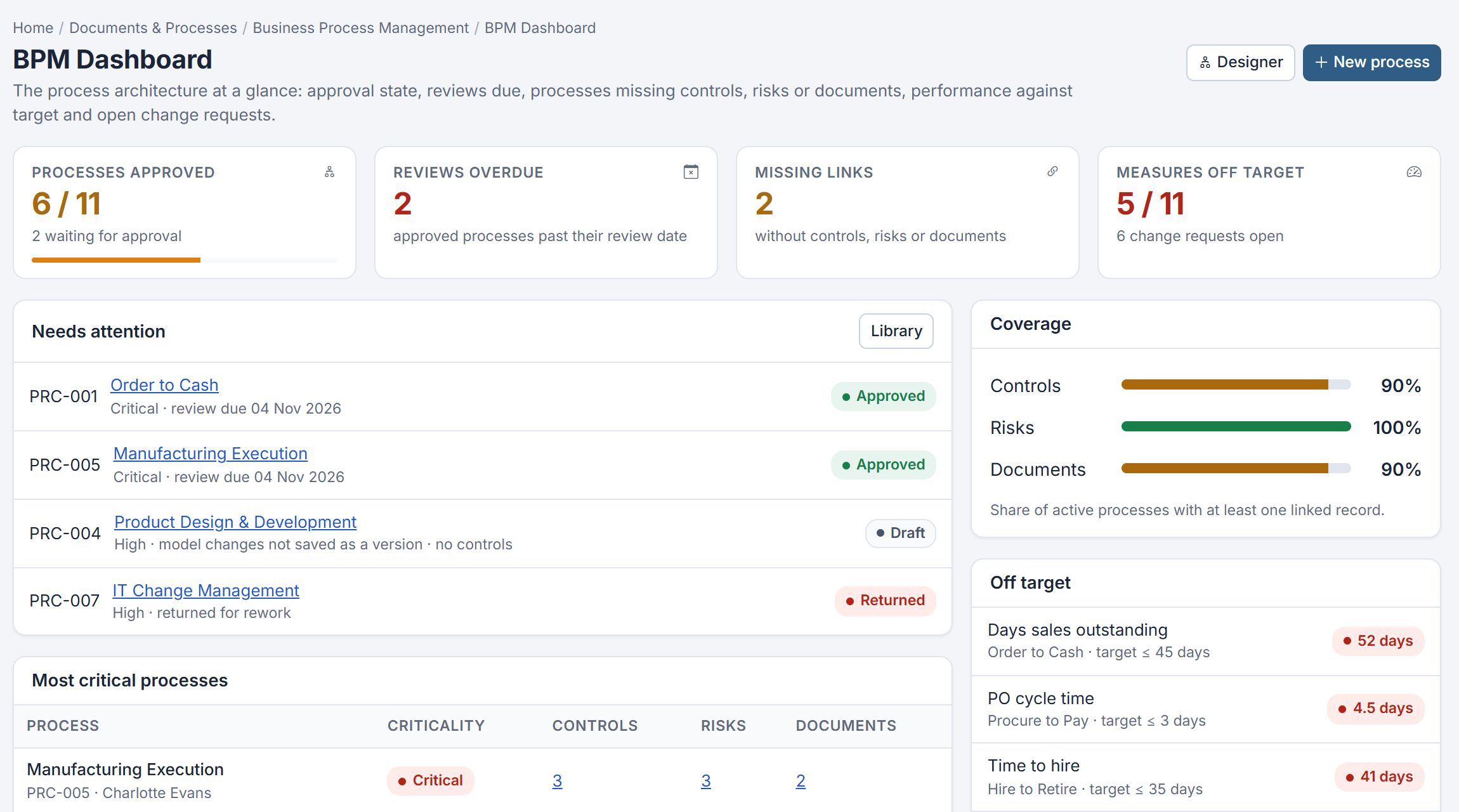
Certora Business Process Management maps the process architecture, models each process with swimlanes and decisions, and links the controls, risks and documents that govern it. Process performance is measured against targets, and change requests are managed through to implementation.
Process owners come from the same organisation model used across Certora, and linked documents, risks and controls are managed in their own modules, so the process map stays connected to the rest of the management system.
Read process change requests for how process maps are kept current as the organisation changes.