Quality KPIs need definitions, targets and approved results to be trusted.
How to define quality KPIs for ISO 9001 clause 9.1 with formulas, targets and thresholds, approved periodic results and an audit trail for target changes.
The principle
A KPI without a definition is an opinion with a number attached.
Most organisations track performance indicators. Fewer can show exactly how each one is calculated, who entered last month’s figure, whether anyone checked it, and why the target changed in March. Those details are what make KPIs credible to auditors and leadership.
When KPI definitions are loose, the same indicator can produce different numbers depending on who calculates it. When results are not checked, errors reach management reports. When targets change without a record, performance can be made to look better simply by moving the goalposts. Each of these undermines trust in the numbers that drive decisions.
01 · Start with context
What clause 9.1 asks for.
ISO 9001 clause 9.1.1 asks the organisation to determine what needs to be monitored and measured, the methods for monitoring, measurement, analysis and evaluation needed to ensure valid results, when monitoring and measuring shall be performed, and when results shall be analysed and evaluated. Documented information must be retained as evidence of the results.
KPIs are the most common way to meet that requirement for process and system performance. Clause 9.1.3 then asks that results are analysed and evaluated, and used to assess conformity, customer satisfaction, system performance, the effectiveness of planning, supplier performance and the need for improvement.
Typical quality KPIs
Common examples include on-time delivery, first-pass yield, customer complaint rate, cost of poor quality, internal nonconformities per month, corrective actions closed on time, supplier on-time delivery and audit findings by severity. The right set depends on your processes and objectives; a few well-chosen KPIs beat dozens that nobody acts on.
02 · Define each KPI
Formula, unit and owner.
- Name and purpose: what it measures and why it matters.
- Formula: exactly how it is calculated, with data sources.
- Unit and frequency: percentage, count or days; monthly or quarterly.
- Owner: the person accountable for the result.
- Direction: whether higher or lower is better.
Clear definitions prevent the same KPI being calculated differently by different people.
Leading and lagging
Lagging indicators, such as complaints or defects, show what has already happened. Leading indicators, such as training completion, preventive maintenance compliance or supplier audits completed, show whether the conditions for good performance are in place. A balanced set includes both, so problems can be anticipated rather than only reported.
03 · Set targets and thresholds
Red, amber and green.
- Set a target that reflects the organisation’s objectives.
- Define thresholds for amber (warning) and red (action needed).
- Link the KPI to the quality objective or process it measures.
- Record the rationale for the target.
Thresholds turn a number into a status that tells people whether to act.
Targets should be challenging but realistic. A target nobody believes can be met is ignored; one that is always met easily drives no improvement. Using historical performance as a baseline, and setting targets that represent a meaningful step forward, usually works best.
04 · Enter and approve results
Valid results, not just numbers.
Results should be entered for each period by the person closest to the data and approved by a second person before they count. Approval catches errors and gives confidence that reported figures are valid, as clause 9.1.1 requires.
A short comment with each result, explaining significant movements, adds context that numbers alone cannot. "On-time delivery fell to 88% due to a two-day carrier strike" tells management whether action is needed in a way that "88%" does not.
05 · Control target changes
Keep an audit trail.
Targets sometimes need to change: a new product line, a market shift, a corrected baseline. Each change should be recorded with who changed it, when and why, so performance can always be interpreted against the target that applied at the time.
Common pitfalls
- Vague definitions: "delivery performance" calculated differently by sales and logistics.
- Unchecked results: figures typed into spreadsheets with no second look.
- Moving targets: targets lowered mid-year without explanation.
- Too many KPIs: dashboards so crowded that nothing gets attention.
06 · Certora KPI management
Defined, approved and traceable KPIs.
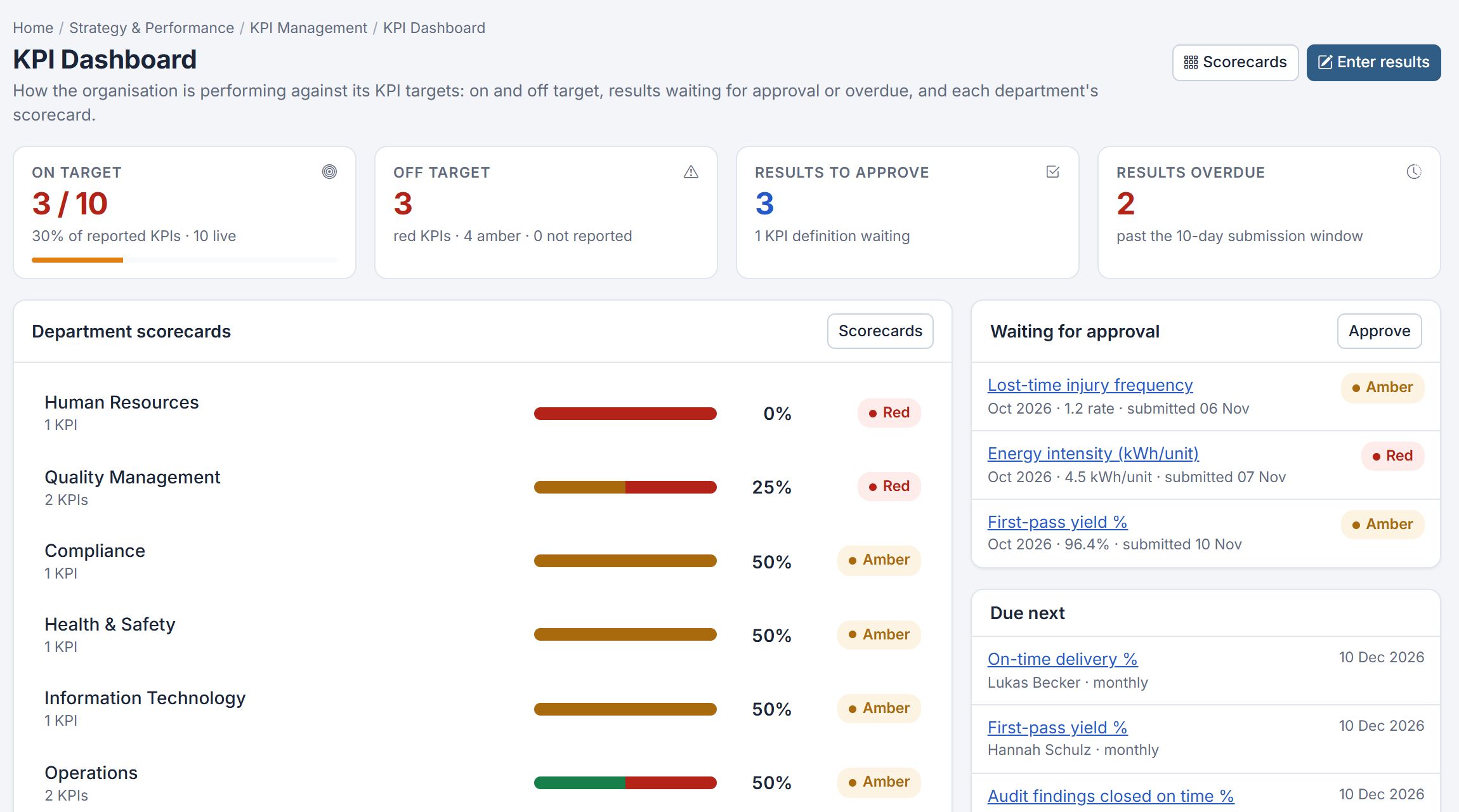
Certora KPI Management defines KPIs with formulas, targets and thresholds, and results are entered and approved each period. Department scorecards show red, amber and green status with trends, target changes are managed with an audit trail, and performance reviews use frozen snapshots.
KPIs connect to quality objectives in Certora Strategy Management and feed management review inputs. Read scorecards leaders trust for how results are reviewed.