Preventive maintenance starts with an asset register you can trust.
How an accurate asset register supports preventive maintenance, inspections, custody, transfers and disposals, in line with ISO 9001 and ISO 55001.
The principle
You cannot maintain an asset you cannot find, and you cannot plan maintenance for assets you have not counted.
Breakdowns are expensive, and most are preventable. Yet preventive maintenance programmes often fail for a basic reason: the asset register is incomplete, so some equipment never appears on a maintenance plan at all.
An accurate asset register is the foundation for almost everything else in asset management: maintenance planning, calibration, risk assessment, insurance, depreciation, custody and disposal. When the register is wrong, every one of those activities inherits the error.
01 · Start with context
Infrastructure is a resource the standard expects you to maintain.
ISO 9001 clause 7.1.3 asks organisations to determine, provide and maintain the infrastructure necessary for the operation of their processes and to achieve conformity of products and services. The standard’s note lists buildings and associated utilities, equipment including hardware and software, transportation resources, and information and communication technology.
ISO 55001 sets out requirements for an asset management system for organisations that want a fuller framework, aligning asset decisions with organisational objectives across the whole asset life cycle.
Why maintenance is a quality issue
Poorly maintained equipment produces variation, defects and unplanned downtime, all of which affect product conformity and on-time delivery. Maintenance records are therefore quality evidence: they show that the infrastructure the standard requires is actually maintained.
02 · Build the register
Every asset, with its context.
- A unique identifier and description.
- Location, custodian and department.
- Acquisition date, value and expected life.
- Criticality: the impact if the asset fails.
- Maintenance, inspection and calibration requirements.
Criticality helps decide how much maintenance effort each asset deserves.
Starting a register
Building a register from scratch is easiest done area by area: walk each site, tag each significant asset, and record its details. Finance records, insurance schedules and purchase histories help find assets that are easy to miss. Deciding a value or criticality threshold for inclusion keeps the register focused on assets that matter.
03 · Plan preventive maintenance
Time- or usage-based.
- Define maintenance tasks for each asset or asset type.
- Set frequencies based on time, usage or condition.
- Schedule tasks and assign them to technicians.
- Record completion, findings and parts used.
Critical assets justify more frequent and more detailed maintenance.
Maintenance strategies
Different assets suit different approaches. Time-based maintenance happens at fixed intervals. Usage-based maintenance follows operating hours or cycles. Condition-based maintenance responds to measured indicators such as vibration or temperature. Run-to-failure is a deliberate choice for low-criticality, low-cost assets. Choosing the right strategy per asset balances cost against reliability.
04 · Inspect and assign
Know condition and custody.
Regular inspections confirm condition between maintenance tasks. Assigning equipment to people, such as laptops, tools or vehicles, makes custody clear and supports recovery when people change roles or leave.
Inspections can also feed risk management. An inspection that finds wear, corrosion or damage should lead to a maintenance task or, for significant findings, an update to the asset’s risk rating.
05 · Approve transfers and disposals
Control the asset lifecycle.
Moving an asset between sites or departments, or disposing of it, should be an approved change. Approval ensures the register stays accurate, values are updated, and disposal meets environmental and data security requirements.
Disposal deserves particular care for IT equipment, which may contain data, and for assets containing hazardous materials, which carry environmental obligations. Recording the disposal method and any certificates of destruction completes the asset’s history.
Common pitfalls
- Incomplete register: assets missing from the list, and therefore from every maintenance plan.
- One strategy for all: the same time-based schedule applied regardless of criticality or usage.
- Unrecorded moves: assets transferred between sites with the register never updated.
- Undocumented disposal: equipment scrapped or sold without approval or data wiping.
06 · Certora asset management
Register, maintenance and lifecycle.
Certora Asset Management registers every physical asset with its value and custody, plans preventive maintenance, and carries out inspections and calibrations. Asset risks are managed, equipment is assigned to people, and transfers and disposals are approved.
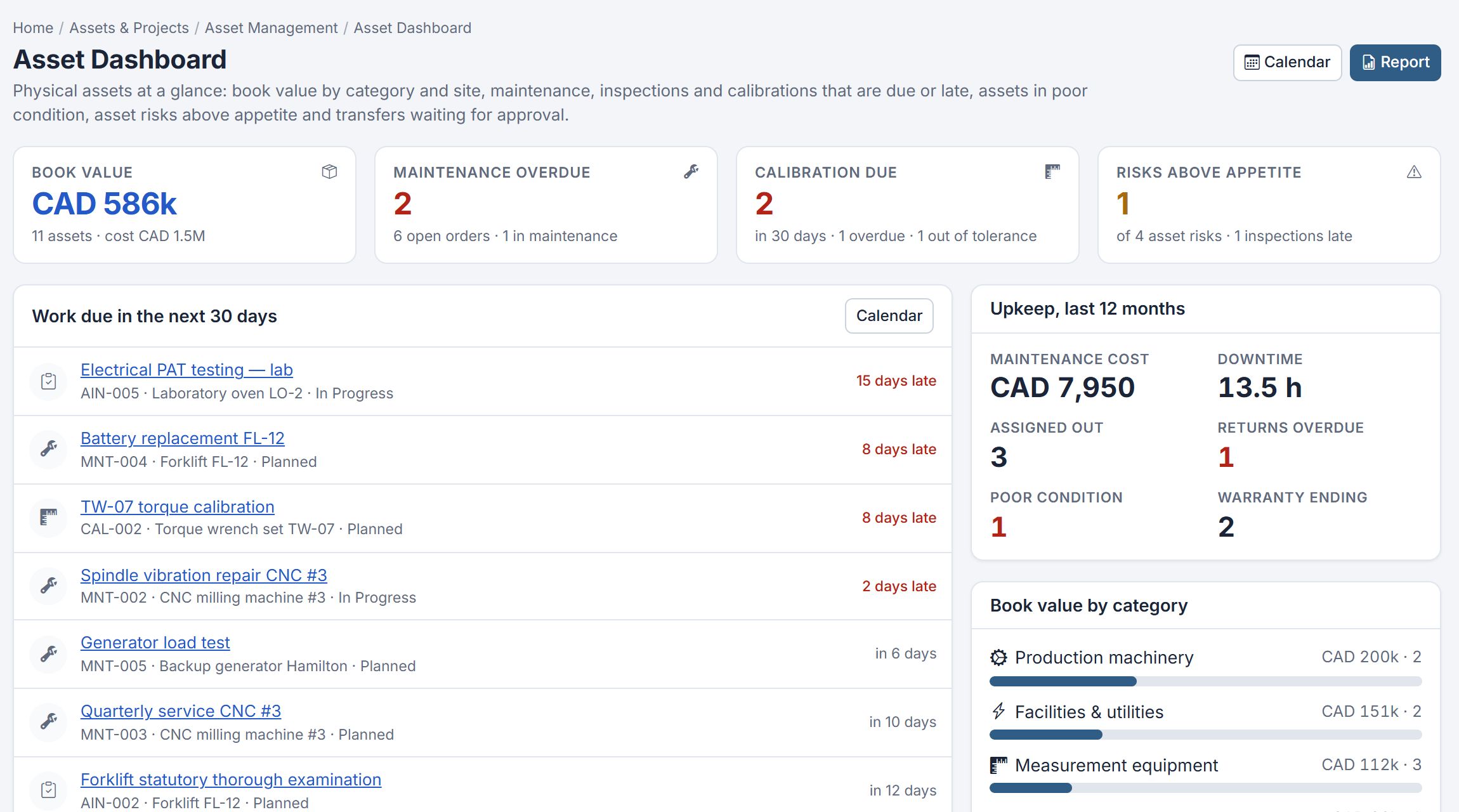
The asset dashboard shows maintenance due, overdue inspections and assets by status. See calibration management for ISO 9001 for measuring equipment.