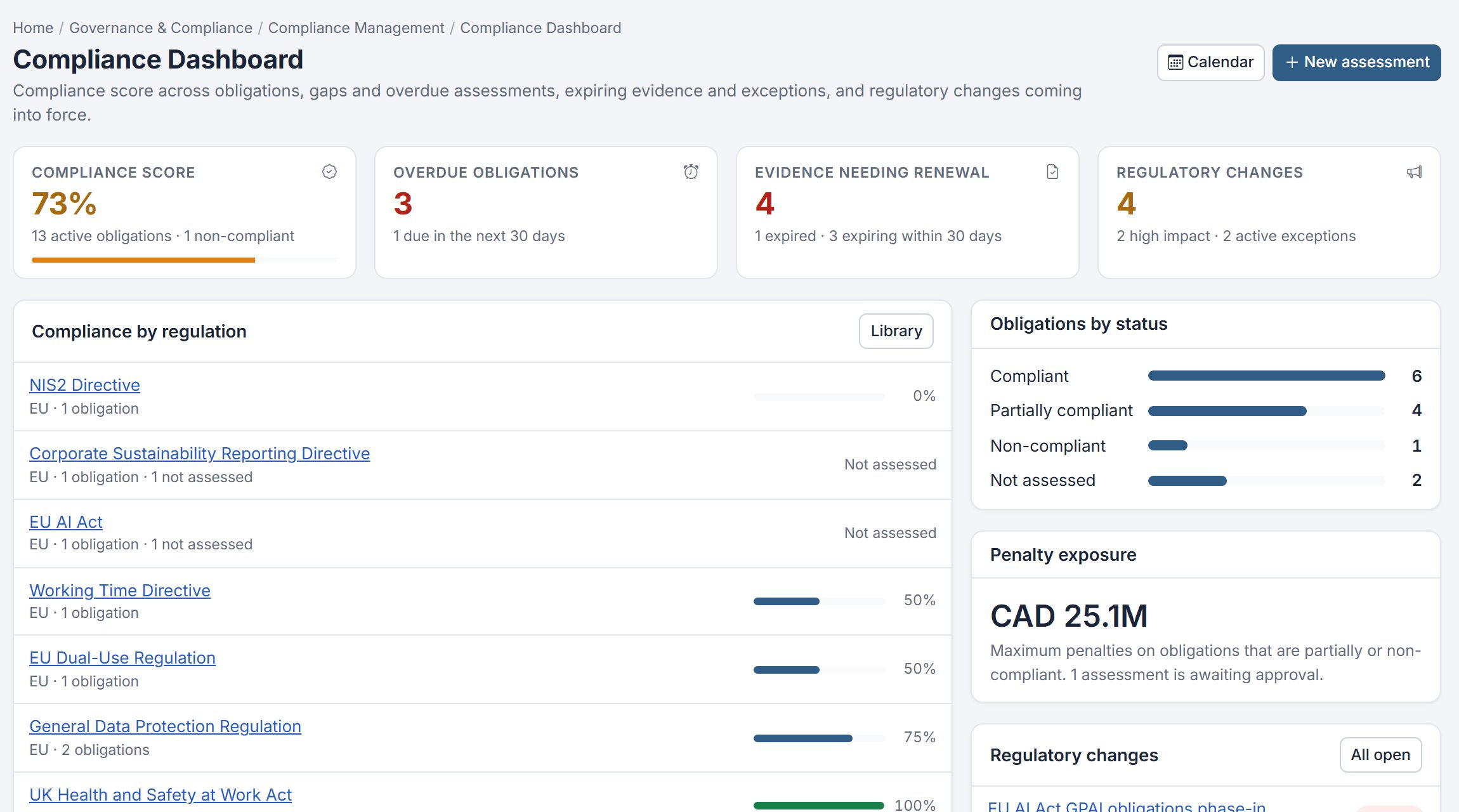
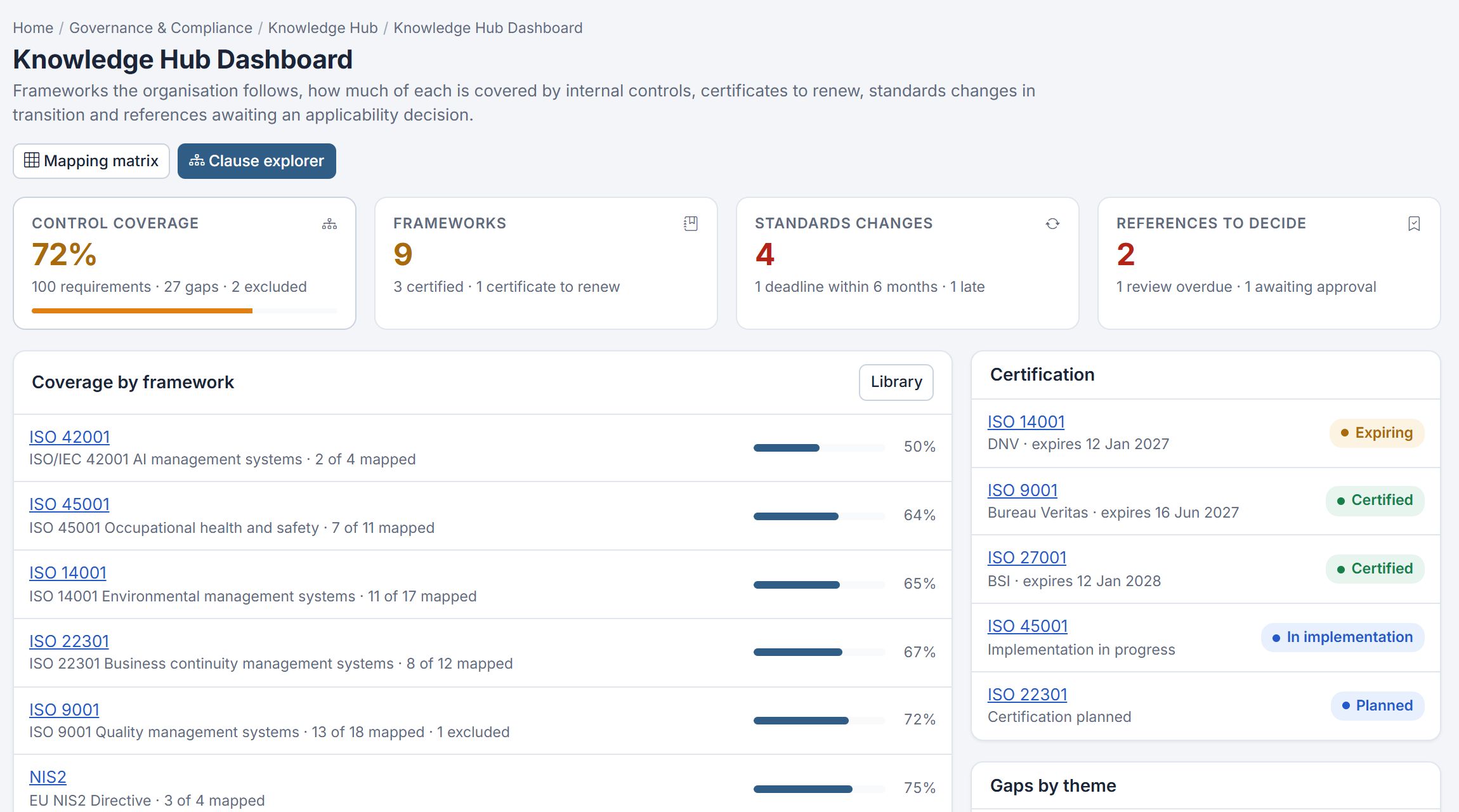
AI governance under ISO/IEC 42001 and the EU AI Act starts with an inventory.
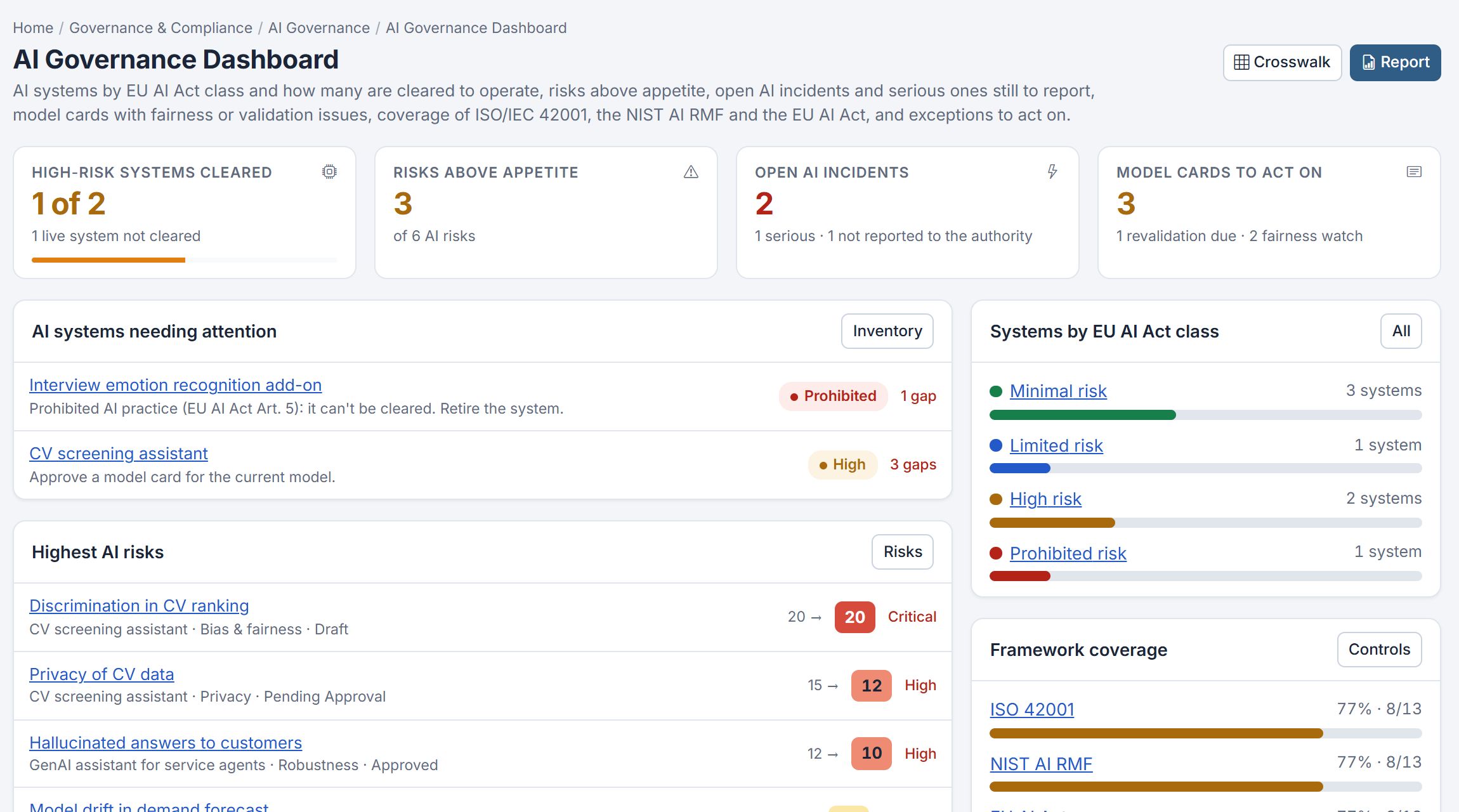
Start AI governance with an AI system inventory: EU AI Act classification, ownership, controls mapped across ISO/IEC 42001 and NIST AI RMF, and clearance.
The principle
You cannot govern AI systems you do not know you are using.
Most organisations already use AI, often more than they realise: built in-house, bought as products, or embedded in software they already license. Governance has to start with finding out what is there.
The inventory problem is real. AI features now appear in office software, customer service platforms, HR tools, analytics products and security systems, often enabled by default. Teams experiment with generative AI services without central approval. An organisation that has not looked may be surprised by both the number of AI systems in use and the decisions they influence.
01 · Start with context
Two frameworks, one starting point.
ISO/IEC 42001, published in December 2023, specifies requirements for an AI management system: AI policy, roles and responsibilities, AI risk assessment, AI system impact assessment, and controls for the responsible development, provision and use of AI systems. Like other ISO management system standards, it follows the harmonised structure, so it integrates with ISO 9001 and ISO/IEC 27001.
The EU AI Act, which entered into force in August 2024 with obligations applying in phases, takes a risk-based regulatory approach. It prohibits certain AI practices, imposes extensive obligations on high-risk AI systems, sets transparency obligations for certain AI systems, such as those interacting with people or generating content, and leaves minimal-risk systems largely unregulated. It also sets obligations for general-purpose AI models.
Both depend on knowing which AI systems exist and what they do.
Providers and deployers
The EU AI Act distinguishes between providers, who develop AI systems or place them on the market, and deployers, who use them under their own authority. Most organisations are deployers of many systems and providers of a few. Obligations differ significantly between the two roles, so the inventory should record which role the organisation plays for each system.
02 · Build the inventory
Every AI system, built, bought or used.
- What the system does and the decisions it supports.
- Whether it is developed, procured or embedded in another product.
- The owner accountable for it.
- The data it uses and the people it affects.
Procurement records, IT asset lists and department surveys are useful sources.
Finding embedded AI
Embedded AI is the hardest to find. Reviewing major software vendors’ product documentation and release notes, asking suppliers directly about AI features, and checking contracts for AI-related terms all help. Including AI questions in supplier due diligence ensures new systems are captured at procurement.
03 · Classify the risk
EU AI Act categories.
- Check whether the use falls into a prohibited practice.
- Determine whether it is a high-risk use case under the Act.
- Identify transparency obligations, such as informing people they are interacting with AI.
- Record the classification and the reasoning.
Classification determines which obligations and controls apply.
High-risk categories include AI used as a safety component of regulated products, and AI used in specified areas such as employment and worker management, access to essential services, education, law enforcement and critical infrastructure. Recruitment screening tools, for example, are a common high-risk use case for ordinary businesses.
04 · Map controls once
Across ISO/IEC 42001, NIST AI RMF and the EU AI Act.
The frameworks overlap substantially. A crosswalk lets one set of AI controls, such as data governance, human oversight, transparency, accuracy and robustness, and model validation, be mapped to requirements in all three, and applied to each system according to its classification.
The NIST AI Risk Management Framework, organised around the functions Govern, Map, Measure and Manage, provides practical guidance that complements both ISO/IEC 42001 and the EU AI Act.
05 · Clear before use
Gaps block clearance.
A system should be cleared for use only when its required controls, obligations, risk assessment and documentation are in place. Gaps, or time-limited exceptions, should be visible and owned.
Common pitfalls
- No inventory: governance policies written without knowing which AI systems exist.
- Embedded AI missed: AI features in existing software never assessed.
- Classification by assumption: high-risk uses, such as recruitment screening, assumed to be low risk.
- Clearance without controls: systems approved before required controls are in place.
06 · Certora AI governance
Inventory, classification and clearance.
Certora AI Governance governs every AI system the organisation builds, buys or uses: an inventory with EU AI Act classification and clearance, AI risk assessments, and a crosswalk of ISO/IEC 42001, NIST AI RMF and EU AI Act controls. Time-limited exceptions and AI incidents with authority reporting are managed alongside.
Read model cards and AI risk assessments for the documentation side.