Management review outputs are decisions, not minutes.
What ISO 9001 clause 9.3.3 expects as management review outputs, how to record decisions and actions, and how to approve minutes auditors trust.
The principle
If a management review produced no decisions, the system was either perfect or not really reviewed.
Auditors reading management review minutes look for one thing above all: evidence that top management made decisions about the system. Minutes that list presentations and end with "no further business" suggest a meeting that informed people but changed nothing.
The outputs of a management review are what turn it from a reporting ritual into genuine leadership of the management system. They are also what the next review builds on, because the status of previous actions is the first input the standard asks you to consider.
01 · Start with context
What clause 9.3.3 requires as outputs.
ISO 9001 clause 9.3.3 says the outputs of management review shall include decisions and actions related to:
- Opportunities for improvement.
- Any need for changes to the quality management system.
- Resource needs.
The organisation must retain documented information as evidence of the results of management reviews. In practice, that means minutes that clearly show what was decided and what will be done.
Other standards add their own expectations. ISO 14001 asks for conclusions on the continuing suitability, adequacy and effectiveness of the environmental management system, and any implications for strategic direction. ISO 45001 has similar language for occupational health and safety. An integrated review should record conclusions for each.
02 · Record decisions explicitly
One conclusion per agenda item.
Each input reviewed should end with a recorded conclusion, even when the conclusion is that no action is needed.
- State the finding: for example, supplier on-time delivery fell below target for two quarters.
- Record the decision: approve a supplier development programme for the two lowest performers.
- Note any resource implication: allocate a purchasing engineer for six months.
Explicit decisions make it obvious to any reader that the review did its job.
Recording "no action" properly
"Noted" is not a conclusion. If performance is acceptable, say so and say why: "Customer satisfaction remains above target at NPS 41; no action required; continue quarterly surveys." A recorded judgement that no action is needed is valid evidence. Silence is not.
03 · Turn decisions into actions
Owners, due dates and follow-up.
A decision without an owner tends to drift until the next review. Each action should be specific.
- What: a clear description of the action.
- Who: a named owner with the authority to deliver it.
- When: a realistic due date.
- Link: the agenda item, objective, risk or nonconformity it relates to.
Actions tracked like any other piece of work give the next review a clear status report, which is itself a required input.
Resource decisions deserve particular clarity, because they are one of the three output types the standard names explicitly. If the review agrees that the quality team needs another auditor, or that a calibration budget must increase, the minutes should state the decision and who will make it happen.
04 · Approve the minutes
The record should be reviewed and signed off.
Minutes are evidence, so they deserve the same control as any other record. A short approval step, by the chair or top management, confirms they are an accurate account of the meeting.
Approved minutes should not be edited afterwards. Corrections belong in a new revision or in the next review, so the original record stays intact.
Timeliness matters
Minutes approved weeks after the meeting lose much of their value. Actions start late, attendees forget the nuance of decisions, and the record looks like an afterthought. Aim to circulate draft minutes within a few days and approve them within a week or two.
05 · Close the loop
The next review starts with this one's actions.
The status of actions from previous management reviews is the first input in clause 9.3.2. When actions are tracked in the same system, that input is ready before the next meeting is even scheduled, and overdue actions are visible early.
Over several cycles, the action history also shows how leadership has improved the system, which is valuable context at recertification.
Common pitfalls
- Minutes as transcript: pages of discussion with no clear decisions.
- Actions without owners: "the team will look into it", which nobody delivers.
- Edited records: minutes changed months later to reflect what people wished they had decided.
- Forgotten actions: previous actions never reviewed, so the same issues return year after year.
06 · Certora management review
Decisions, actions and approved minutes.
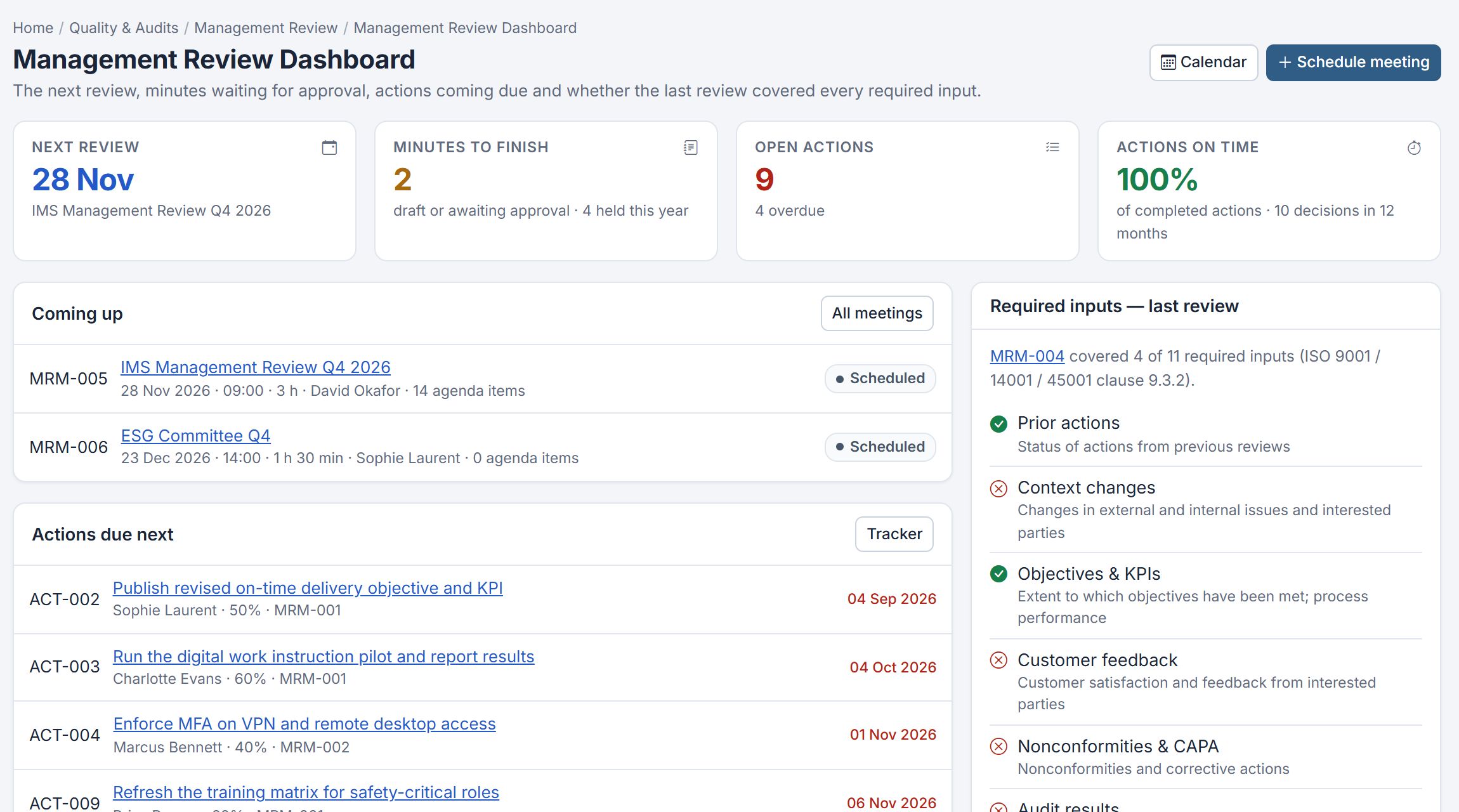
Certora Management Review runs the meeting with attendance and notes, records decisions and actions against the agenda, and approves the minutes in the system. Actions are tracked with owners and due dates, and their status flows into the agenda of the next review.
Because the agenda is built from live data across Certora, the minutes connect each decision to the audits, KPIs, risks and nonconformities behind it, giving auditors a complete trail from input to decision to result.
Read building the agenda from live data for the inputs side.