Testing internal controls: design first, then operating effectiveness.
How to test internal controls for design and operating effectiveness, record deficiencies and verify remediation, using a control library aligned with COSO.
The principle
A control that is well designed but not performed protects no one. A control performed perfectly but badly designed protects the wrong thing.
Internal controls are the checks that keep processes reliable: approvals, reconciliations, segregation of duties, reviews. Organisations usually have many of them. Fewer can show that each control is designed correctly and actually operating.
That distinction matters more than it first appears. A control that exists on paper gives management false comfort. Testing is how the organisation finds out, before an external auditor or an incident does, whether the controls it relies on would actually catch the problems they are meant to catch.
01 · Start with context
Why controls need testing.
Frameworks such as COSO’s Internal Control – Integrated Framework describe five components of an effective internal control system: the control environment, risk assessment, control activities, information and communication, and monitoring activities. Monitoring includes ongoing and separate evaluations to ascertain whether each component is present and functioning.
ISO management system standards make a similar point in their own language: controls introduced to treat risks should be evaluated for effectiveness, and internal audits should provide information on whether the system is effectively implemented.
Who tests
Testing can be performed by control owners as self-assessment, by a dedicated internal control or compliance function, or by internal audit. Many organisations use a combination: owners self-assess frequently, a second line tests key controls periodically, and internal audit provides independent assurance. Whatever the model, the person testing a control should not be the person who performs it.
02 · Build the control library
Know what you rely on.
- Control description: what is done, by whom, how often.
- Objective: which risk or requirement the control addresses.
- Type: preventive or detective, manual or automated.
- Key or non-key: whether reliance on it is critical.
- Owner: the position that performs or oversees it.
Key controls deserve the most frequent and rigorous testing.
Writing a testable control
A good control description answers who, what, when, how and with what evidence. "Finance reviews payments" is untestable. "Each week, the finance manager reviews all supplier payments above $10,000 against approved purchase orders, signs the payment run report and files it in the payments folder" can be tested, because it says exactly what evidence should exist.
03 · Test design
Would the control work if performed as described?
A test of design asks whether the control, as described, would prevent or detect the risk it targets. It is usually done by walking through the process, reviewing the control description and challenging gaps.
For example, a purchase approval control designed with a threshold above most transactions may be performed perfectly and still miss the risk.
Design tests should also consider timing and precision. A monthly reconciliation cannot prevent a fraudulent payment made on the second of the month; at best it detects it weeks later. Whether that is acceptable depends on the risk, which is exactly the judgement a design test makes explicit.
04 · Test operating effectiveness
Is it performed consistently?
- Select a sample of occurrences across the testing period.
- Inspect evidence that the control was performed each time.
- Check it was performed by the right person, on time, as designed.
- Record exceptions and conclude on effectiveness.
Sample sizes typically increase with the frequency of the control and the reliance placed on it.
Typical sample sizes
Practice varies, but common guidance scales samples with frequency: one or two instances for an annual control, a few for a quarterly control, more for monthly, and larger samples for weekly, daily or transaction-level controls. Automated controls can often be tested with a single instance plus evidence that the underlying system configuration has not changed.
05 · Remediate deficiencies
Through to verified closure.
When a test fails, the result is a deficiency. Each deficiency needs a severity rating, a remediation plan with an owner and due date, and a retest once remediation is complete. Closing a deficiency without a retest leaves the original question unanswered.
Open deficiencies, especially in key controls, are important information for governance committees and management review.
Severity typically reflects both the likelihood that the deficiency could lead to a significant error or loss and the magnitude of that impact. Several minor deficiencies affecting the same process can together amount to a significant weakness, so aggregation deserves a look before reporting.
Common pitfalls
- Untestable descriptions: controls written so vaguely that no evidence could prove they were performed.
- Testing your own control: owners certifying their own controls with no independent check.
- Design never questioned: operating tests repeated every year on a control that was poorly designed from the start.
- Closing without retesting: deficiencies marked remediated on the owner’s word.
06 · Certora governance & internal controls
Controls tested and deficiencies remediated.
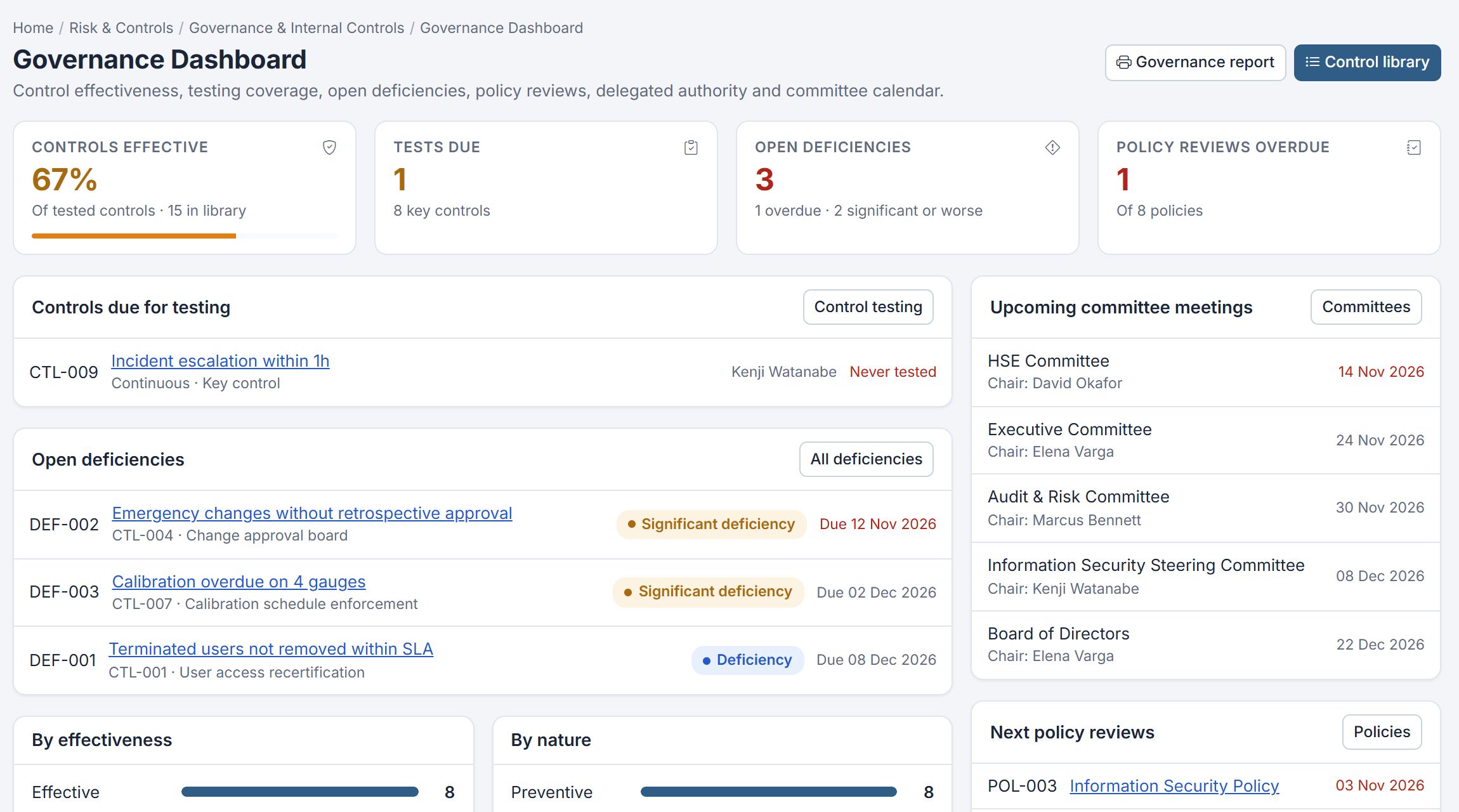
Certora Governance & Internal Controls runs the internal control system: policies with owners and review cycles, a library of key and non-key controls, and tests of design and operating effectiveness. Deficiencies are tracked through to verified remediation.
Delegated authority and governance committees are managed in the same module, controls can be mapped to clause-level requirements in the Knowledge Hub, and the governance dashboard shows control effectiveness and open deficiencies. Read keeping approvals within delegated limits for the authority side of governance.