Incident reporting works when reporting takes a minute.
How to design incident reporting people actually use, then triage, investigate, assess impact and raise corrective actions in line with ISO 45001 and ISO 9001.
The principle
If reporting an incident is hard, the incidents still happen. You just stop hearing about them.
The quality of an incident management system is decided at the very first step. When reporting means finding a form, filling in twenty fields and chasing a manager, people report only the incidents they cannot avoid reporting. The rest disappear, along with the lessons they carried.
Underreporting is one of the most persistent problems in safety, quality and security management. Studies of workplace safety have long suggested that serious incidents are preceded by many minor events and near misses. Each unreported event is a missed chance to fix a weakness before it causes real harm.
01 · Start with context
Incidents feed improvement.
ISO 45001 clause 10.2 requires organisations to establish processes to manage incidents and nonconformities: react in a timely manner, evaluate with the participation of workers whether corrective action is needed, investigate and determine causes, take corrective action, review the effectiveness of actions taken, and communicate documented information to relevant workers.
ISO 9001 clause 10.2 asks the same for nonconformities, and ISO/IEC 27001 for information security events and incidents. None of that is possible without reliable reporting.
What counts as an incident
Definitions should be broad enough to capture what matters. Typical categories include injuries and ill health, near misses, property damage, environmental releases, quality escapes reaching customers, security breaches and service failures. A clear, inclusive definition, communicated widely, tells people that reporting is expected rather than exceptional.
02 · Make reporting easy
Capture first, enrich later.
- A short form anyone can complete in about a minute.
- Only the essentials: what happened, where, when and who was involved.
- Available on any device, including at the location of the incident.
- Optional anonymity where it helps people speak up.
Details can be added by the person who triages the report.
Culture matters as much as tools
Even the simplest form will not be used if people fear blame. Leaders who thank people for reporting, respond visibly to reports and focus investigations on systems rather than individuals build a culture where reporting is normal. Feeding back to reporters, telling them what was done with their report, is one of the most effective ways to sustain it.
03 · Triage quickly
Decide severity and next steps.
- Confirm the facts and classify the incident type.
- Assess severity and immediate risk.
- Take immediate actions to make the situation safe.
- Assign an investigator proportionate to the severity.
Fast triage also identifies incidents that must be reported to regulators within statutory deadlines.
Severity scales should consider both actual and potential outcomes. A near miss that could have caused a fatality deserves a more thorough investigation than a minor injury with no potential for worse, even though no one was hurt.
04 · Investigate properly
Chronology, impact and cause.
A good investigation builds a chronology of events, assesses the actual and potential impact, and determines the root cause using structured methods such as 5 Whys. The aim is to understand why the incident was possible, not to assign blame.
Interviews should happen soon after the event, while memories are fresh, and should include the people involved, witnesses and those who know how the work is normally done. Physical evidence, records and photographs should be secured early. ISO 45001’s emphasis on worker participation applies here: the people who do the work often understand the causes best.
05 · Act and close
Corrective actions with approval.
Corrective actions should address the root cause and be tracked with owners and due dates. Closure should require approval once actions are complete, so incidents are not closed simply because the investigation report was written.
Statistics on incident types, severity and trends give management and regulators the picture they need.
Common pitfalls
- Complex reporting forms: so many fields that people give up or never start.
- Blame-focused investigation: "operator error" as the conclusion, which discourages future reporting.
- Missed statutory deadlines: reportable incidents not identified at triage.
- Closed on report, not action: incidents marked complete before corrective actions are done.
06 · Certora incident management
From a one-minute report to approved closure.
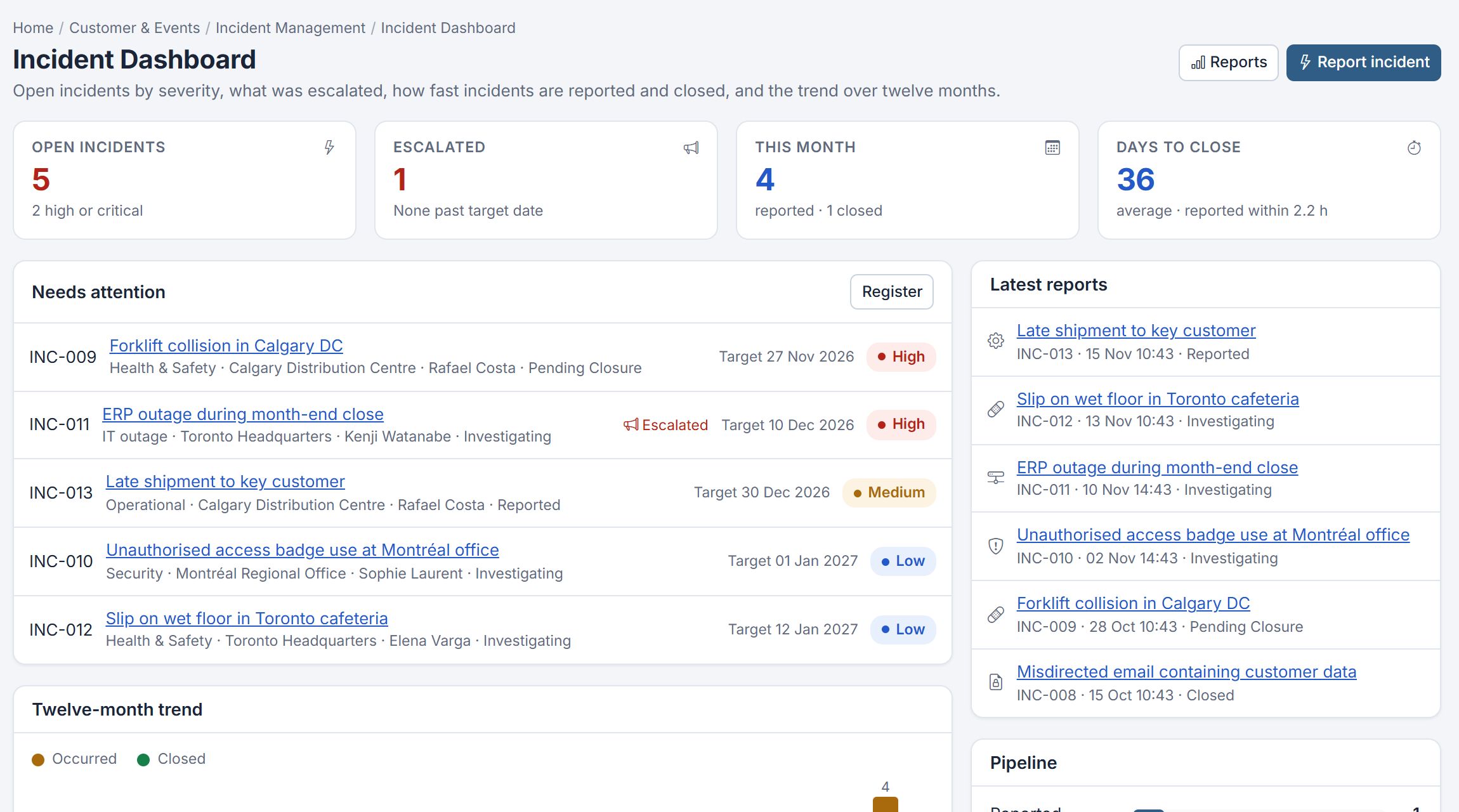
Certora Incident Management lets anyone report an incident in a minute, then supports triage, investigation, impact assessment and a chronology of events. Corrective actions are raised and tracked, lessons learned are captured, and incidents close with approval.
Incident statistics serve management and regulators, and the incident dashboard shows open incidents by severity and age. Read turning lessons learned into prevention for what happens after closure.