Lessons learned only count when they change what people do next.
How to capture incident lessons learned, share them across sites and teams, and turn them into changes that prevent similar incidents elsewhere.
The principle
An incident fixed in one place but repeated in another was investigated, not learned from.
Most incident processes end with corrective actions for the location where the incident happened. The same weakness often exists in other teams, sites or processes, and the next incident there is a surprise only because the lesson never travelled.
Organisations with several sites, shifts or similar processes are especially exposed. A guard missing from a machine at one site is a sign that the same model of machine at another site may have the same gap. A data entry error in one region’s system may be possible in every region. Learning from incidents means asking those questions systematically.
01 · Start with context
Learning is part of improvement.
ISO 45001 clause 10.2 asks organisations to determine whether similar incidents have occurred, whether nonconformities exist, or whether they could potentially occur. Clause 10.3 calls for continual improvement of the suitability, adequacy and effectiveness of the management system. ISO 9001 clause 10.2.1 b) similarly asks whether similar nonconformities exist or could occur elsewhere.
Lessons learned are the mechanism that answers those questions.
Learning from success too
Some organisations also study events that went well: an emergency handled effectively, a near miss caught by an alert worker, a recovery completed ahead of target. Understanding why things go right reveals capabilities worth protecting and spreading, which complements learning from failure.
02 · Capture the lesson
Write it for someone who was not there.
- What happened, in plain language.
- Why it was possible: the underlying cause, not just the trigger.
- What was changed as a result.
- Where else the same conditions might exist.
A lesson written in the language of the investigation report rarely reaches the people who need it.
A short format helps: a title that describes the hazard or failure, two or three sentences on what happened, one sentence on the cause, and a clear statement of what others should check or change. A photograph or simple diagram often communicates more than paragraphs of text.
03 · Ask the "where else" question
Look across the organisation.
- Identify other sites, processes or teams with similar equipment, tasks or conditions.
- Ask their owners to check for the same weakness.
- Raise preventive actions where it exists.
- Record the result, including where the weakness was not found.
This step is what turns a corrective action into prevention.
Making it routine
The "where else" review works best as a required step before an incident can be closed, at least for incidents above a given severity. When it is optional, it tends to be skipped under time pressure. Recording which locations were checked, and the outcome at each, also gives management evidence that lessons are being applied.
04 · Share deliberately
Through the channels people use.
Lessons can be shared through safety briefings, team meetings, toolbox talks and updates to procedures and training. High-severity lessons may justify an organisation-wide alert. The aim is that people who perform similar work hear about it in a form they can apply.
Searchability matters for the long term. A lessons-learned library, searchable by equipment, task, location and cause, lets planners and engineers check for relevant lessons before starting new work, rather than relying on someone remembering an incident from three years ago.
05 · Look for patterns
Trends reveal systemic causes.
Individual incidents tell one story. Trends across many incidents reveal systemic issues: a recurring cause, a location with rising frequency, a type of task involved again and again. Regular trend analysis, reported to management review, helps target improvement where it matters most.
Leading indicators complement incident counts. The number of near misses reported, the proportion of investigations completed on time and the share of preventive actions closed show whether the learning system itself is healthy, not just whether incidents happened.
Common pitfalls
- Local fixes only: corrective action at the incident site, with no check elsewhere.
- Lessons in reports nobody reads: findings buried in long investigation documents.
- No searchable history: lessons lost when the people involved move on.
- Counting only incidents: no leading indicators of how well learning is working.
06 · Certora incident management
Lessons learned captured on every incident.
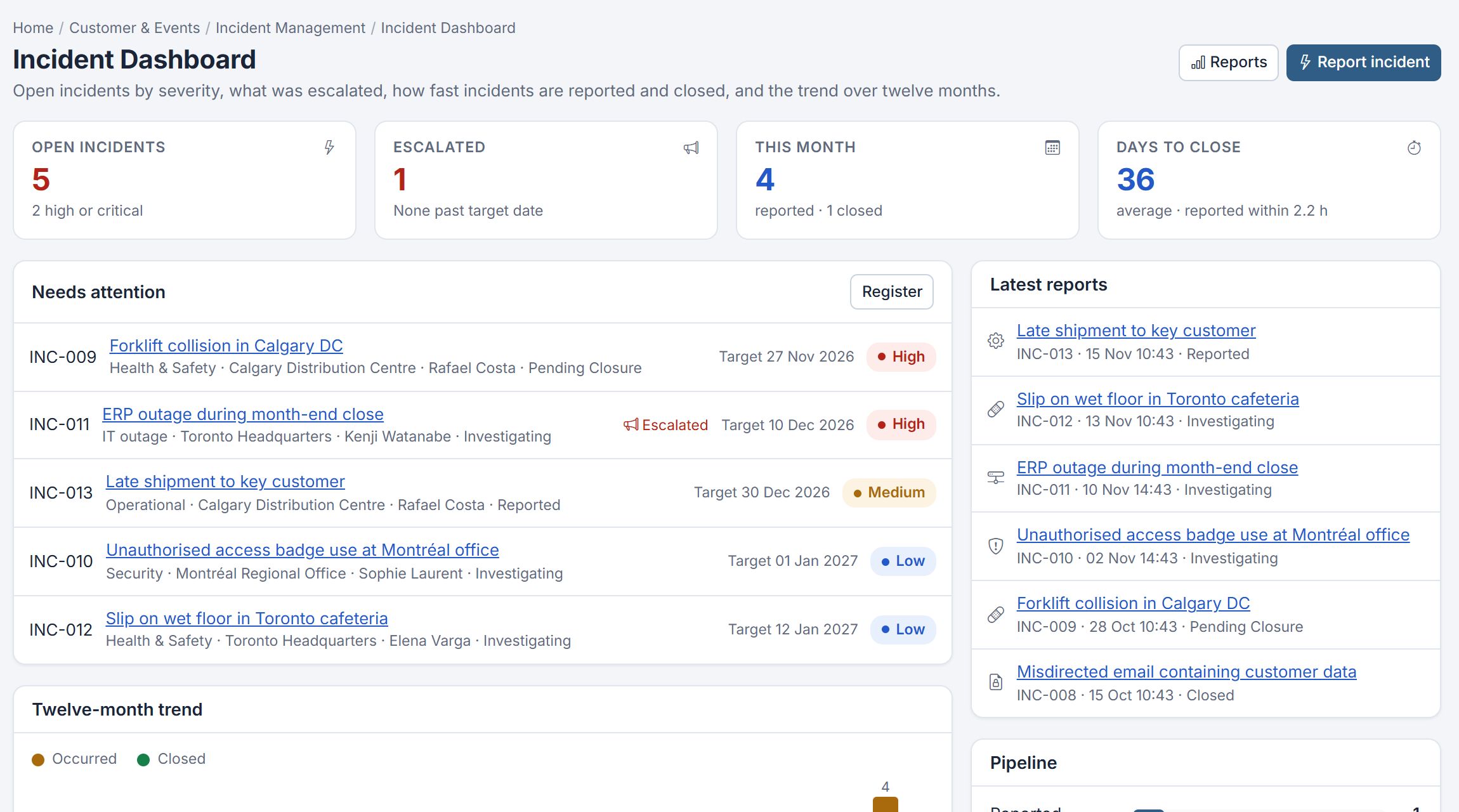
Certora Incident Management captures lessons learned as part of closing each incident, alongside the chronology, impact assessment, root cause and corrective actions. Incident statistics show trends by type, severity and location for management and regulators.
Corrective actions can connect to Nonconformity & CAPA for effectiveness review. See incident reporting that people actually use for the reporting side.