Hazard identification under ISO 45001 is continuous, not annual.
How to meet ISO 45001 clause 6.1.2: ongoing hazard identification, risk assessment, the hierarchy of controls, residual ratings, inspections and near misses.
The principle
Hazards change every time work changes. Identification has to keep pace with the work.
A hazard register completed once a year captures the workplace as it was on the day of the assessment. New equipment, new tasks, contractors and temporary layouts create hazards that the register never sees, until something goes wrong.
Workplaces change continuously, and the hazards in them change with every change in work. A safety management system that only looks for hazards at fixed intervals will always be behind. ISO 45001 asks for identification that keeps pace with the work, drawing on every source of information the organisation has.
01 · Start with context
What clause 6.1.2 requires.
ISO 45001 clause 6.1.2.1 requires the organisation to establish, implement and maintain processes for hazard identification that are ongoing and proactive. They must take into account, among other things:
- How work is organised, social factors, leadership and culture.
- Routine and non-routine activities and situations.
- Past relevant incidents, internal or external, including emergencies, and their causes.
- Potential emergency situations.
- People, including workers, contractors, visitors and others.
- Other issues, such as the design of work areas, processes, equipment and procedures.
- Actual or proposed changes in organisation, operations, processes, activities and the management system.
- Changes in knowledge of, and information about, hazards.
Clause 6.1.2.2 then requires assessment of the occupational health and safety risks arising from those hazards. The word "ongoing" is the important one.
02 · Identify hazards
From many sources.
- Task and workplace inspections.
- Near miss and hazard reports from workers.
- Incident investigations.
- Changes to equipment, materials, processes or people.
- Worker consultation and participation, which ISO 45001 emphasises.
Psychosocial hazards
ISO 45001 explicitly includes social factors such as workload, work hours, harassment and leadership. Psychosocial hazards are increasingly recognised as significant contributors to ill health, and ISO 45003 provides guidance on managing them. A complete hazard register considers them alongside physical, chemical, biological and ergonomic hazards.
03 · Assess and control
The hierarchy of controls.
- Rate the risk before controls, using likelihood and severity.
- Apply controls in order of effectiveness: eliminate, substitute, engineer, administer, and finally personal protective equipment.
- Rate the residual risk with controls in place.
- Record required PPE and training for the task.
Clause 8.1.2 of ISO 45001 sets out this hierarchy explicitly.
Why the hierarchy matters
Controls higher in the hierarchy are more reliable because they depend less on human behaviour. Eliminating a hazard, such as designing out a need to work at height, removes the risk entirely. PPE, at the bottom, protects only if it is worn correctly every time. Relying on PPE when higher-level controls are practicable is a common audit finding.
04 · Inspect regularly
Confirm controls are working.
Inspections check that controls exist and work as intended. A failed inspection item should lead to a corrective action, so problems are fixed rather than recorded and forgotten.
Inspection checklists should be based on the hazards and controls in the register, not generic templates. An inspection of a warehouse should check the specific controls identified for forklift traffic, racking and manual handling in that warehouse.
05 · Learn from near misses
Free lessons before harm occurs.
Near misses are incidents without injury. They reveal hazards and control weaknesses at no human cost. Making near miss reporting easy, including anonymously, and linking reports back to the hazard register keeps identification continuous.
Every near miss should prompt a question: is this hazard already in the register, and were the controls adequate? If not, the register should be updated, closing the loop between reporting and assessment.
Common pitfalls
- Annual assessment only: hazards identified once a year, missing changes in between.
- PPE as first resort: reliance on protective equipment where engineering controls are possible.
- Workers not consulted: assessments done by specialists without input from those doing the work.
- Near misses not linked: reports filed without updating the hazard register.
06 · Certora health, safety & environment
Hazards, assessments, inspections and near misses.
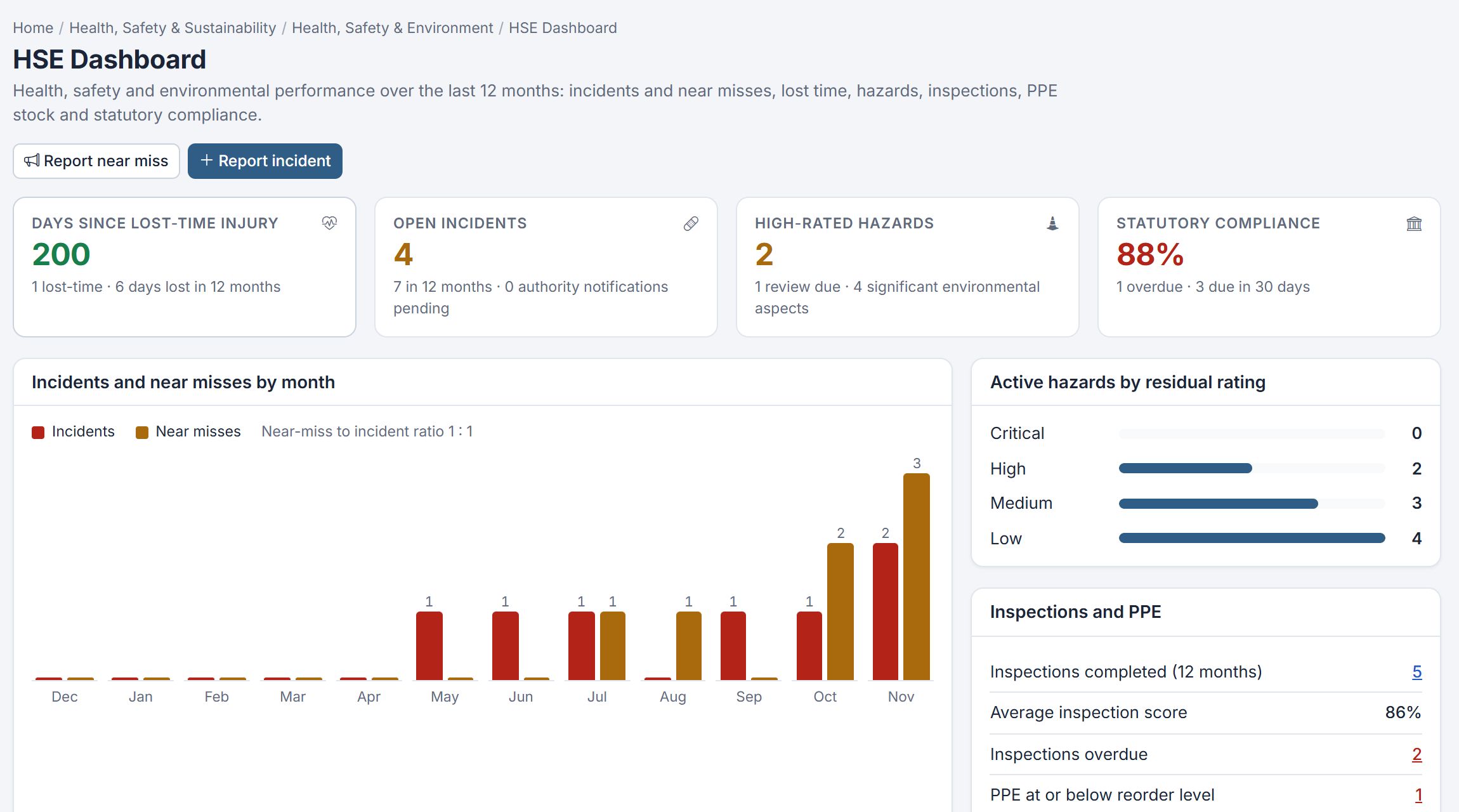
Certora Health, Safety & Environment keeps hazards with residual ratings, safety risk assessments, inspections and near misses, linked so that findings update the hazard register. Failed inspections require a CAPA, and HSE incidents are managed with lost time and statutory reporting, alongside PPE stock and statutory requirements.
Read environmental aspects for ISO 14001 for the environmental side.