A double materiality assessment decides what your ESG reporting should cover.
A practical approach to double materiality assessment: impact and financial materiality, stakeholder input, scoring, thresholds and links to ESG objectives.
The principle
Materiality is the filter for everything else in ESG. Get it wrong and you will measure the wrong things very carefully.
Sustainability reporting can cover an almost unlimited range of topics. A materiality assessment decides which ones matter for your organisation, and double materiality asks that question from two directions at once.
The assessment shapes everything that follows: which metrics are collected, which objectives are set, which disclosures appear in the sustainability statement, and where management attention goes. A weak assessment leads either to reports full of immaterial topics or, worse, to material issues left out entirely.
01 · Start with context
Two perspectives on materiality.
Double materiality considers both:
- Impact materiality: the organisation’s actual and potential impacts on people and the environment, across its own operations and value chain.
- Financial materiality: sustainability matters that affect, or could reasonably be expected to affect, the organisation’s financial position, financial performance, cash flows, access to finance or cost of capital over the short, medium or long term.
A topic is material if it meets either test. The concept is central to the European Sustainability Reporting Standards (ESRS) under the Corporate Sustainability Reporting Directive (CSRD), and is widely used as good practice beyond the EU.
How it differs from single materiality
Frameworks focused on investors, such as the ISSB’s IFRS Sustainability Disclosure Standards, centre on financial materiality: how sustainability matters affect the company. Double materiality adds the outward-facing view: how the company affects the world. Organisations reporting under several frameworks often run one double materiality assessment and derive each framework’s requirements from it.
02 · List the topics
Start broad.
- Compile candidate topics from reporting frameworks, industry peers and your value chain.
- Group them into environmental, social and governance themes.
- Describe each topic in terms specific to your operations.
Topical standards in ESRS, GRI and sector guidance provide useful starting lists. The aim at this stage is completeness: it is easier to screen out an irrelevant topic than to discover later that a material one was never considered.
03 · Involve stakeholders
Evidence from those affected.
Impact materiality depends on understanding how people and the environment are affected. Input from employees, customers, suppliers, communities and investors, through surveys, interviews or existing data, makes the assessment credible.
Value chain matters
Many of an organisation’s most significant impacts sit in its value chain rather than its own operations: working conditions at suppliers, emissions from purchased goods, or the end-of-life treatment of products sold. Double materiality expects the value chain to be considered, which often means engaging suppliers and using sector data where direct data is unavailable.
04 · Score and threshold
Consistent criteria for both lenses.
- For impacts: scale, scope, irremediability and likelihood.
- For financial effects: magnitude and likelihood over short, medium and long term.
- Apply thresholds to each lens and record the rationale.
A materiality matrix plotting both dimensions helps communicate the result.
Documentation is essential. Assurance providers and regulators will want to see how topics were identified, who was consulted, how scores were assigned and why thresholds were set where they were. A transparent, repeatable method is worth more than a polished matrix.
05 · Act on the result
Material topics drive objectives and metrics.
Material topics should lead to measurable ESG objectives, the metrics that track them, and the disclosures in your sustainability statement. Reassess materiality periodically and when the business or its context changes significantly.
Materiality also connects to risk management. Topics that are financially material are, by definition, sources of risk or opportunity, and belong in the enterprise risk register alongside other business risks.
Common pitfalls
- Matrix as output: a chart produced and admired, with no link to metrics or objectives.
- Desk-based only: assessments done without real stakeholder input.
- Own operations only: value chain impacts left out of scope.
- No audit trail: scores and thresholds that cannot be explained to an assurer.
06 · Certora ESG management
Materiality to sustainability statement.
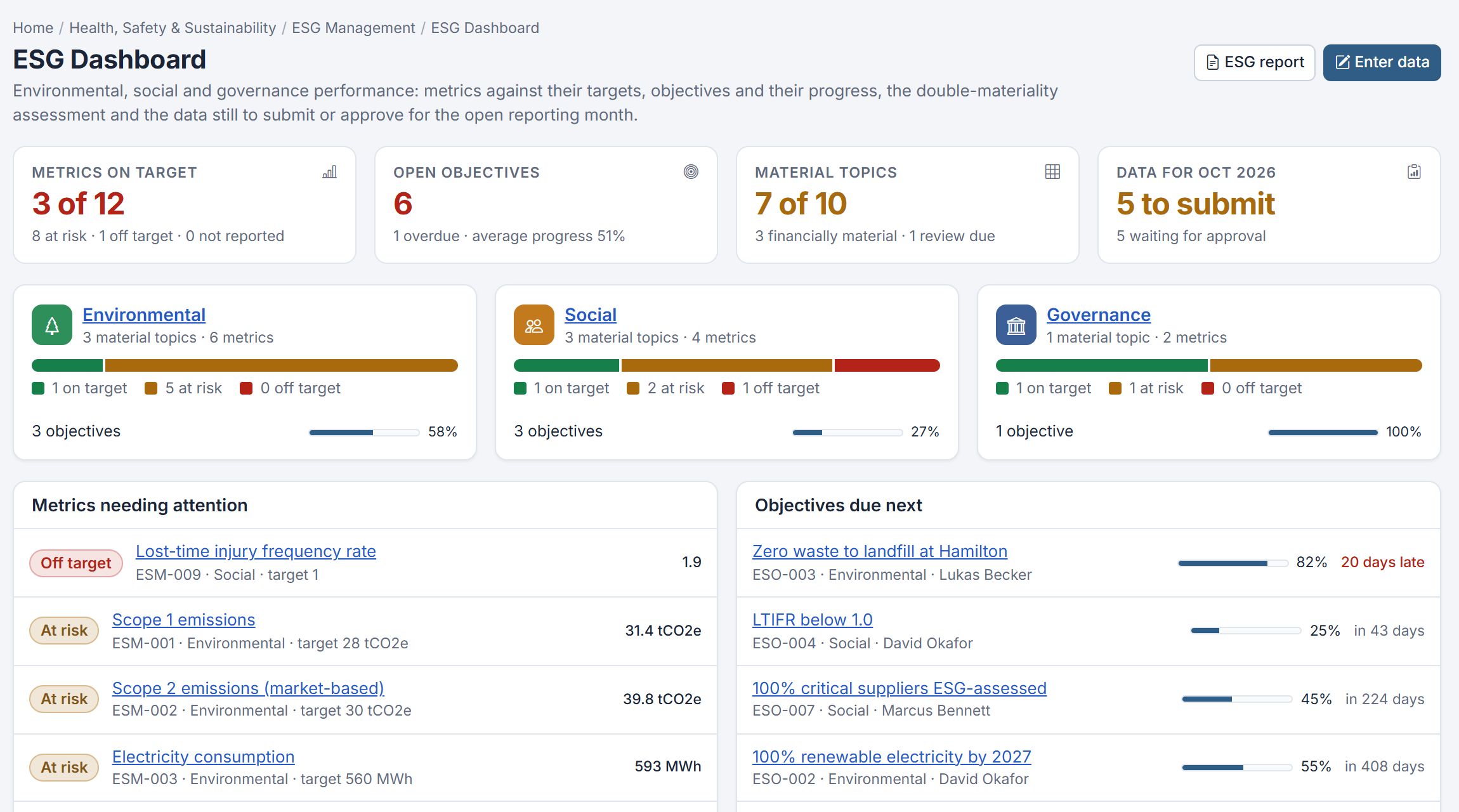
Certora ESG Management assesses double materiality, sets measurable ESG objectives, and collects monthly ESG metrics with independent approval. Environmental, social and governance performance is followed in one place, and a sustainability statement is published from the same data.
Read ESG metrics with independent approval for how the data is collected.