Environmental aspects become manageable when significance is assessed consistently.
How to identify environmental aspects and impacts for ISO 14001 clause 6.1.2, assess significance consistently, and link aspects to obligations and controls.
The principle
Every activity has environmental aspects. The work is deciding which are significant, and then controlling those.
An aspects register can easily grow to hundreds of lines, each describing an activity and its effect on the environment. Without a consistent way to decide what is significant, the register becomes a list rather than a management tool.
Significance is what turns the register into decisions. Significant aspects drive environmental objectives, operational controls, monitoring and training. When significance is decided inconsistently, or by whoever filled in the spreadsheet, the environmental management system ends up controlling the wrong things.
01 · Start with context
What clause 6.1.2 requires.
ISO 14001 clause 6.1.2 requires the organisation, within the defined scope of the environmental management system, to determine the environmental aspects of its activities, products and services that it can control and those it can influence, and their associated environmental impacts, considering a life cycle perspective.
When determining aspects, the organisation must take into account change, including planned or new developments and new or modified activities, products and services, and abnormal conditions and reasonably foreseeable emergency situations. It must determine which aspects have or can have a significant environmental impact, using established criteria, and communicate significant aspects among the various levels and functions as appropriate.
Aspect versus impact
An aspect is an element of an activity that can interact with the environment, such as electricity use or solvent emissions. An impact is the resulting change to the environment, such as greenhouse gas emissions or air pollution. The register records both, because controls act on aspects while significance is judged by impacts.
02 · Identify aspects
Activity by activity.
- Emissions to air: from boilers, vehicles, processes.
- Releases to water and land: effluent, spills.
- Use of resources: energy, water, raw materials.
- Waste: hazardous and non-hazardous.
- Other: noise, odour, biodiversity.
Consider normal, abnormal and emergency conditions for each activity.
Life cycle perspective
The life cycle perspective asks the organisation to consider stages it can control or influence, from raw material acquisition through design, production, transport, use, end-of-life treatment and disposal. This does not require a formal life cycle assessment, but it does mean looking beyond the factory gate, for example at the packaging customers dispose of or the energy a product uses in service.
03 · Assess significance
Criteria applied the same way every time.
- Define criteria such as severity, scale, frequency and legal requirements.
- Score each aspect against the criteria.
- Apply a threshold to identify significant aspects.
- Record the result and the reasoning.
Aspects linked to a compliance obligation are often treated as significant regardless of score.
Interested party concerns
Criteria can also include the concerns of interested parties. An aspect with a modest environmental effect might still be significant if neighbours, regulators or customers are particularly concerned about it, such as noise near a residential area or odour from a waste facility.
04 · Link to obligations and controls
Make significance actionable.
Each significant aspect should link to the compliance obligations that apply to it, such as permits and emission limits, and to the operational controls that manage it. This connection makes it clear why each control exists.
Significant aspects should also inform environmental objectives under clause 6.2, training needs under clause 7.2, and emergency preparedness under clause 8.2. An aspect linked to all of these is genuinely managed; one that only appears in the register is not.
05 · Monitor and review
Aspects change with operations.
New products, processes, sites and suppliers change aspects. Reviewing the register when changes occur, and at least annually, keeps significance current. Monitoring results, such as energy use or waste volumes, show whether controls are effective.
Common pitfalls
- Inconsistent scoring: significance decided differently by different people.
- Normal conditions only: spills, start-ups and emergencies left out of the register.
- Gate-to-gate view: life cycle stages the organisation can influence ignored.
- Significance without action: significant aspects with no linked controls or objectives.
06 · Certora health, safety & environment
Environmental aspects with significance.
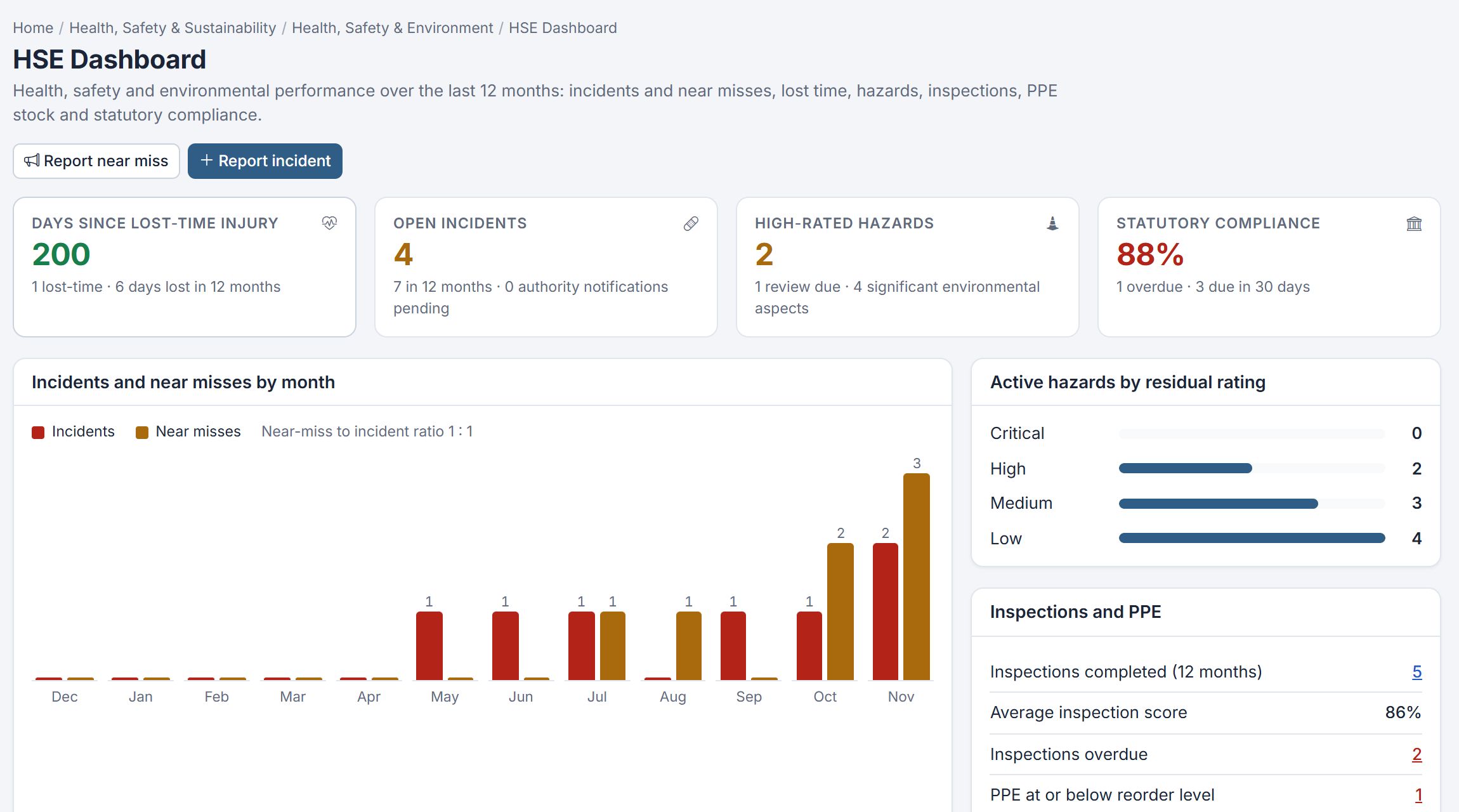
Certora Health, Safety & Environment manages environmental aspects with significance, linked to obligations and assets, alongside statutory requirements completed with compliance evidence. Hazards, inspections, near misses and HSE incidents are managed in the same module, so environmental and safety management share one record.
See hazard identification under ISO 45001 for the safety side.