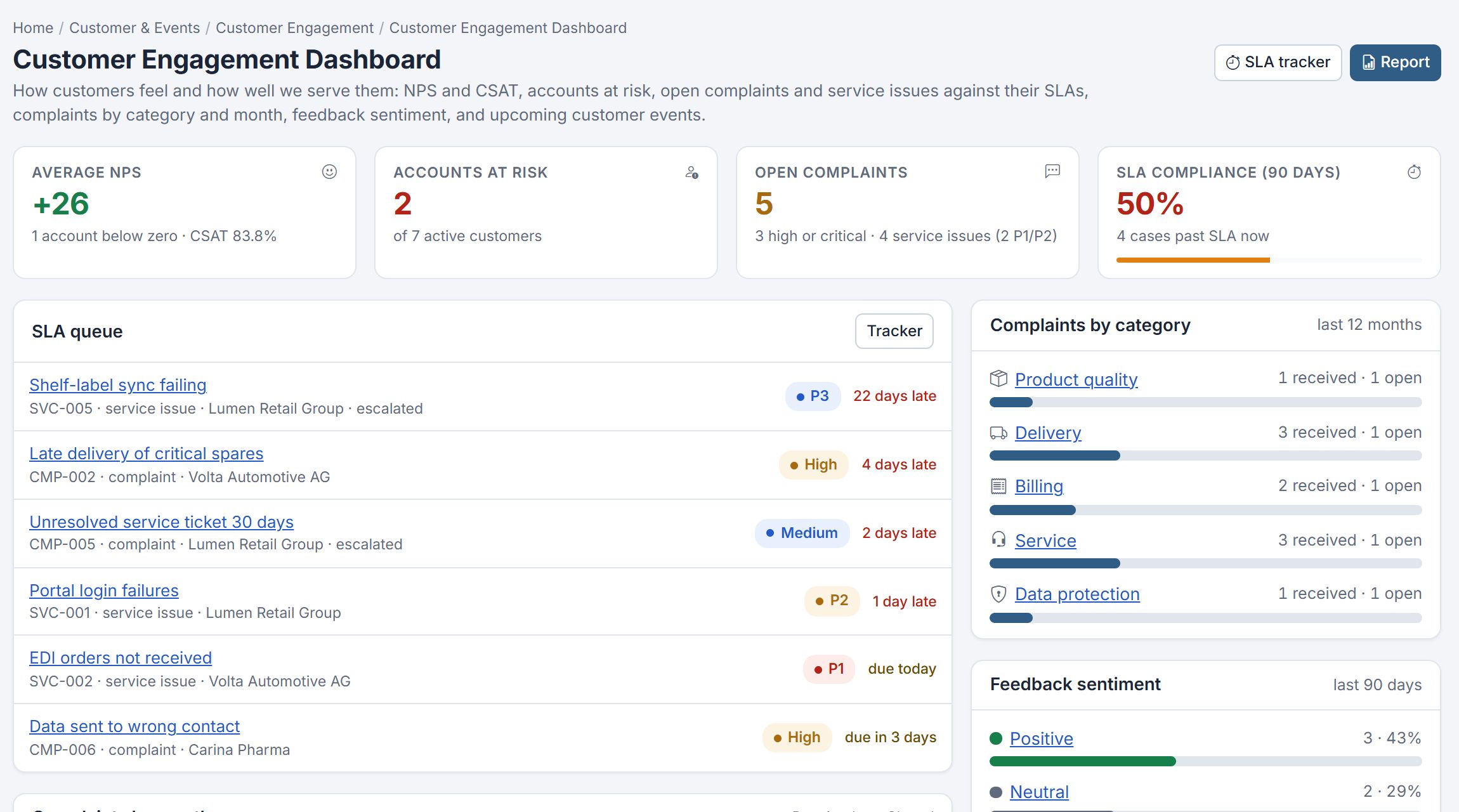
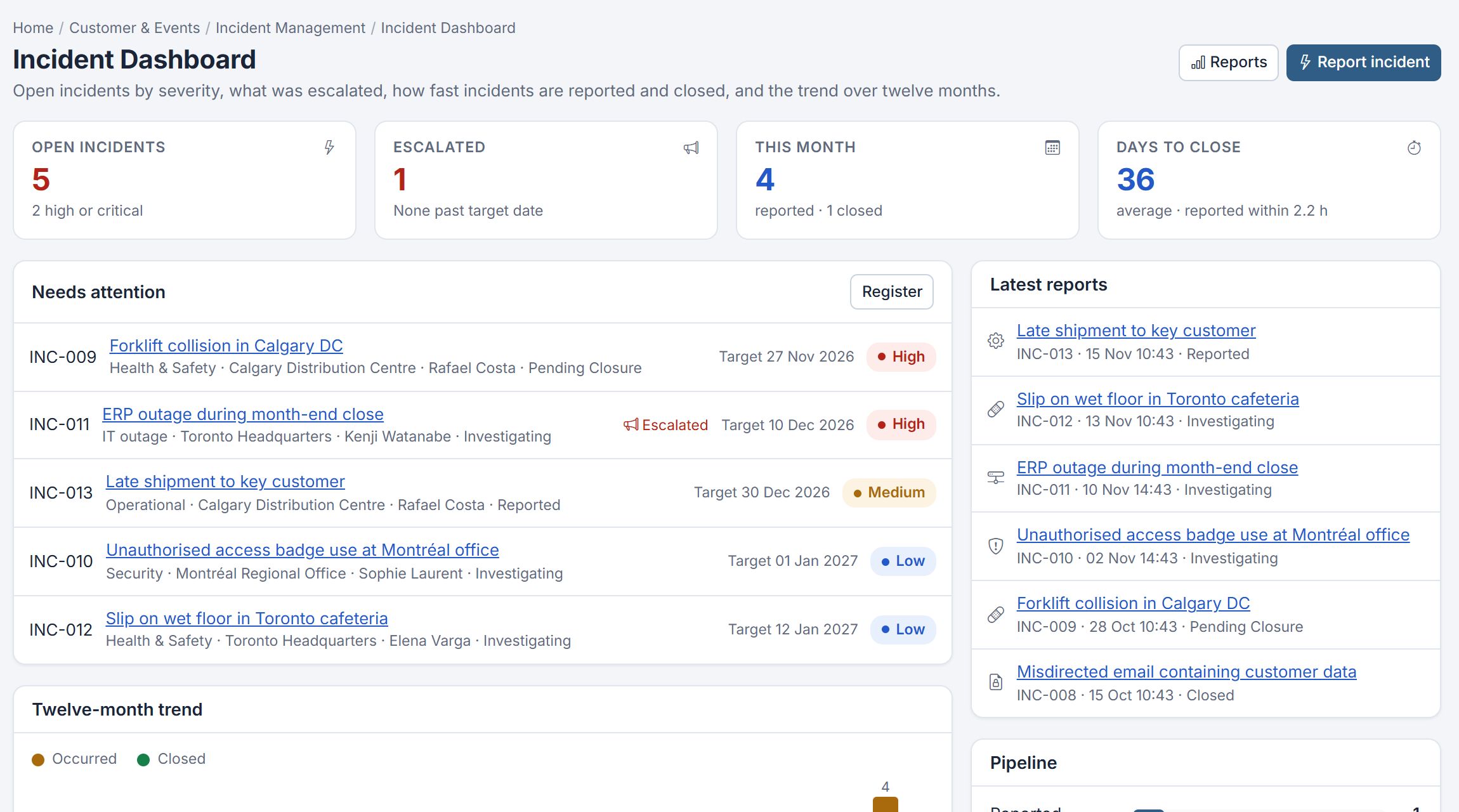
When an event falls short, feedback should trigger improvement.
How to collect event feedback with ratings, write a post-event summary and raise an improvement action when an event falls below expectations.
The principle
Feedback collected and filed changes nothing. Feedback with a threshold for action changes the next event.
Feedback forms are standard at the end of most events. The ratings are averaged, a few comments are read, and the results sit in a folder. The next event repeats the same weaknesses because nothing connected the feedback to action.
The fix is not more feedback. It is a simple rule that turns feedback into a decision: when results fall below an agreed level, someone owns finding out why and changing the next event. That rule is what distinguishes a quality process from a satisfaction survey.
01 · Start with context
Events are part of continual improvement.
ISO management system standards expect organisations to monitor performance and improve. ISO 9001 clause 9.1 asks for monitoring, measurement, analysis and evaluation, and clause 10.3 for continual improvement. For events, the most direct performance measure is the experience of the people who attended. Feedback is the input; improvement actions are the output.
For training events, feedback also contributes to evaluating the effectiveness of training under clause 7.2, alongside assessments and observed performance.
Different events, different expectations
A supplier day, a customer workshop and an internal training session serve different purposes and audiences. Feedback questions and thresholds can reflect those differences. A customer event might weigh the relevance of content heavily; an internal briefing might focus on clarity and practical value.
02 · Ask the right questions
Short and specific.
- An overall rating on a simple scale.
- Ratings for content, speakers, organisation and venue.
- What worked well, and what should change.
- Whether attendees would attend again or recommend it.
Collect feedback soon after the event, while experiences are fresh.
Response rates fall quickly with time and length. A short form sent the same day, or completed on a device before people leave, gathers far more responses than a long survey sent a week later. Every question should earn its place by informing a decision.
03 · Summarise the event
A short post-event review.
- Attendance against registration and capacity.
- Average ratings by category.
- Key themes from comments.
- Issues on the day and how they were handled.
A post-event summary is a useful record and a natural input to planning the next event.
Reading comments well
Free-text comments often carry the most useful information, but they need grouping. Sorting comments into themes, such as timing, content depth, room conditions or networking time, reveals which issues were mentioned by many people and which by one. A single strong complaint deserves attention; a theme raised by a third of attendees deserves action.
04 · Set a threshold for action
Make improvement automatic.
Rather than relying on someone deciding to act, set a threshold. If the overall rating falls below an agreed level, an improvement action is raised automatically, with an owner responsible for analysing the cause and agreeing changes.
This turns feedback from an opinion survey into a quality control.
A common threshold is an average below 3 on a 5-point scale, though the right level depends on the event type and your expectations. What matters is that the threshold is defined before the event, applied consistently, and leads to a recorded action rather than a discussion.
05 · Track the actions
Through to the next event.
Improvement actions should be tracked like any other corrective action, with root cause, owner and due date, and checked when the next similar event takes place. Over time, ratings across events show whether improvements are working.
Comparing ratings across a series of recurring events, such as quarterly supplier days or annual conferences, is especially valuable. A rising trend confirms that changes worked; a flat or falling trend signals that the root cause has not been addressed.
Common pitfalls
- Feedback filed, not used: ratings collected and never reviewed against any expectation.
- Long, late surveys: low response rates that leave results unrepresentative.
- No owner: poor results discussed but no one responsible for changing the next event.
- No comparison: each event judged in isolation, with no view of trends.
06 · Certora event management
Feedback with an improvement CAPA below threshold.
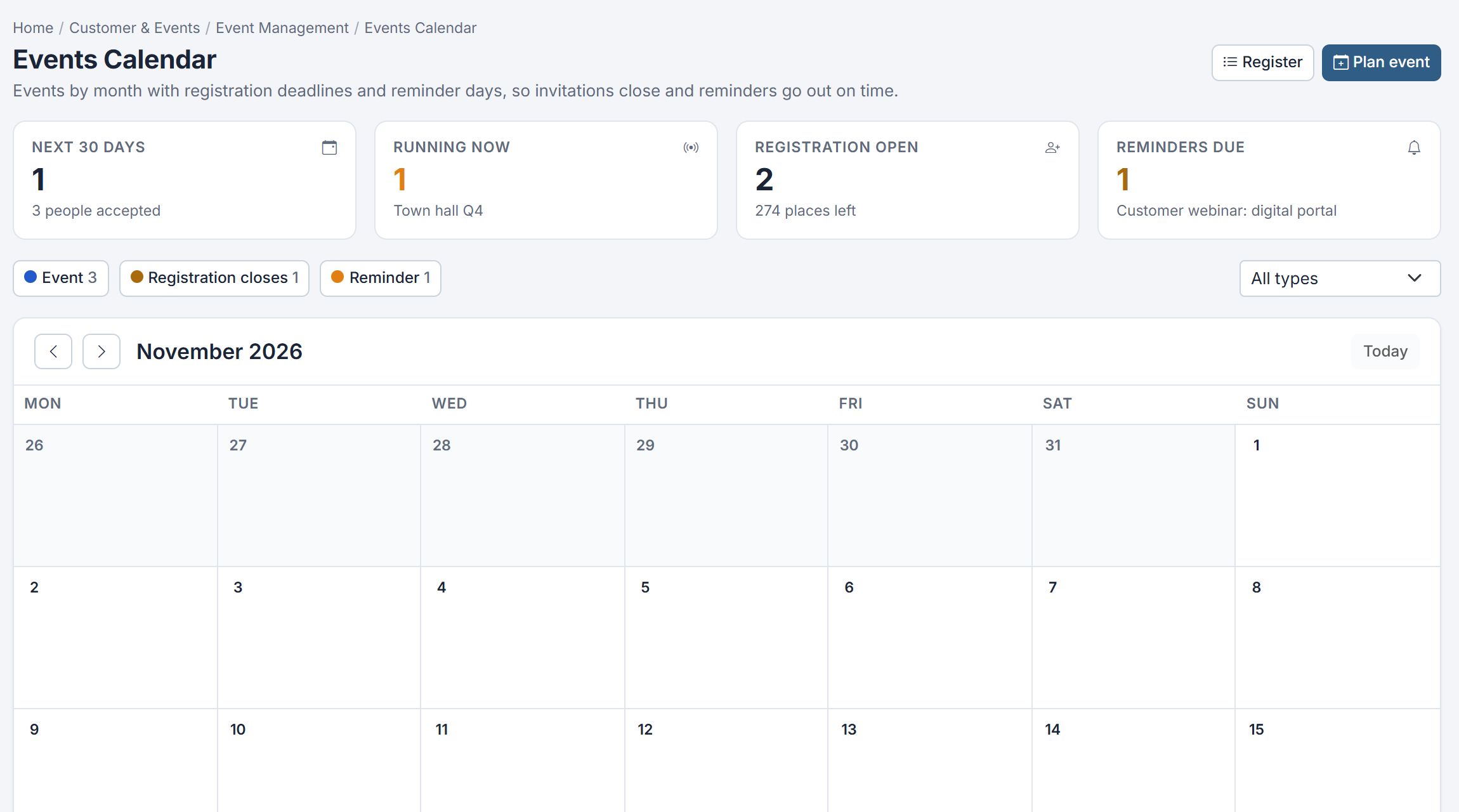
Certora Event Management collects feedback with ratings for each event, produces a rating summary and CSV export, and raises an improvement CAPA when an event falls short of the threshold. Attendance tracking, agendas and post-event summaries sit alongside.
Improvement actions run through Certora Nonconformity & CAPA, so root cause, tasks and effectiveness review follow the same discipline as any other corrective action. See running events with quality controls for planning and registration.