A business impact analysis sets recovery objectives everyone can defend.
How to run a business impact analysis under ISO 22301: prioritised activities, impact over time, MTPD, RTO and RPO set consistently, and continuity strategies.
The principle
Recovery objectives should come from the impact of disruption, not from what the IT team thinks is achievable.
Business continuity plans often start with recovery targets that someone simply chose. When disruption arrives, those targets turn out to be either impossible or irrelevant. A business impact analysis (BIA) grounds them in what the organisation actually needs.
The BIA is the analytical heart of business continuity. It answers the questions every other part of the programme depends on: which activities matter most, how quickly they must resume, what they depend on, and how much data the organisation can afford to lose. Without those answers, continuity strategies are guesses.
01 · Start with context
Where the BIA fits in ISO 22301.
ISO 22301 clause 8.2.2 requires a process for business impact analysis that:
- Defines the impact types and criteria relevant to the organisation’s context.
- Identifies the activities that support the provision of products and services.
- Uses the impact types and criteria to assess the impacts over time resulting from disruption of these activities.
- Identifies the time frame within which the impacts of not resuming activities would become unacceptable.
- Sets prioritised time frames for resuming disrupted activities at a specified minimum acceptable capacity.
- Uses the BIA to determine which activities are prioritised.
- Determines the resources needed to support prioritised activities, and the dependencies, including partners and suppliers, and interdependencies.
The BIA works alongside risk assessment under clause 8.2.3, and together they inform the choice of continuity strategies.
02 · Define impact criteria
Consistent scales across the organisation.
- Financial: revenue loss, penalties, additional costs.
- Customer: service failure, contractual breach.
- Regulatory and legal: breaches of obligations.
- Reputational: media, stakeholder and public perception.
- Safety and wellbeing: effects on people.
Shared criteria allow activities in different departments to be compared fairly.
Calibrating the scales
Each criterion needs defined levels, for example from 1 (negligible) to 5 (severe), with concrete descriptions. A financial level 5 might mean losses above a defined amount; a reputational level 5 might mean sustained national media coverage. Approval of these scales by senior management ensures the BIA reflects the organisation’s real tolerance for disruption.
03 · Assess impact over time
When does disruption become unacceptable?
- For each activity, assess impact at intervals such as 4 hours, 1 day, 3 days and 1 week.
- Identify the point at which impact becomes unacceptable: the maximum tolerable period of disruption (MTPD).
- Set a recovery time objective (RTO) safely within the MTPD.
- For data-dependent activities, set a recovery point objective (RPO): how much data loss is tolerable.
Minimum capacity
Recovery does not always mean full restoration. ISO 22301 refers to a minimum acceptable capacity: the reduced level at which an activity must operate to avoid unacceptable impact. A customer service team might need to handle half its normal volume within a day, with full capacity restored later. Defining minimum capacity makes recovery strategies more realistic and affordable.
04 · Map dependencies
People, sites, systems and suppliers.
Each prioritised activity depends on resources: key people, facilities, IT systems, data and suppliers. Recording dependencies reveals single points of failure and ensures supporting resources have recovery objectives consistent with the activities they serve.
Consistency is essential. If order processing has an RTO of four hours but depends on an ERP system with a recovery time of two days, the activity’s RTO cannot be met. Mapping dependencies exposes these mismatches so they can be resolved before a disruption reveals them.
05 · Choose strategies
Options that meet the objectives.
With recovery objectives set, continuity strategies can be evaluated: alternative sites, remote working, backup suppliers, data replication or manual workarounds. The chosen strategy must be able to meet the RTO and RPO at acceptable cost.
The BIA should be reviewed at planned intervals, typically annually, and whenever the organisation changes significantly: new products, new sites, new key suppliers or major system changes.
Common pitfalls
- Targets chosen first: RTOs set by preference rather than impact analysis.
- Inconsistent dependencies: IT recovery times that cannot support business RTOs.
- One-off analysis: a BIA completed for certification and never updated.
- Ignoring suppliers: critical third parties left out of dependency mapping.
06 · Certora business continuity management
From BIA to approved plans.
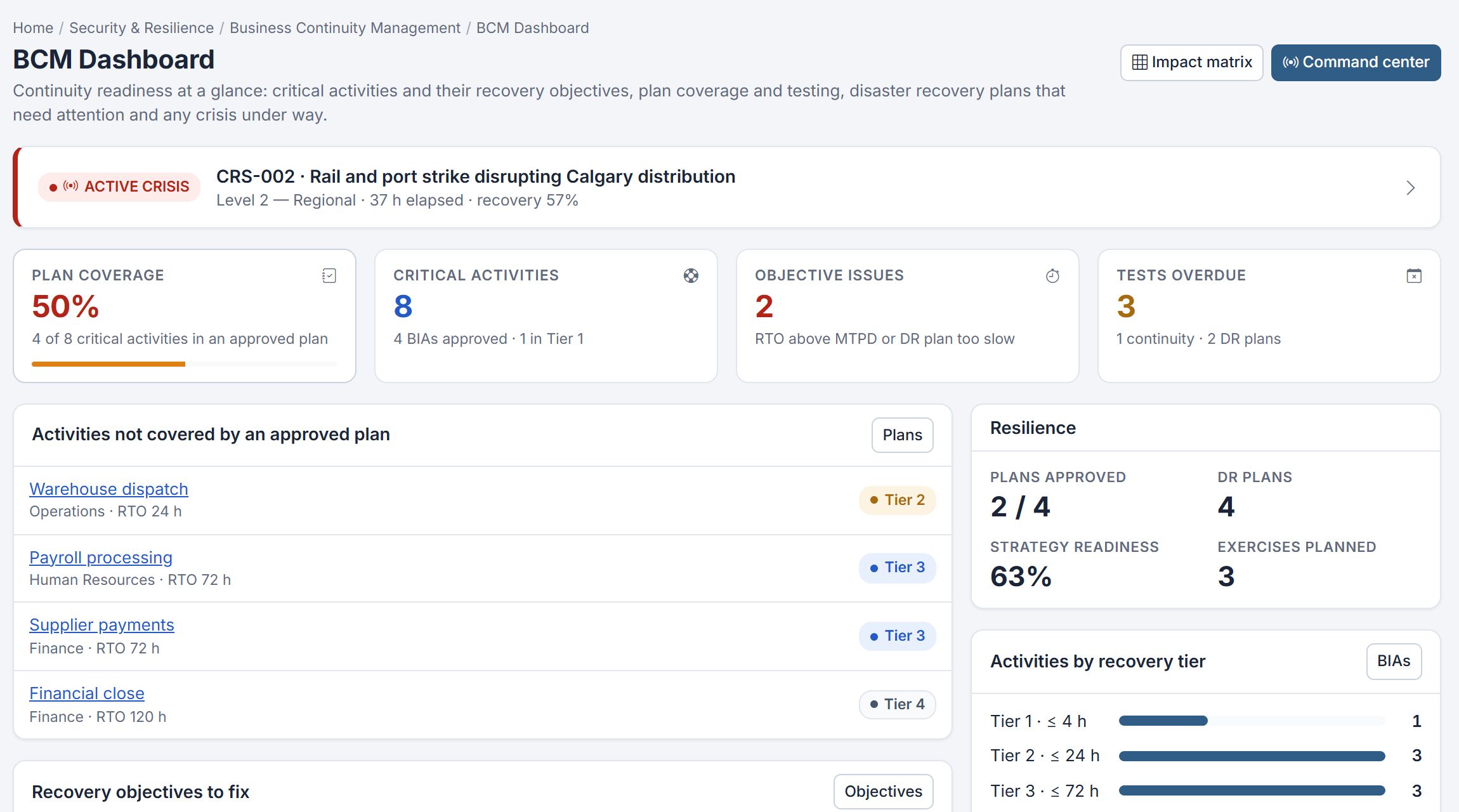
Certora Business Continuity Management analyses the business impact of disruption and sets consistent recovery objectives. Continuity strategies are chosen, continuity and disaster recovery plans are approved, and plans are exercised.
During a crisis, situation reports and live recovery tracking keep the response coordinated. Read exercising continuity plans for testing and crisis response.